
5 km return via same track
Do not visit Mautohe Cathedral Cove during or immediately after heavy rain. Landslide risk is high.
Image gallery
About this walk
- Natural rock archway
- Marine reserve and golden sand beaches
- Sealed track with steep sections and steps
Coromandel’s world-famous Mautohe Cathedral Cove is accessible by walking or water. The area is bordered by Te Whanganui-o-Hei/Cathedral Cove Marine Reserve.
Mautohe Cathedral Cove Track starts at the top of Grange Road, Hahei. There’s no parking here: to plan transport, see ‘Getting there’.
The track follows coastal hilltops through patches of native bush. There are stunning views down to Waimata/Gemstone Bay and Te Karaka/Stingray Bay.
After the junction with the private Cathedral Cove Gateway Trail, the track descends steeply to Mares Leg Cove. There are wooden stairs in places.
At Mares Leg Cove, you’ll see the famous natural rock archway to Mautohe Cathedral Cove. There are iconic views through the archway to the rock formation named Te Hoho.
Return to the car park the same way you came.
Safety at Mautohe Cathedral Cove
Mautohe Cathedral Cove has multiple hazards. See ‘Know before you go’ for important safety information.
Side trips
Tokawhakairo McHands Lookout
25 min / 1.25 km (return)
Easy to intermediate walking track
Tokawhakairo McHands Lookout Track is signposted off Mautohe Cathedral Cove Track. It's a steep climb to the lookout, which has expansive views over Te Whanganui-o-Hei/Mercury Bay.
Directions
Access to Mautohe Cathedral Cove Track is from Hahei, on the Coromandel Peninsula.
Hahei is signposted off SH25 between Thames and Whitianga. Turn right onto Hot Water Beach Road and continue onto Link Road.
Turn right onto Hahei Beach Road and continue for 1.2 km. Hahei Visitor Car Park is signposted on your right.
Travel times (by car)
- Whitianga (40 min)
- Thames (1 hr 15 min)
- Coromandel (1 hr 30 min)
Parking
No parking at track entrance
No parking is available at the Mautohe Cathedral Cove Track entrance on Grange Road. This is a drop-off and pick-up zone only.
Mautohe Cathedral Cove Track parking information (PDF, 3,108K)
Hahei Visitor Car Park has:
- free parking for cars and campervans
- an accessible toilet.
You can catch a shuttle bus or walk from the car park to the track entrance.
Shuttle bus
For fares and timetables, see Cathedral Cove Park & Ride.
Walking
It takes 30 min to walk from the car park to the track entrance. There’s a long uphill section with little shade.
Paid parking
Paid parking is available at Cathedral Cove Gateway Trail car park at 150 Lees Road, Hahei. The trail provides private walking access to Mautohe Cathedral Cove Track.
Boats and kayaks
Mautohe Cathedral Cove can be accessed by boat or kayak from Hahei and Whitianga. Commercial operators run tours from these locations too.
Mana whenua
Ngāti Hei holds mana whenua or customary authority over this special place.
Safety and hazards
Landslide risk
Mautohe Cathedral Cove has a history of major landslides and rockfall.
To reduce risk:
- Do not visit during or immediately after heavy rain.
- Move quickly through the rock archway.
- Do not sit directly under the cliffs.
Make sure you know the risks and are comfortable with them before you visit.
- Tidal access: At high tide, Mautohe Cathedral Cove beach can be cut off from the track. Keep an eye on the tide and do not enter the rock archway if it’s underwater.
- Dangerous waves: In rough seas, waves surge through the rock archway and onto the beach. They can cut off the beach or make access unsafe.
- Unpatrolled beaches: Beaches have rip currents and big waves. They are not patrolled by lifeguards. Supervise children and if in doubt, stay out.
- Boats and watercraft: There are no boat lanes to separate boats, jet skis and kayaks from swimmers. Stay alert in and around the water.
- Steep drops: The track to Tokawhakairo McHands Lookout has sheer drops and gets very windy. Stay on the track and away from cliff edges.
When to go
- At low tide, there’s more room on the beach and it’s easier to stay clear of the cliffs.
- In summer, Mautohe Cathedral Cove gets very crowded and hot. There is little shade on the track or beach.
- Do not visit during or immediately after heavy rain.
- Do not visit in rough seas.
Before you go:
- Check this page for track closures.
- Check for heavy rain warnings.
View weather forecast - Time your visit for low tide.
View tide times - Check for coastal warnings.
View marine forecast
Plan your visit
- Bookings are not required for Mautohe Cathedral Cove Track.
- Non-flushing toilets and an accessible toilet are located at the track entrance. There are flush toilets (non-accessible) on the track 10–15 min walk from the beach.
- Drinking water is not available on the track or at the beach. There is a drinking fountain and water bottle refill station at Hahei Visitor Car Park.
- Seating is provided at the lookout by the track entrance and at viewpoints along the track.
- Food and petrol can be found in Hahei.
What to take
- Sturdy footwear with good grip – lightweight sandals and jandals are unsuitable
- Sun protection including sunscreen, sun hat, sunglasses and a long-sleeved top
- Portable shade such as an umbrella or beach tent
- 1 to 2 litres of water per person
- Food and snacks
- Warm and waterproof clothing
- Mobile phone
- Rubbish bag or container
For a complete list, see Day Hikes gear list.
Care for nature
Ngāti Hei have an enduring cultural responsibility to care for Mautohe Cathedral Cove. Your care supports Ngāti Hei in their role as kaitiaki or guardians of this special place.
- Rubbish bins are not provided. Take your rubbish with you.
- Graffiti on rock surfaces is illegal and deeply disrespectful to Ngāti Hei.
- Use the toilets provided.
- Mautohe Cathedral Cove is part of Te Whanganui-o-Hei/Cathedral Cove Marine Reserve. All marine life is protected.
Marine reserve
Te Whanganui-o-Hei/Cathedral Cove Marine Reserve is home to rich marine life, vibrant sponge gardens and diverse reef systems.
Commonly encountered species at Mautohe Cathedral Cove include:
- snapper
- blue cod
- kelpfish/hiwihiwi
- rock lobster (crayfish)/kōura
- clown nudibranch.
Te Whanganui-o-Hei/Cathedral Cove Marine Reserve
Birds
The coastal bush around Mautohe Cathedral Cove is home to native forest birds. You might see or hear:
- tūī
- New Zealand pigeon/kererū
- fantail/pīwakakawaka
- bellbird/korimako.
At the beach, you might see seabirds and shore birds such as:
- red-billed gull/tarāpunga
- white-fronted tern/tara
- variable oystercatcher/tōrea pango.
Plants
Native trees and plants along Mautohe Cathedral Cove Track include:
- silver fern/ponga
- New Zealand flax/harakeke
- kawakawa
- māpou/matipo.
Pōhutukawa trees on the beach flower bright crimson in December and early January.
Ngāti Hei
Mautohe Cathedral Cove is deeply significant to Ngāti Hei.
Ngāti Hei have lived here for generations. They have an unbroken connection to rohe whenua and rohe moana – the tribal estate of land and sea.
In Te Ao Māori, the sea is a living ancestor. By actively respecting this marine reserve, we honour the mauri/life force of the ocean and its marine creatures. We support them to thrive, regenerate and flourish.
These protected waters are not simply a place for recreation. They provide vital habitats for many species, and they’re living classrooms.
Unique geology
The archway at Mautohe Cathedral Cove and other rock formations in the area are made of a light-coloured volcanic rock called ignimbrite.
Ignimbrite is a mixture of volcanic ash and pumice that erodes easily. Over time, waves and weather have shaped it into unique rock features.
Volcanic eruptions formed the coastline and islands around Te Whanganui-o-Hei/Mercury Bay about 8 million years ago.
The rest of the Coromandel Peninsula is much older. Some sedimentary rock in the area is 120 million years old.
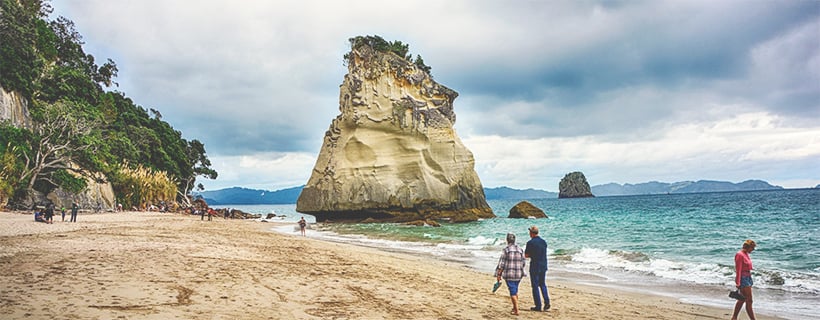 Mautohe Cathedral Cove
Image: Mariano Mantel | Creative Commons
Nature's in trouble
Thousands of New Zealand’s native species are heading towards extinction. Once they’re gone, they’re gone for good. Nature needs your help.
Protect our marine reserves
- No fishing of any kind.
- Don't take or kill marine life.
- Don't remove or disturb any marine life or materials.
- Don't feed fish - it disturbs their natural behaviour.
- Take care when anchoring to avoid damaging the sea floor.
Stop kauri disease and protect kauri
- Scrub all soil off shoes and gear.
- Use cleaning stations.
- Always stay on the track.
Kauaeranga Visitor Centre
| Phone: | +64 7 867 9080 |
| Email: | kauaerangavc@doc.govt.nz |
| Address: | 995C Kauaeranga Valley Road Thames 3577 |
| Hours: | Visitor centre hours and services |
DOC Customer Service Centre
| Phone: | 0800 275 362 |
| Email: | coromandeldistrict@doc.govt.nz |
| Address: | Whitianga Base |