Brochures
Dogs
- Dogs must be on lead on the beach access track and sand dune area.
- To the right of the beach (at track end) dogs are allowed to be supervised off-lead. Note: Dogs are not permitted on the beach to the left of the track end.
From the carpark, climb over a stile and walk briefly through private farmland before reaching another stile. From here, a short path leads through the sand dunes and gently opens out onto the beach.
To the right, a wide sandy expanse reaches towards the Hoopers Inlet mouth, the perfect spot to walk on a sunny day, or go exploring.
To the left, rugged coastal habitat sits close to the track entrance and stretches around to the towering cliffs which surround Mt Charles/Poatiri.
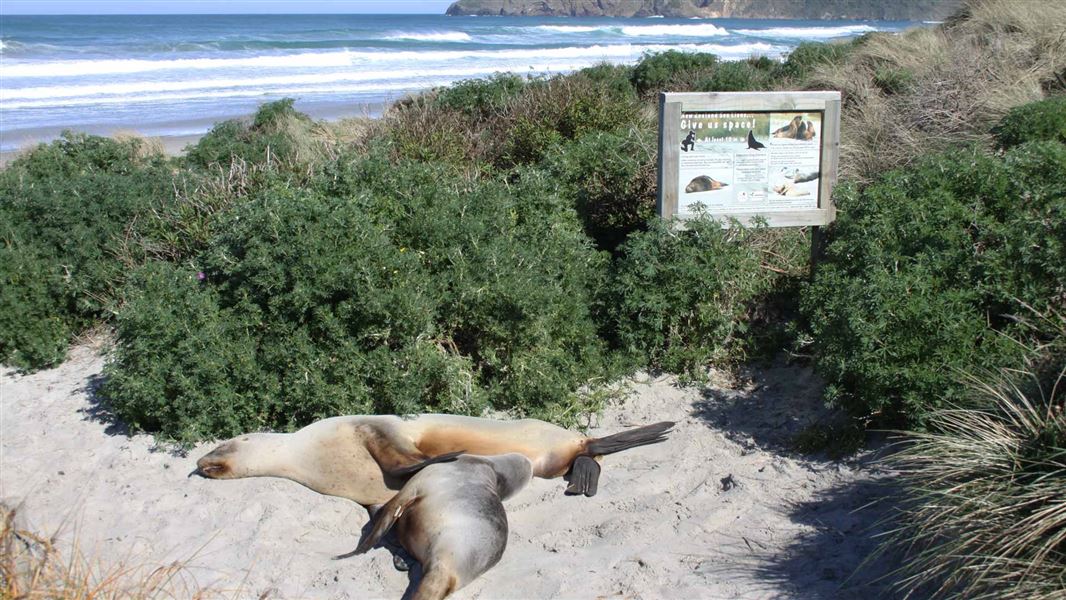
The entire beach is frequently dotted with New Zealand sea lions/pakake, New Zealand fur seals/kekeno, a variety of sea birds and even the odd penguin.
Combined with the stunning backdrop this makes it a great spot to visit for nature/wildlife photography, or even just for a day of naturing.
From Dunedin the two main routes to Portobello are either Portobello Road or Highcliff Road.
From Portobello turn onto Allans Beach Road. The carpark is at the end of the road.
Be aware that from where it reaches Hoopers inlet, Allans Beach Road is gravelled and at points requires care when passing vehicles travelling in the opposite direction.
New Zealand sea lions/pakake use Hoopers Inlet to nurture their young and may often be found on the roads in the area. Reduce speed, keep an eye out and give them plenty of space when driving in the area.
The distance from the city is approximately 25 km, for either route.
To protect wildlife, dogs are not allowed on the eastern end of the beach, but are allowed on a leash at the western end.
Swimming can be dangerous where there are strong winds and currents.
The nearest toilets are in Portobello.
Tsunami risk
This track is susceptible to tsunami. If a siren sounds or a tsunami alert is received move to higher ground and stay away from the coast until the risk or alert period is over.
Dunedin Wildlife Care Code
Dunedin is home to rare and special wildlife. Do not disturb, touch, feed or go too close to wildlife. Keep dogs under control as they can harm wildlife.
Sea lions and other seals
View all seal and sea lions from a safe distance of at least 20 m and do not disturb them. If you must pass sea lions on the beach, keep as much distance as possible and do not loiter.
Penguins
Stay at least 50 m away from penguins. Never approach them. Do not block their entry and exit from the water as this prevents them from returning to feed chicks. Do not use flash photography.
Red-billed gulls
Do not feed or harass gulls. Don’t let dogs chase them. They are endangered and vulnerable to human disturbance.
Drones and wildlife
It is an offence to fly drones within 150 m of marine mammals or 300 m vertically above. The use of drones is prohibited in many sensitive areas and can require a permit elsewhere.
Find more information on recreational drone use on conservation land.
New Zealand fur seals/kekeno and New Zealand sea lions/pakake haul themselves out on the rocks and beach and wallow in the sand.
Seals and sea lions may look placid, but they are powerful, wild predators and can be very dangerous if they are approached too closely.
Other seabirds such as spotted shags, sooty shearwaters, penguins and variable oystercatchers are also based in the area.
DOC Customer Service Centre
| Phone: | 0800 275 362 |
| Email: | dunedinoffice@doc.govt.nz |
| Address: | Ōtepoti / Dunedin Office |