10 km return via same track
Avalanches can cross the upper section of Rob Roy Track from May to November. We strongly recommend ending your hike at the lower lookout during these months.
Image gallery
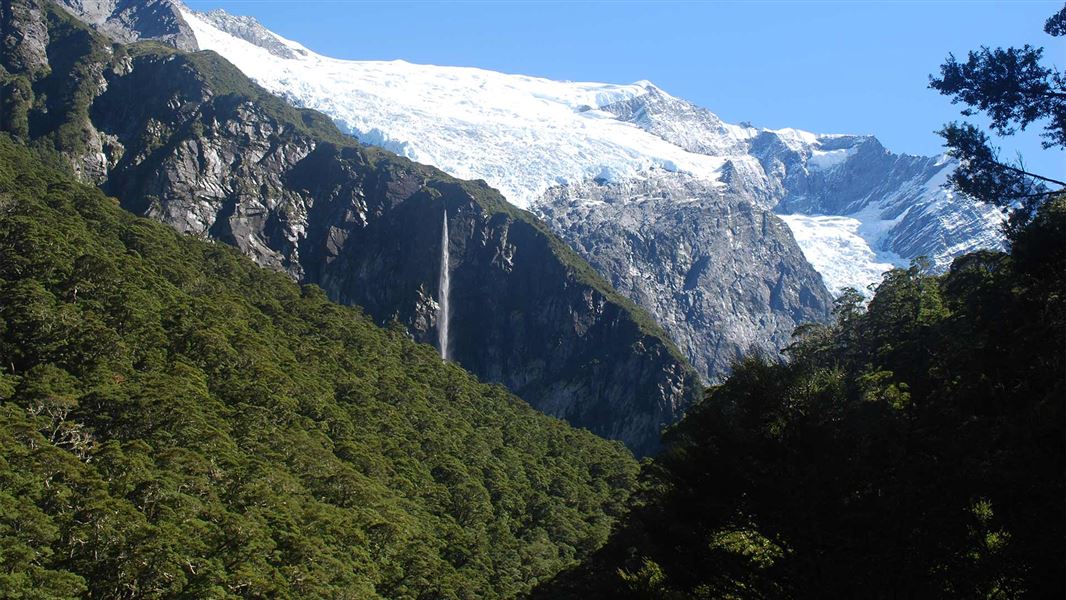
About 15 minutes from the Raspberry Flat car park, cross a swing bridge across the West Matukituki River. The track climbs through a small gorge into beech forest, then into alpine vegetation at the head of the valley, with good views of the Rob Roy Glacier.
The track ends at the upper lookout, adventuring beyond this point is not recommended as the terrain is dangerous with steep drop offs, canyons, unstable ground and fast flowing water.
Sections of the track have steep drop-offs. Take care when crossing.
Rob Roy Track crosses active avalanche paths between the lower lookout and upper lookout. Avalanches are most common from May to November and can occur even when there is no snow on the track, as valleys can funnel avalanches down from the snowy slopes high above. We strongly recommend that you do not go past the lower lookout from May to November.
The track starts at the Raspberry Creek car park, 54 km west of Wanaka on the Wanaka-Mount Aspiring Road. The drive takes about 1 hour 20 minutes. The last 30 km are gravel.
There are several creeks to drive through in the last 10 km of the road. These rise in heavy rain and can become impassable to 2WD and sometimes 4WD vehicles. After 24 hours of little or no rain, the fords are usually passable for 2WD vehicles, including campervans.
Check the weather forcast on NIWA website.
Drive slowly through the fords and, if in doubt, get out of your vehicle to check the depth of them beforehand. If needed, you can park before the final two fords and walk the remaining few hundred metres to the car park – just make sure your vehicle is safely off the road and not blocking any farm gates.
After particularly heavy rain, the road is prone to washouts, sometimes requiring it to be closed for repairs.
Check the weather forecast and road conditions
Weather in this area can be unpredictable and alpine conditions can arrive at any time of year – take appropriate clothing and check the weather forecast.
Be prepared for icy conditions during winter and early spring, particularly in shaded areas. Surfaces can become slippery – take extra care with your footing, wear footwear with good grip and consider using trekking poles.
Mount Aspiring National Park weather forecast – NIWA website.
End your hike at the lower lookout from May to November
Rob Roy Track crosses active avalanche paths between the lower lookout and upper lookout. Even if you cannot see snow from the track, there may be enough snow on the upper slopes to form an avalanche that could reach the track.
Continuing beyond the lower lookout from May to November further puts you directly in the path of potential avalanches. We strongly recommend you end your hike there.
If you are considering hiking beyond the lower lookout at these times, make sure you:
- Have checked the current avalanche and weather conditions with the local DOC Visitor Centre
- Know how to recognise dangerous avalanche terrain
- Are carrying avalanche rescue equipment, including transceivers, shovels and probes, and know how to use it.
Check the current avalanche danger
Learn more about avalanche risk in Wakatipu and Wānaka
Swing bridges
There's a limit to the number people allowed on the swing bridges at any one time – be prepared to wait at each end if numbers allowed have been reached.
This track crosses private land
Respect the landowner's livestock and property. Stay on the marked track, leave gates as you find them and use stiles where provided.
- Livestock can be unpredictable - avoid disturbing stock when travelling through the valley.
The playful and inquisitive kea, with its harsh ‘kee-a’ call, is often seen and/or heard in the valley (don’t feed them).
Nature's in trouble
Thousands of New Zealand’s native species are heading towards extinction. Once they’re gone, they’re gone for good. Nature needs your help.
Wānaka Tititea/Mount Aspiring National Park
Visitor Centre
| Phone: | +64 27 269 6871 |
| Email: | wanakavc@doc.govt.nz |
| Address: | 1 Ballantyne Road Wānaka 9305 |
| Hours: | Visitor centre hours and services |