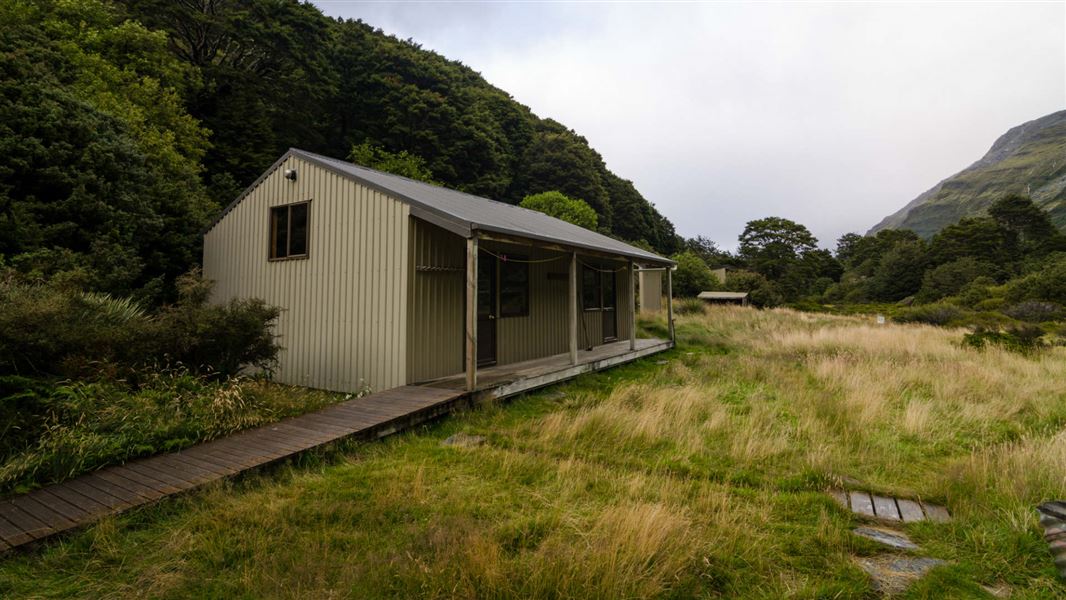
You do not need to book this hut (first come, first served) but fees still apply.
Image gallery
Fees
Backcountry Hut Passes
Passes are valid for use in this hut from 1 May to 30 September. Passes won't be accepted from 1 October to 30 April.
- Adult (18+ years): $25 per night
- Child/youth (5–17 years): $12.50 per night
- Infant (0–4 years): free
Before you go, buy 1 Serviced Hut Ticket (green) or 1 Serviced Youth Hut Tickets (red) for each night's stay. Put these in the honesty box at the hut. Or buy a Backcountry Hut Pass for unlimited use at most Serviced and Standard huts for a 12 month period.
About hut tickets and passes | Retailers that sell hut tickets and passes
You can camp outside the hut on a 'first-come, first-served' basis. See Shelter Rock Campsite for fees.
Campers may use hut water supply and toilets.
Times from nearest road end and huts:
- Muddy Creek car park (Rees Valley Road) via Rees-Dart Track: 6–8 hr (19 km)
- Dart Hut via Rees-Dart Track: 4–6 hr (10 km)
Tracks to this hut
-
Duration: 4-5 days one way Difficulty: Advanced
Location
NZTopo50 map sheet: CA10
Grid/NZTM2000 coordinates: E1243317, N5056268
Takahē conservation in Rees Valley
18 takahē were released into the Rees Valley in February 2025.
You may see takahē as you walk, hunt or stay at the hut in Rees Valley. They may disperse into other areas. There are around 500 in the total takahē population as of 2024.
At a glance, people may mistake the takahē for a pūkeko. Takahē are a large bird with deep blue and green colouring, sturdy red legs and beak.
The chicks are black and small, as they grow, they will grey out. The juveniles will go from grey and muted blue and green, to the striking colours as they mature. Find information about takahē conservation: Takahē Recovery.
If you see a takahē
To keep takahē safe in their new home:
- keep a respectful distance to reduce stress on the birds
- don't share any food with takahē as human food can make them sick
- report any sightings (particularly outside the Rees Valley). Try to note details such as location, number of birds and leg band colours.
Whakatipu-wai-Māori/Queenstown Visitor Centre
| Phone: | +64 3 442 7935 |
| Email: | queenstownvc@doc.govt.nz |
| Address: |
50 Stanley Street |
| Hours: | Visitor centre hours and services |