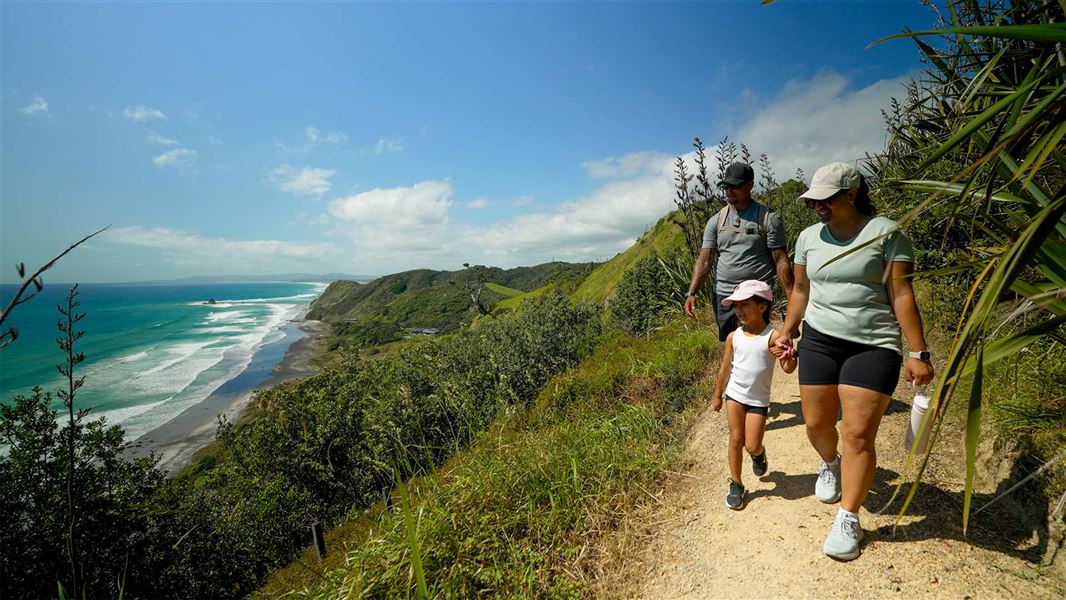
8.4 km return via same track
Image gallery
About the walk
- Dazzling ocean and offshore island views
- White sand and pōhutukawa trees
- Steep ups and downs with lots of steps
Mangawhai Cliffs Walkway rewards you with breathtaking views of:
- Te Whara/Bream Head
- Taranga/Hen Island nature reserve
- Te Hauturu-o-Toi/Little Barrier Island nature reserve.
This track is part of Te Araroa Trail.
On a clear day, Aotea/Great Barrier Island and Coromandel Peninsula can often be seen on the horizon.
Mangawhai Cliffs Walkway crosses private land – keep to the track.
Car park to walkway sign via Mangawhai Heads Beach
1.2 km / 20 min (one way)
From Mangawhai Heads car park, follow the beach north. After 20 min, the sign for Mangawhai Cliffs Walkway is on your left.
This part of the beach is accessible at any tide. You’ll walk on sand, with a bit of scrambling around two rocky points.
Cliff walkway
3 km / 1 hr 10 min (one way)
From the walkway sign, the gravel track climbs steeply up to a viewpoint. There are steps in places.
The cliff walkway leads you past nīkau palms and ancient pōhutukawa trees teetering on sheer slopes. At its end, you’ll look north to Te Whara/Bream Head.
From here, it’s a steep descent with lots of steps down to the coast and a natural rock archway.
Return to the car park via the track, or the beach (low and mid tide only).
Return via beach loop (low and mid tide only)
4.8 km / 1 hr (one way)
At low and mid tide, you can walk from the rock archway along Mangawhai Heads Beach all the way to the car park.
At high tide, this section of beach is impassable. If water is surging through the archway, return via the cliff walkway.
This coastal section is rocky and uneven. You’ll need sturdy footwear.
Directions
Mangawhai is 25 km from Waipū to the north and 26 km from Wellsford to the south.
Follow the signs to Mangawhai from SH1, and then to Mangawhai Heads.
Access to Mangawhai Cliffs Walkway is from Mangawhai Heads car park, at the end of Wintle Street.
The track is signposted after the first beach section.
Travel times (by car)
- Whangārei (1 hr)
- Auckland (1 hr 30 min)
Parking
Mangawhai Heads car park has:
- free parking for cars and campervans
- marked mobility spaces.
The car park gets very busy during the summer season (November to April). It is managed by Kaipara District Council.
Shuttle bus
A free bus runs from Mangawhai to Mangawhai Heads Beach in summer. For details, visit the Kaipara District Council website.
Te Araroa
Te Araroa provides walking access to Mangawhai Cliffs Walkway via the following sections:
- Bream Tail to Mangawhai Cliffs Walkway, to the north
- Mangawhai to Pākiri, to the south.
The link track between Cove Road and Mangawhai Cliffs Walkway closes every year from 1 September to 31 October for lambing and calving.
Mana whenua
Te Uri o Hau hold mana whenua or customary authority over this special place.
Safety and hazards
- Tidal access: At high tide, it’s not possible to return from the far end of the cliff walkway via the coastal section. Return via the track if water is surging through the rock archway.
- Steep drops: The cliff walkway has steep drops. Keep children close and watch out for loose gravel at the track’s edge.
- Falling rocks: Cliffs along the coastal section of the track contain loose and unstable material. Stay away from cliff faces.
- Wasps: Wasps and wasp nests may be present. Bring antihistamines if you are allergic to wasp stings.
When to go
- To return from the cliff walkway via Mangawhai Heads Beach, start your walk 2 to 3 hours before low tide.
- New Zealand weather changes quickly. Check the weather forecast before you go, and be prepared.
Plan your visit
- Bookings are not required for Mangawhai Cliffs Walkway.
- Toilets and accessible toilets are located at Mangawhai Heads car park.
- Drinking water is not available. Bring your own.
- Picnic tables and seating are provided at the car park. There is some seating along the track.
- The nearest DOC campsite is Uretiti Beach Campsite (35 min by car).
- Food and petrol can be found in Mangawhai (10 min by car).
- Mobile phone coverage can be unreliable.
What to take
Care for nature
- No rubbish bins are provided. Take your rubbish with you.
- Stay on the track to protect kauri and stop kauri disease.
Plants
Mangawhai Cliffs Walkway winds through native nīkau palms and pōhutukawa trees, which flower crimson in early summer.
Birds
If you’re lucky, you may see New Zealand pigeon/kererū (known as kūkupa by local iwi) feasting on nīkau berries. Kākā occasionally visit from offshore islands.
Many native seabirds and shore birds are found around Mangawhai Heads. From the beach, you may see:
- fluttering shearwater/pakahā
- red-billed gull/tarāpunga
- Australasian gannet/tākapu.
New Zealand fairy tern/tara iti
New Zealand fairy tern/tara iti nest nearby, on Mangawhai Spit. These tiny seabirds are critically threatened.
Te Uri o Hau is the local iwi. According to Māori tradition, their ancestors arrived in Aotearoa on the waka Māhuhu-ki-te-rangi.
In the 1800s, Ngāti Whātua chief Te Whai lived here at Manga (‘where the rivers meet’). This is the origin of the name Mangawhai.
Nature's in trouble
Thousands of New Zealand’s native species are heading towards extinction. Once they’re gone, they’re gone for good. Nature needs your help.
Stop kauri disease and protect kauri
- Scrub all soil off shoes and gear.
- Use cleaning stations.
- Always stay on the track.
DOC Customer Service Centre
| Phone: | 0800 275 362 |
| Email: | whangarei@doc.govt.nz |
| Address: | Whangārei Office |