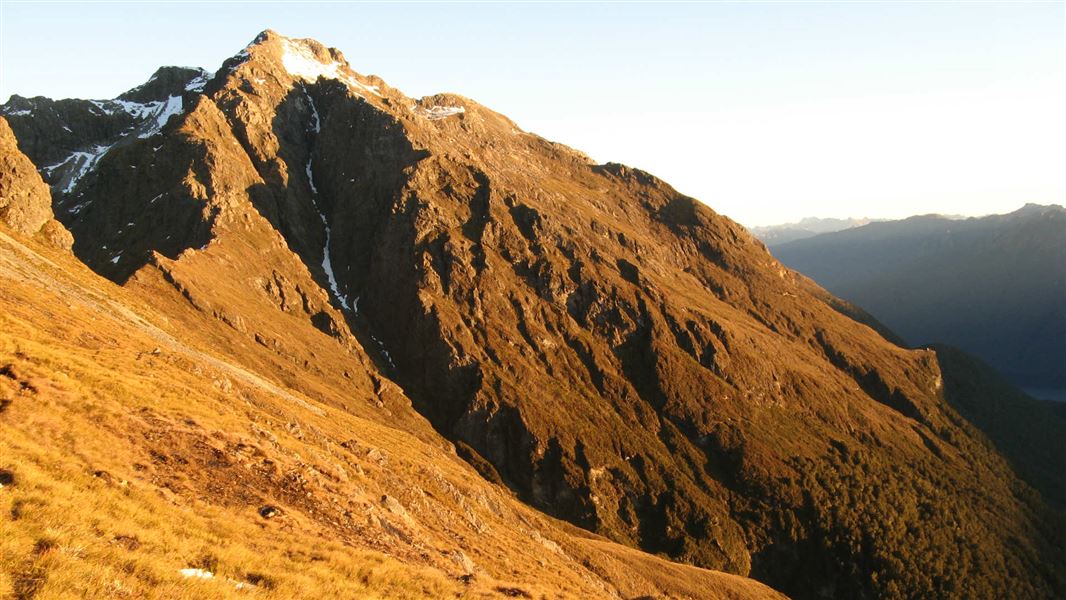
This is a challenging tramping route that requires route finding skills, river crossing and alpine experience.
The route offers fine views of the head of Lake Te Anau and the Clinton Valley in good weather, but is difficult for travel when covered in mist.
This route begins from the Milford Road, Fiordland, about 70 km north from Te Anau.
The Dore Pass carpark and original start point were washed out. Visitors now need to park at Kiosk Creek Campsite and begin the journey to Dore Pass from there. This change adds approximately 3 km to the original walk.
This is an advanced route requiring route-finding skills and self-navigation. There is no formed track for the re-route.
There are some route markers (orange triangles) located across the road from Kiosk Creek indicating the general direction of travel toward Dore Pass, but walkers should be competent in backcountry navigation.
This is a challenging route so you will need above average fitness and high level backcountry (remote areas) skills and experience, including navigation and survival skills. In winter and spring it is likely that alpine skills and equipment will also be required.
More detailed track information
Further information is available in "Moirs Guide South” edited by Robin McNeill.
Note: If you intend to connect with the Milford Track, note that prior bookings for huts are required and there is no camping allowed.
There may be avalanche danger
Check the avalanche terrain in this area.
Avalanches usually occur from May to November in Fiordland National Park. There can also be avalanches outside this period, if there is still snow coverage.
Check the avalanche danger before you go on the New Zealand Avalanche Advisory.
If you are going into avalanche terrain, always:
- Have the relevant avalanche skills and training.
- Check the ATES rating and the New Zealand Avalanche Advisory.
- Go with a buddy. Both of you should carry and know how to use an avalanche transceiver, a snow shovel and a probe.
Stay safe in the outdoors
- Choose the right trip for you. Learn about the route and make sure you have the skills for it.
- Understand the weather. Check weather forecasts.
- Pack warm clothes and extra food. Check gear lists.
- Share your plans and take ways to get help. Leave your intentions with a trusted contact and take a distress beacon.
- Take care of yourself and each other.
Te Rua-o-te-moko/Fiordland National Park Visitor Centre
| Phone: | +64 3 249 7924 |
| Email: | fiordlandvc@doc.govt.nz |
| Address: | 1 Lakefront Drive Te Anau 9600 |
| Hours: | Visitor centre hours and services |