Image gallery
Lake Te Anau
Lakeshore
Lake Te Anau is a great option for day kayaking or activities with the family. This can be linked in with walks on the Kepler Track, such as Brod Bay. Didymo is present in this lake.
Access is from the beaches and lakefront.
Tributaries
You must not take your kayak in tributary rivers after it’s been in Lake Te Anau.
Didymo is present in Lake Te Anau and must not be spread up any tributary rivers. If you’ve been kayaking in Lake Te Anau, your kayak is infected.
North Fiord (16 km)
This section of the lake can be very rough. There is good camping at the entrance to the fiord and at The Narrows further down, or stay at the Glaisnock Hut at the end of the fiord. Didymo is present in this lake.
Access to the lake is from Te Anau Downs – 30 km north of Te Anau.
Middle Fiord (20 km)
This section of the lake can be very rough, but also offers sheltered bays and islands, and the Junction Burn Hut in South West Arm. Didymo is present in this lake.
There is no access or camping allowed in the Murchison Mountains including the southern side of Middle Fiord. This is a special takahē area, which is closed to the public. Limited special access permits are available between December and February. Contact the Fiordland National Park Visitor Centre for more information.
More experienced parties may enjoy the adventure of going to the George Sound Route. To get there you can take a 45 min portage from North West Arm to Lake Hankinson. Kayaks and packrafts must be thoroughly cleaned if they have been used in Lake Te Anau or elsewhere where didymo is present. This is essential to ensure Lake Hankinson remains didymo free.
The best access to the lake is from Te Anau Downs – 30 km north of Te Anau.
Lake Te Anau – South Arm (22 km)
There are walking tracks to the Hidden Lakes and a lookout point and jetty at Mussel Cove. Didymo is present in this lake.
There is no access or camping allowed in the Murchison Mountains including the north side of the south arm This is a special takahē area, which is closed to the public. Limited special access permits are available between December and February. Contact the Fiordland National Park Visitor Centre for more information.
Access is from the beaches and lakefront.
Lake Manapouri
Lake Manapouri is very scenic with sheltered islands, beautiful beaches and good walking options accessible from shore. You can access Moturau Hut, Shallow Bay Hut, Hope Arm Hut, Circle Track, Back Valley Track and the Monument Track.
Didymo is present in this lake. Always clean your vessel and any gear that has been in contact with the water before entering other waterways.
Access to the water is at Pearl Harbour, Manapouri, or at the end of Supply Bay Road.
Lake Monowai
Lake Monowai is a beautifully scenic lake with several inlets and bays. There are huts accessible by water including Rodger Inlet Hut, Eel Creek and Monowai Hut. There is a walking option at the end of the lake on the Borland Road to Monowai Hut track
Didymo is present in Lake Monowai. You must check, clean and dry your vessel before and after contact with the lake water. You cannot kayak up the tributary rivers from Lake Monowai as they are didymo free.
Take care around the shoreline as there are submerged tree stumps.
Access to the water is at the end of the Lake Monowai Road.
Lake Hauroko
Lake Hauroko can be very rough and windy but has some bays and inlets. You can access Teal Bay Hut, Caroline Hut and Hauroko Burn Hut from the water.
Lake Hauroko is Didymo free and has one of the most unique and diverse macrophyte communities in the country, you must clean your vessel and gear before and after use in the water.
To access this lake, turn off the Southern Scenic Route (SH99) and drive to the end of Lillburn Valley Road.
Mavora Lakes
Both North Mavora and South Mavora lakes can be kayaked. Motorised craft are only allowed in the North Lake, making the South Lake quieter with less traffic. Didymo is present in both lakes and in the Mararoa River. From the lakes there is access to the North and South Mavora Lakes campsites and Careys Hut.
The Mararoa River between the lakes and below the South Mavora Lake provides good kayaking with some rapids (grade II to III).
Access is at the bottom of the North or South Lake.
While challenging to access the sea around Fiordland, sea kayaking here is highly rewarding for the more skilled and adventurous. The most accessible areas are listed below. You can go further afield by using air or large boat transport.
Fiordland by Sea - A guide to the Fiordland (Te Moana o Atawhenua) Marine Area.
Any vessels (even kayaks) that enter the Fiordland Marine Area must hold a Clean Vessel Pass. These can be applied for online with Environment Southland.
Milford Sound / Piopiotahi (18 km)
Milford Sound/Piopiotahi is a very steep-sided fiord with striking beauty, but busy with boat traffic. The southern side is more sheltered from the prevailing westerly winds, in particular the afternoon day breeze which is common during summer.
You can kayak to Sandfly Point for day walks on the Milford Track, but you cannot continue to kayak up the rivers that flow into Milford Sound. There is a layer of freshwater atop the sea water in Milford Sound from the inflow of the surrounding rivers and streams. This means didymo can be found in Milford Sound. Access is by boat ramp off Deepwater Basin Road in Milford Sound/Piopiotahi. Didymo is present in freshwater at Deepwater Basin.
You can only kayak the Arthur River (flowing into Milford Sound) if you have a properly clean vessel to prevent spreading didymo. Kayaking this river is only permitted as far as Lake Ada and you must hold a permit for this. Permits are issued by the Fiordland National Park Visitor Centre.
Doubtful Sound/Pātea (38 km)
Doubtful Sound/Pātea is quiet, wild, isolated, and beautiful. The southern side is more sheltered from the prevailing westerly winds. There are numerous camp spots including Hall Arm, and you can stay at Deas Cove Hut (Te Awa-o-Tū/Thompson Sound).To access Doubtful Sound/Pātea, kayaks can be barged across Lake Manapouri to West Arm and driven over the Wilmot Pass to Doubtful Sound/Pātea (contact Meister Services for barge bookings).
There is a charge for using the Wilmot Pass Road. You can apply for a Casual Wilmot Pass Permit at the Fiordland DOC office to drive your own vehicles and trailers or contact a local service provider.
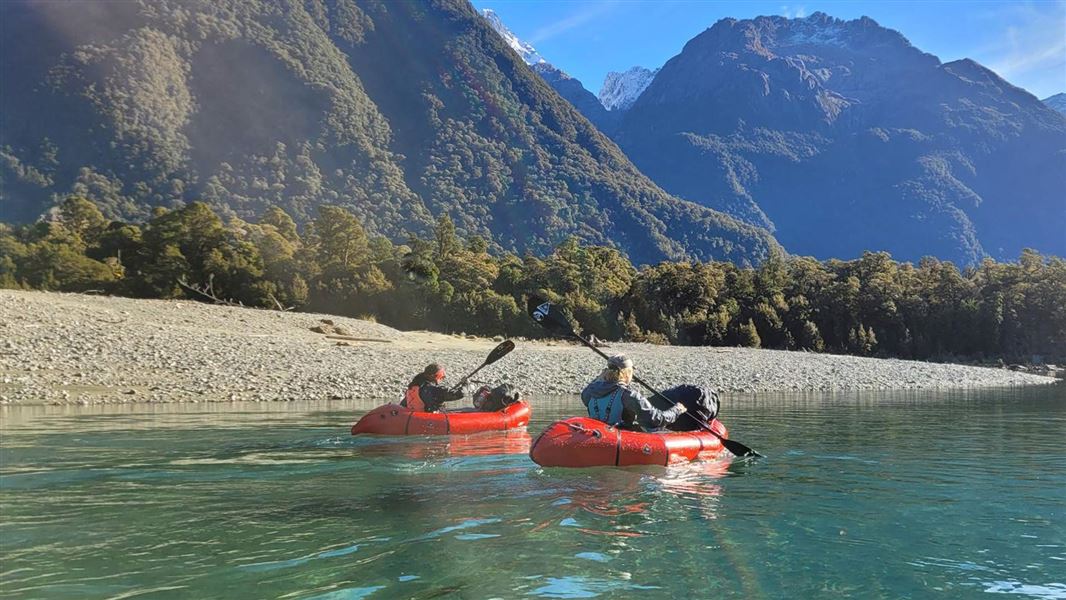
Fiordland has many options for beginner, intermediate, and advanced kayakers or packrafters.
Upper Waiau River – between lakes Te Anau and Manapouri.
There are many trip options along this stretch of river, which can be combined with overnight stays at Shallow Bay or Moturau Hut.
Natural hazards include fallen trees that may cause snags, strainers or trap points, and eddies that can affect boat control. Jetboats also operate in the area, so be sure to stay clear.
Access points include Yerex Reach, Queens Reach, Rainbow Reach, and Boulder Reach. Didymo is present in this river.
Hollyford River
This is an increasingly popular river, which can be combined with the Pyke River to form a 5–6-day loop. Despite its popularity, this trip does require prior research and skills, as the paddling is quite varied, and there are lots of log hazards from past flood events.
Hut options are along the Hollyford Track and the Pyke Big Bay Loop. Be sure to plan your trip during a good weather window and allow for delays, as flooding is quite common in the area. Access is off Hollyford Road.
Didymo is present in the Hollyford River, Lake McKerrow and in the South end of Lake Alabaster. Pyke River is Didymo Free. We recommend packrafting from the Hollyford River, cleaning your vessel thoroughly using MPI guidelines, and then rafting back on the Pyke River. Packrafting in the other direction risks spreading didymo into the Pyke River and further North in Lake Alabaster.
Eglinton River
The lower Eglinton (from Mackay Creek campsite down to Lake Te Anau) offers easier packrafting, while the upper Eglinton (from Cascade Creek to Mistake Creek) offers more of a challenge. Access is off the Milford Highway from various points not including across private farmland. Didymo is present in the Eglington River.
Wairaurahiri River
This river offers a continuous grade II challenge, dropping 150m over 25kms from Lake Hauroko to the coast of Foveaux Straight. Access is via Lake Hauroko, which can be difficult and dangerous, or the Teal Bay Track. Teal Bay to South Coast Track: Fiordland National Park, Fiordland region is also an option for this paddle- as it allows for vehicles to be left at a single point. Wairaurahiri River is Didymo Free.
Note-several commercial Jet Boat operators use the Wairaurahiri river. All river users are asked to fill out the boating intentions book located at Teal Bay hut to alert other river users of their presence.
Safety and planning tips for kayaking
Your safety choices are your responsibility. Make sure you have the skills, knowledge, and correct equipment to safely complete your chosen activity.
Read about staying safe while kayaking or canoeing.
Assess risk
Fiordland weather can change at any time so be prepared for anything.
Be aware the lakes and fiords are exposed and the wind usually strengthens in the afternoon.
Fiordland rivers can rise and fall rapidly following rain or snow melt. Due to the huge catchments draining into the rivers, it doesn’t have to be raining where you plan to kayak to be at risk from flooding.
Understand how to use your kayak/packraft
Make sure you know and have practiced how to pack it, how to navigate rapids and obstacles, and what to do if you fall out. This will help keep you safe.
If you’re not confident, maybe consider a commercially led trip or training session.
Safety tips
- Wear bright clothing, so you’re more visible to boats.
- We recommend you carry a personal locator beacon device for safety, especially on multi day trips. Personal locator beacons can be hired in Te Anau.
- Fiordland waters can be very cold due to their large size. Pack plenty of warm, quick-drying clothes and extra food.
- Sandflies are prominent in all areas, so we advise taking insect repellent.
Prevent the spread of freshwater pests
Help prevent the spread of didymo and other freshwater pests that threaten our waterways.