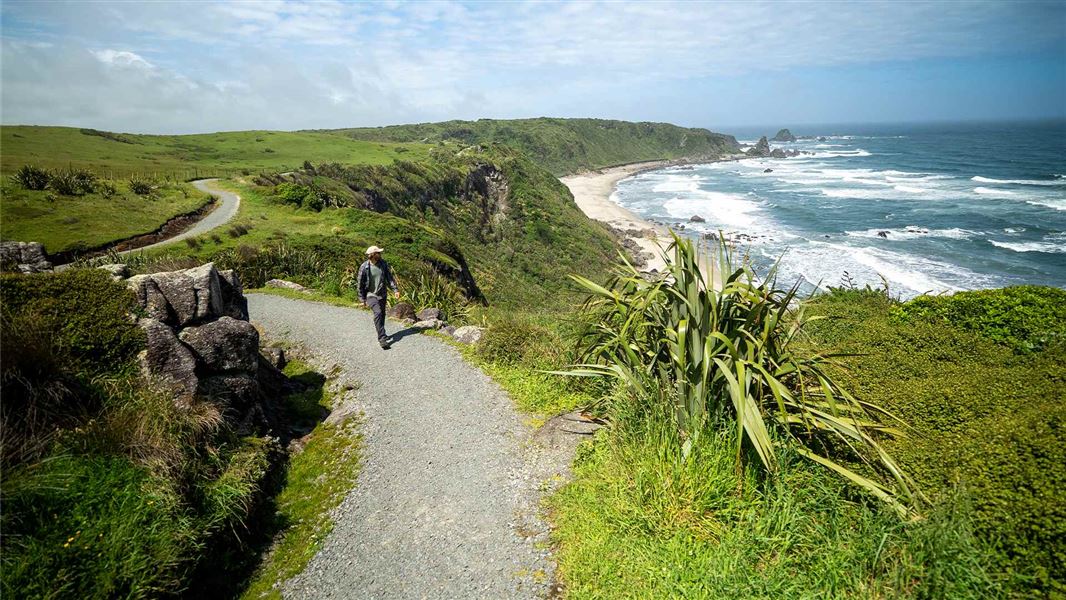
Image gallery
About the walk
- New Zealand fur seal/kekeno colony
- Coastal views and historic lighthouse
- Wheelchair-accessible option
Cape Foulwind Walkway leads to one New Zealand’s most accessible seal colonies.
Enjoy spectacular views of the coast and mountains. On a fine day, you can see:
- south to Aoraki/Mount Cook
- north toward Kahurangi National Park
- inland to the Paparoa Range.
Information panels along the track tell stories of Māori history, sea voyages and early explorers.
You can walk Cape Foulwind Walkway from either end. Most people start at Tauranga Bay.
The track from Tauranga Bay to the seal colony is suitable for wheelchairs and buggies.
Tauranga Bay car park to seal colony viewpoint
30 min / 1 km (return)
Wheelchair-accessible short walk
From Tauranga Bay car park, follow the signs to the seal colony viewpoint.
Take the short side track to Wall Island lookout for views of the small rocky island just offshore. It’s home to a large population of seabirds.
Continue to the seal colony viewpoint. New Zealand fur seals/kekeno live at the Cape Foulwind seal colony year-round. During the summer breeding season, it’s full of playful seal pups.
The track is gravel with some boardwalks. It’s mostly flat or gently sloping, with some steep sections.
Return to the car park the same way you came, or continue to Cape Foulwind.
Tauranga Bay car park to Cape Foulwind lighthouse
2 hr / 5.8 km (return)
Easy to intermediate walking track
From the seal colony viewpoint, follow the signs to Cape Foulwind.
You’ll walk above the rugged coastline and through New Zealand flax/harakeke to the Cape Foulwind lighthouse lookout. Get stunning views out to the Tasman Sea and rocky islets known as The Steeples.
From the lighthouse, it’s another 15 min to Cape Foulwind car park. You can:
- arrange to be picked up
- retrace your steps to Tauranga Bay
- return via Kawatiri Coastal Trail.
No mountain biking
Mountain bikes are not permitted on Cape Foulwind Walkway.
Cape Foulwind Walkway is 15 min by car from Westport.
There is a car park at both ends of the walkway. Start at Tauranga Bay for the seal colony, or Cape Foulwind for the lighthouse.
Tauranga Bay car park
From Westport, take SH67 over the Buller River and turn right at the junction with Cape Foulwind Road (SH67A). Continue for 11 km.
Turn left onto Tauranga Road at the coastal settlement of Omau. From here, it’s 5 km to Tauranga Bay car park.
Tauranga Bay car park has:
- free parking for cars and campervans
- two marked mobility spaces.
Cape Foulwind car park
Follow the same directions as for Tauranga Bay but at Omau, turn right onto Lighthouse Road. From here, it’s 1 km to the Cape Foulwind car park.
Cape Foulwind car park has:
- free parking
- two marked mobility spaces.
Kawatiri Coastal Trail
Kawatiri Coastal Trail provides walking and cycling access to Cape Foulwind Walkway. The Omau section of the trail runs inland from the walkway, linking the car parks at either end.
Mana whenua
Ngāti Waewae hold mana whenua or customary authority over this special place.
Safety and hazards
- Steep drops: Parts of the track are exposed. Stay away from track edges and keep children close.
- Seal colony: Seals can be aggressive. For your safety and theirs, view the seal colony from the viewing platform only.
- Wasps: Wasps and wasp nests may be present. Bring antihistamines if you are allergic to wasp stings.
Plan your visit
- Bookings are not required for Cape Foulwind Walkway.
- Toilets and an accessible toilet are located at Tauranga Bay car park. Toilets are also located at Cape Foulwind car park.
- Drinking water is not available. Bring your own.
- Picnic tables and a small shelter are provided at Tauranga Bay car park, and a picnic table at Cape Foulwind car park. There is seating at the seal colony viewpoint.
- Food and petrol are available at Westport (15 min by car).
- Mobile phone coverage is unavailable in places.
When to go
- The best time to see the Cape Foulwind seal colony is during the breeding season, between September and February.
- Cape Foulwind Walkway can be enjoyed in any weather. It’s exhilarating in a storm, and spectacular on a fine day.
- New Zealand weather changes quickly. Check the weather forecast before you go, and be prepared.
What to take
- Sturdy footwear
- Warm and waterproof clothing
For a complete list, see Short Walks gear list.
Care for nature
- Rubbish bins are not provided. Take your rubbish with you.
- New Zealand fur seals are protected native animals. Stay at least 20 m away and keep dogs on a lead.

Seal colony
The seal colony at Cape Foulwind is home to New Zealand fur seals/kekeno year-round. It’s one of six breeding colonies on the West Coast.
Cape Foulwind is an ideal place for fur seals to live and breed. The rocky shoreline has lots of places for them to come ashore (called ‘haul-outs’), and the sea is rich in food.
Seabirds
Cape Foulwind and its offshore islands are home to breeding populations of:
- fairy prion/tītī wainui
- red-billed gull/tarāpunga
- black-backed gull/karoro
- white-fronted tern/tara
- sooty shearwater/tītī
- little penguin/kororā.
Australasian gannet/tākapu and spotted shag/parekareka can also be seen in the area.
Marine mammals
Hector’s dolphins and orca are sometimes seen off Cape Foulwind Walkway.
Sheltered anchorage
Ara tawhito are traditional travel routes. They lead up and down Te Tai Poutini/the West Coast, providing access to pounamu/greenstone and abundant mahinga kai/food-gathering places.
Tauranga Bay, south of Cape Foulwind, was an important place on this coastal route. It was a sheltered anchorage for waka/canoes and a resting place for people travelling by sea and land.
A place of foul winds
Dutch explorer Abel Tasman sailed past Cape Foulwind in 1642 and named it Rocky Point. Tasman was the first European to set eyes on Aotearoa, but he never stepped ashore.
In 1770, British explorer James Cook’s ship, the Endeavour, was beset by gales here. Cook described it as a ‘place of foul winds’ – the origin of its English name today.
Cape Foulwind lighthouse
A timber lighthouse at Cape Foulwind was first built in 1876. Its beacon guided ships on the difficult approach to Westport Harbour for 50 years.
A concrete lighthouse with an automated light replaced the original lighthouse in 1926. It still operates today.
Nature's in trouble
Thousands of New Zealand’s native species are heading towards extinction. Once they’re gone, they’re gone for good. Nature needs your help.
Paparoa National Park Visitor Centre
| Phone: | +64 3 731 1895 |
| Email: | paparoavc@doc.govt.nz |
| Address: | 4294 Coast Road Punakaiki RD 1 Runanga 7873 |
| Hours: | Visitor centre hours and services |