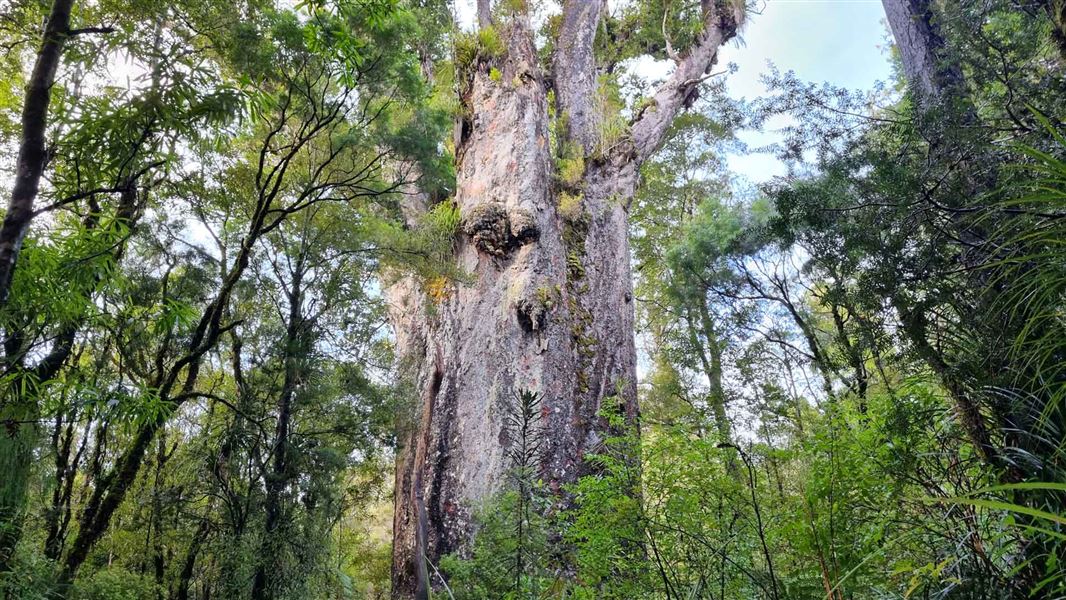
The guiding principle of the project is ‘forest health first’. The impacts of kauri dieback disease, visitor safety, and better recognition and promotion of cultural values of the forest are core drivers for the project.
Waipoua and the adjoining forests of Mataraua and Waimā make up the largest remaining tract of ancient kauri in the world.
Kauri dieback disease (Phytophthora agathidicida, PA) has been found within 60 metres of Tāne Mahuta. Across Northland, there is a strong correlation between kauri dieback disease and access trails. This suggests that humans are a significant vector in the spread of the disease.
The project is designed to ensure that the health and biodiversity of Waipoua is upheld for future generations.
Rākau Rangatira is funded by Budget 17, which is aimed to help DOC upgrade and develop tourist facilities on public conservation land. The fund also enables communities to respond to tourism demand. This includes facilitating future growth in some of New Zealand’s newer tourism regions.
Phase one – Tāne Mahuta assets replaced
Tāne Mahuta reopens with blessing – Media release 21 December 2024
A karakia and blessing by Te Roroa marked the formal reopening of Tāne Mahuta on 21 December 2024.
The walking track to Tāne Mahuta in Waipoua Forest now includes a specially designed raised boardwalk, bridge, and viewing platform, ensuring safer access while minimising ongoing environmental impact.
The project, delivered in partnership with Te Roroa, has worked with Northland Regional Council, DOC’s Plant Pathogens Team, Kauri Ora, and Tiakina Kauri to ensure all works were managed in compliance with the National Pest Management Plan. Compliance measures utilised included isolation of workers from the ground, isolation of machinery, thorough cleaning of all tools and plant before delivery and throughout construction.
New assets largely occupy the same footprint as the old infrastructure to prevent unnecessary tree removals and pruning. The overall design philosophy has focussed on longevity, resilience, and the minimisation of soil movement required during construction.
It is still essential however, that visitors follow good kauri hygiene practice by always remaining on the new structures and using the wash station when entering and exiting the forest.
Phase two – Kauri Walks infrastructure upgrade (March – October 2026)
Investing in naturing: DOC and Te Roroa take Waipoua forward – Media Release 12 January 2026
Phase two construction will:
- Remove and replace aging tracks at Kauri Walks.
- Build a new boardwalk on a new alignment, offering visitors access to parts of Waipoua which have previously been inaccessible.
- Reopen the Four Sisters (closed to the public for many years due to kauri dieback risks).
- Invest $8m to futureproof and safeguard Waipoua.
Kauri Walks will be closed for approximately 8 to 10 months. Tāne Mahuta will remain open during this time.
Alternative experiences
- Tāne Mahuta – New Zealand’s largest living kauri, open daily 9 am–4 pm
- Trounson Kauri Park Loop Track – 40-minute walk through spectacular kauri, 38 km north of Dargaville
- Puketi and Omahuta Forests – Walks, tramps, and camping among kauri and native birds.
Phase two is expected to further position Waipoua as a world-class nature destination and deliver long-term environmental and economic returns. DOC and Te Roroa are working closely with stakeholders, visitor groups, and the community to provide updates on project progress.
Future phases
Future phases of the Rākau Rangatira project aim to:
- identify transformative approaches to deepen visitors’ connection to culture and nature,
- increase public safety,
- minimise environmental impact,
- allow visitors to play an active role in contributing to ongoing conservation.
Contact
Please direct any enquiries to rakaurangatira@doc.govt.nz.