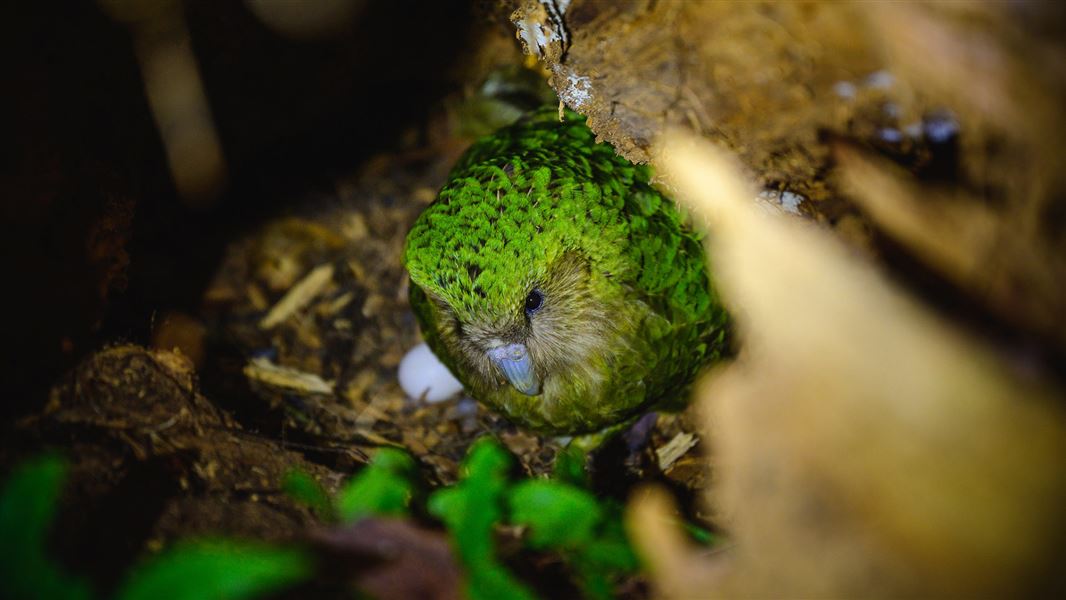
Note: This camera is running from a remote island with limited technology, sound or video may drop out.
Why Kākāpō Cam matters
There's 235 kākāpō left in the world. They're only found in New Zealand. Very few people will ever see one in real life. This is the first breeding season for kākāpō since 2022.
Kākāpō Cam:
- helps scientists learn about nesting behaviour
- lets people around the world watch without disturbing the birds
- builds support for protecting one of Aotearoa's most unique species.
You can help kākāpō by sharing this video with your friends and family. Use #AlwaysBeNaturing and tag @docgovtnz when you share. The more people who care, the better the future for kākāpō.
Watch Kākāpō Cam for Conservation Week
Tuning into kākāpō cam is a great and easy way to get naturing this Conservation Week (20–26 April). Check it out during your lunch break, put it on the staff room TV, or tune in at home.
Who are the stars?
Kākāpō name: Rakiura.
Name meaning: Her name comes from the te reo name for Stewart Island (Rakiura), where much of the original kākāpō population once lived.
Hatch day: 19 February 2002.
Age: 24 years old.
Chicks: Rakiura hatched two genetically important chicks this season: Vori-A1-2026 who hatched on 24 February, and Nora-A2-2026 who hatched on 2 March. At two weeks old, Vori-A1 was transferred to another foster mum. Heather-A3 joined Nora-A2 in the nest on 14 March for a few days and rejoined on 4 April.
What you're watching
You're looking into Rakiura's underground nest. The nest is tucked under the roots of a rātā tree.
She has chosen this same nest site since 2008. This has allowed rangers to improve the nest over time to help keep it safe, dry, and warm. A small hatch has also been added so we can check on eggs and chicks when needed.
Kākāpō are nocturnal, which means she's most active at night.
Listening in on nature
Enjoy the sounds of Whenua Hou.
Day sounds
During the day, you'll hear birds like:
- tūī and bellbirds/korimako
- fantails/pīwakawaka and kākā
- yellowhead/mohua and tomtit/miromiro
- grey warbler/riroriro and silvereye/tauhou
You might also hear kingfisher/kōtare, fernbird/mātātā, red and yellow‑crowned kākāriki, brown creeper/pīpipi, long‑tailed cuckoo/koekoeā,swamp harrier/kāhu
Night sounds
At night, you may hear:
How kākāpō nesting works
Kākāpō breeding is slow and careful:
- After mating, the male's role is finished.
- About a week later, the female begins laying eggs – up to five, three days apart.
- She incubates the eggs for around a month.
- Once chicks hatch, they stay in or close to the nest for about three months.
- Even after leaving the nest, chicks rely on their mum for food and protection for another three.
What's happened so far
January 2026
- 15 Jan – Rakiura mated with Kōmaru.
- 21 Jan – She was artificially inseminated using sperm from Bluster Murphy, Moss, and Gaupo.
- 22 Jan – At 4:30 pm her first egg was laid.
- 23 Jan – Kākāpō Cam went live once Rakiura committed to her nest.
- 25 Jan – At 3:00 pm her second egg was laid on camera.
- 28 Jan – At 2:36 pm her final egg was laid on camera.
February 2026
- 1 Feb – A nest check showed three fertile eggs. Eggs 1 and 2 were moved to incubators. Egg 3 and one infertile egg were left in the nest.
- 7 Feb – Egg 3 was moved to the incubator to join the others.
- 11 Feb – Early embryo death of Rakiura-A1 (egg 1) reported. Egg 2 and egg 3 both still doing well in incubators.
- 19 Feb – Rakiura's hatch day. She's 24 years old. Happy Birthday Rakiura.
- 21 Feb – Smart egg that mimics pre hatch chick sounds put in nest.
- 22 Feb – Rakiura defends nest from mottled petrel intruder. Meanwhile, Rakiura-A2-2026 hatches in another nest.
- 24 Feb – First chick hatches in nest after two stand-in eggs removed and replaced with almost-ready-to-hatch egg Vori-A1-2026.
March 2026
- 1 March – Second genetically valuable egg Nora-A2-2026 transferred to nest.
- 2 March – Second chick Nora-A2-2026 hatches in nest.
- 8 March – Vori-A1-2026 transferred to another foster mum.
- 14 March – Gold ranked male chick Heather-A3 (hatched 2 March) joins nest.
- 17 March – Heather–A3 transferred to nearby nest, leaving just one chick in this nest for now.
April 2026
- 1 April – Nora-A2 is 30 days old and through the most high-risk period of chick rearing.
- 4 April – Heather-A3 rejoins nest while his foster mum focuses on another chick needing extra care.
More on Rakiura the kākāpō
Rakiura hatched on 19 February 2002 on Whenua Hou/Codfish Island. She is the offspring of Flossie and Bill.
Rakiura has nine living descendants, three females and six males, across six breeding seasons. In 2008 came Tōitiiti, in 2009 Tamahou and Te Atapō, in 2011 Tia and Tūtoko, in 2014 Taeatanga and Te Awa, in 2019 Mati-mā and Tautahi. She also has many grandchicks.
Support our work
Kākāpō are critically endangered. Adopt a kākāpō or donate to Kākāpō Recovery to support the conservation of one of New Zealand's rarest and most unique birds.