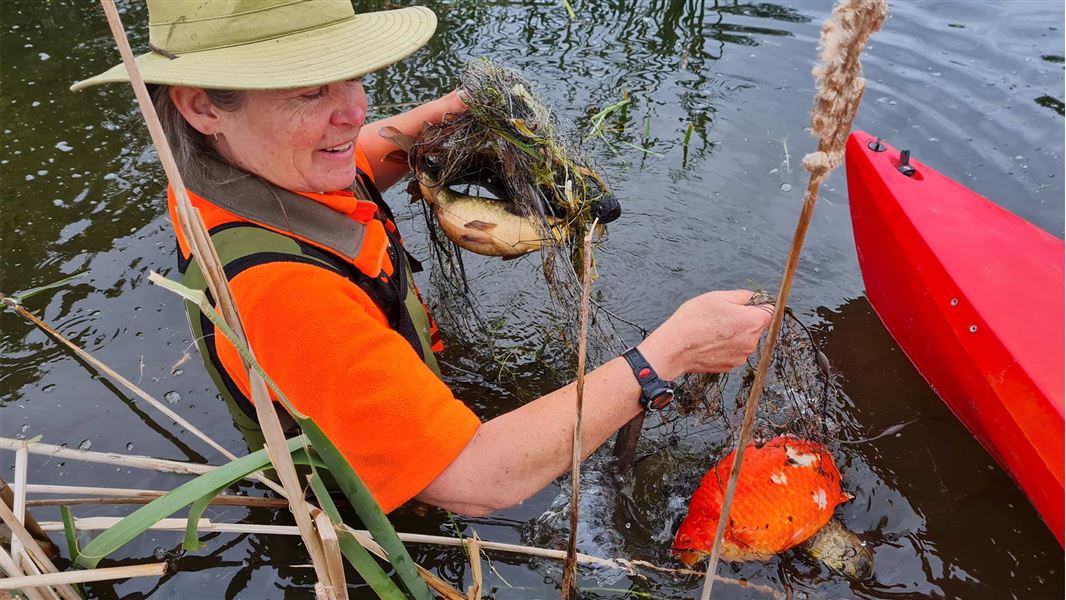
Stopping the spread of invasive species
Ngā Riha Wai Māori works to reduce the spread of invasive freshwater species across the country undertaking surveillance, advocacy and pest management. The work is carried out in collaboration with other agencies, iwi partners and communities.
The programme is focused on managing a range of invasive freshwater species that could cause significant damage to New Zealand’s waterways and wetlands if they spread further, including:
Ngā Riha Wai Māori also helps DOC meet its legal responsibilities to reduce the impacts of freshwater pests in New Zealand.
Read about DOC’s responsibilities for preventing freshwater pests.
Programme strategy and objectives
The programme’s strategy has five objectives:
- effective and efficient operational delivery
- advanced capability and capacity
- cohesive interagency collaboration
- strong relationships with tāngata whenua and communities
- development of research and tools.
Read the strategy: (PDF, 337K)
The strategy’s objectives are linked to those in the New Zealand Biodiversity Strategy, particularly to reduce the biological threats and pressures to native species through management.
Team and approach
Ngā Riha Wai Māori has up to 12 rangers around the country who work with councils, iwi partners and the community to manage priority pest species in their regions. The rangers have shared roles between this programme and Ngā Ika e Heke, and work closely with Arawai Kākāriki and Ngā Awa river rangers.
The programme is supported by a small team of technical advisors who help deliver research and development to support the programme.
Ngā Riha Wai Māori is closely aligned with the National Freshwater Biosecurity Partnership Programme. This programme is led by Biosecurity New Zealand and brings together DOC, Fish & Game, local government agencies, industry organisations and specific Māori entities. It works to prevent the further spread of freshwater pests, including through the Check Clean Dry campaign.
Research project summaries and reports 2022-2025
Te ao Māori and the freshwater biosecurity system
This report aims to understand how Māori freshwater biosecurity kaitiaki interacts with the freshwater biosecurity system.
Recommendations are intended to help DOC better incorporate te ao Māori principles and support whānau, hapū and iwi in their kaitiakitanga roles.
Mapping the incorporation of Te Ao Māori in the Freshwater Biosecurity system (PDF, 6,178K)
Environmental DNA research
A field guide for sampling still freshwater environments for eDNA analysis: eDNA sampling in still freshwaters – field guide
A summary of research into eDNA processing methods for analysis of invasive fish (catfish) in lakes: Efficacy of single-species eDNA assays for invasive fish monitoring (PDF, 322K)
Remote detection of submerged freshwater weeds
Research to develop automatic detection for freshwater weeds, using a video camera and real-time AI detection system to detect the presence and location of target species.
- Invasive macrophyte remote detection research (2022) (PDF, 3,074K)
- Invasive macrophyte remote detection research (2023) (PDF, 4,759K)
- Invasive macrophyte remote detection research (2024) (PDF, 874K)
Koi carp
Five culverts in the upper catchments of Mystery Creek and Mangaotama stream were assessed for fish passage to see if they would prevent koi carp incursion. The culverts did not restrict koi carp movement.
Assessment of barriers to koi carp migration, Ōhaupo catchment (PDF, 1,481K)
A standard operating protocol was developed to detect invasive fish (specifically koi carp) in New Zealand’s lowland lakes. Read a stepwise summary of the method.
Detecting low densities of koi carp and other pest fish species in lakes using environmental DNA
Golden dodder (cuscuta) research and monitoring
Bolboschoenus fluvitalis (river bullrush) is an important native wetland plant. This study researched its susceptibility to being parasitised if golden dodder was already established on another nearby host plant. This risk was found to be low.
Cuscuta campestris: parasitism of Bolboschoenus fluvitalis (PDF, 793K)
Glasshouse and laboratory studies were carried out to determine the threat posed by golden dodder to New Zealand’s ecosystems. This research is intended to inform weed management plans and riparian planting choices. Cuscuta did not parasitise manuka, cabbage trees or harakeke.
Cuscuta campestris: host themes and preferences (PDF, 2,756K)
This research-based plan describes methods for monitoring golden dodder at a large scale with aerial imagery and at a small scale with transects and drone-based image capture.
Cuscuta campestris: Monitoring plan (PDF, 1,050K)
Freshwater fish farming
A survey sent to councils and central government revealed 16 consent conditions associated with freshwater fish farms. The research showed several information gaps, including the lack of explicit biosecurity monitoring requirements.
The biosecurity risks presented by freshwater fish farms in New Zealand were assessed. The report recommends taking a precautionary approach and suggests creating a biosecurity risk profile for each freshwater species.
Potential ecosystem impacts of biosecurity risks associated with freshwater fish farms (PDF, 1,197K)
Contact
For more information email info@doc.govt.nz.