
Why we need a predator-free New Zealand
Native wildlife is unique and in trouble
Many of our native species are found nowhere else in the world. They evolved for millions of years without mammal predators or defences against them.
We’ve got cheeky parrots, ancient frogs, army-crawling bats and ground foraging birds.
More than 4,000 of these unique native species are threatened or at risk of extinction. Once they’re gone, they’re gone for good.
Meet your one-of-a-kind neighbours
Introduced predators threaten native plants and wildlife
Introduced predators are one of the key threats to native species. Rats, possums, feral cats and mustelids (stoats, ferrets, weasels) kill an estimated 25 million native birds each year.
These introduced predators were chosen because they are considered the most harmful to native wildlife and realistic to eradicate by 2050. They are included in the Predator Free 2050 Target Species List.
In addition to these select introduced predators, mice and hedgehogs are a focus for Predator Free 2050 research. This is so we can better understand their impact, find tools to manage them and understand if they need to be added to the Target Species List in the future.
You can learn about other animal pests, freshwater pests and weeds on our Pests and Threats section.
We target these predators
Learn about each of the predators that we aim to eradicate.
New Zealanders will see big benefits
The benefits of achieving Predator Free 2050 will go beyond birds. People will see positive changes in our economy, culture, wellbeing and recreation. They will even see some surprising perks.
The benefits include:
- native plants and wildlife bouncing back
- ecosystems restored to health and more resilient to climate change
- whānau, hapū and iwi expressing kaitiakitanga and rangatiratanga
- generations of New Zealanders reconnecting with the natural environment
- New Zealand’s international standing increasing
- our economy growing.
Predator Free 2050 is a goal, programme and movement
New Zealand’s bold goal
Predator Free 2050 is a bold nationwide goal to eradicate damaging introduced predators (rats, possums, feral cats and mustelids) from all of Aotearoa New Zealand by 2050 so that nature and communities can thrive.
Defining eradication
We aim to completely and permanently remove introduced predators from the whole country. This is called 'eradication'.
Eradication is much more difficult to achieve than controlling predator numbers. This is because it requires removing every last animal and stopping them from coming back into the area once they’ve gone.
There are important stepping stones on the journey to eradication like achieving 'elimination'.
Check out this infographic that explains the concepts of predator suppression, elimination and eradication.
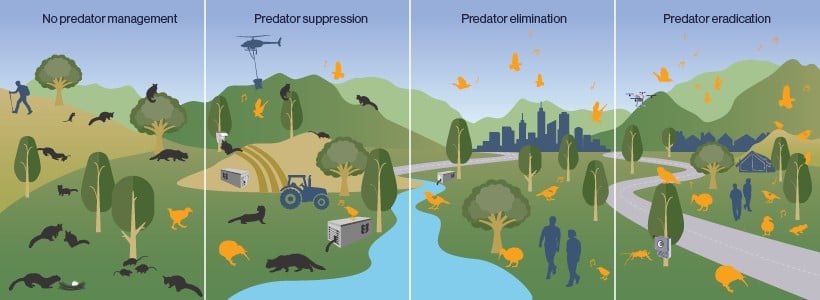 Infographic showing the difference between no predator management, predator supression, elimination and eradication.
Image: DOC
Government-funded programme
The New Zealand Government launched the ambitious goal in 2016 as a response to the steep decline in native species due to introduced predators.
Following the announcement, the Government committed significant funding, began the development of the first collective 5-year strategy and kickstarted the national Predator Free 2050 programme.
DOC is the Government’s lead agency responsible for Predator Free 2050 and helps lead the programme.
With input from communities, Treaty partners and collaborators, we developed the strategy that sets out the steps to get us to the shared goal. Achieving the goal cannot be done by any single organisation alone. It is a collective effort.
The programme funds work led by iwi, hapū, imi, NGOs, businesses, fenced eco-sanctuaries, community groups and scientists.
Learn more about our programme of work
Grassroots movement
The vision of a predator-free future has captured the hearts and minds of New Zealanders like no other conservation initiative.
Across the country, New Zealanders from all walks of life are doing their bit. From backyard trappers to sanctuary volunteers to school kids building wētā hotels – everyone has a role to play.
This people-powered movement to protect nature and control predators isn’t new, and came well before the Government’s announcement of the goal.
The Government-funded programme builds on the long-standing work of people who continue to protect nature.