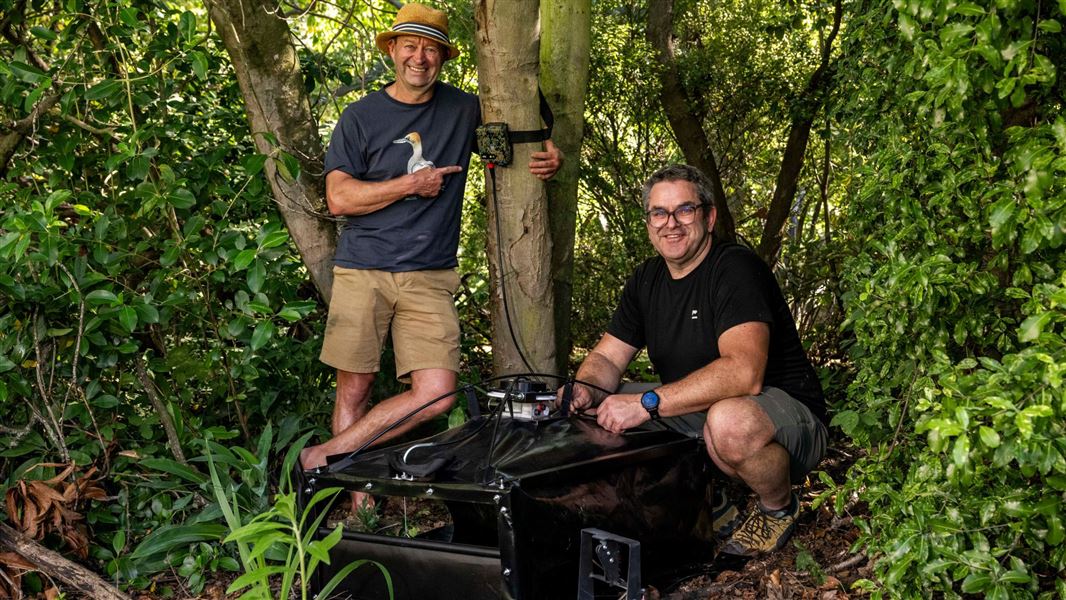
Growing the range of tools to eradicate predators
Science and innovation are a key focus for the next five years of Predator Free 2050. We know our current tools alone won’t get us there, and there is no one tool or method that will be a silver bullet. To succeed, we need many tools that are affordable, humane and acceptable to the public.
Scientists, engineers and practitioners are developing tools such as smart traps and new toxins and lures. They're also testing new technology like AI and remote communications systems.
All tools, including toxins, are carefully tested. They must be safe, effective and meet animal welfare standards.
Research into future breakthrough solutions is also being explored. One area of research is genetics. It has not been used in New Zealand before and is a long way from being ready.
New technologies will be shared with the public before decisions are made. New Zealanders will be able to give feedback through consultation.
Highlights of science and innovation work
These examples show the wide range of projects supporting Predator Free 2050. Each one helps move us closer to the goal.
Currently funded projects
There are currently no toxins that target only carnivores such as feral cats, stoats, ferrets, weasels and hedgehogs. Creating species-specific baits reduces risks to non-target animals.
We can also use existing toxins in new ways to support successful and scalable eradication strategies.
Sausage bait with PAPP (DOC Predator Science Team)
A pre-made meat bait containing the toxin PAPP (para-aminopropiophenone) is being developed for use both on the ground and from the air.
This bait will help control carnivores (stoats, feral cats) when rodent numbers are low and secondary poisoning is not an effective option. Work is underway to understand risks to non-target species.
Sausage bait with 1080 (DOC National Eradication Team)
A pre-made meat bait containing the toxin 1080 (sodium fluoroacetate) is being developed. This will help control carnivores such as stoats, feral cats and hedgehogs when rodent numbers are low.
Gel-based D+C toxin for Spitfire devices (Envico Technologies)
Developing gel-based toxin mixtures (diphacinone + cholecalciferol) for possum and rat Spitfire devices. These deliver toxin by exploiting grooming behaviour instead of bait consumption.
Rodent carcass bait for stoat control (ZIP)
Developing a bait to target stoats using rat carcasses treated with 1080 to mimic natural secondary poisoning pathways. This provides an effective stoat control option when rodent numbers are low.
Norbormide baits (Invasive Pest Control / Boffa Miskell)
Development of a rat-specific toxin in both paste (development complete and is waiting registration) and solid bait form that is safer for birds, pets, livestock and the environment.
Gel-based 1080 for stoat Spitfire (Envico Technologies)
Developing a 1080 gel formulation compatible with stoat-specific Spitfire devices.
DR8 bait (Orillion / ZIP – TBC)
Developing a new rat-specific bait, which uses a slow-release formulation of norbormide, that is safe for non-target species and can be deployed aerially.
Aerial delivery of Double Tap bait (IPC Ltd)
Research to explore extending the use of Double Tap bait (diphacinone and cholecalciferol) to include aerial delivery. This would provide another tool for controlling rats across large and rugged landscapes.
These projects aim to improve the way toxins are delivered on the ground through tools like bait stations. The focus is on protecting non-target species like pets and wildlife.
Wildlife friendly bait station (ZIP)
Long duration toxin delivery with features preventing access by non-target species, especially kea in backcountry environments.
Wildlife friendly bait station
BaitSense (eTrapper)
Remote monitoring of bait station levels via Trap.NZ, with near real time alerts for bait uptake or required refilling.
Aerial toxin delivery is the most effective tool for remote and hard‑to‑reach areas.
Improving accuracy makes operations more effective and cost-efficient. It also allows targeted treatment where predators return.
Precision baitpod system (Aerospread Ltd)
Development of drone deployed biodegradable bait pods for precise and efficient bait deployment. The drone dispersal system deploys the bait pods containing multiple baits, which break open on hitting the ground.
Use cases include accurate deployment of baits along sensitive boundaries, buffer/exclusion zones, spot treatments for reinvasions and deployment in challenging or unsafe areas such as steep cliffs.
Aerial bait bucket improvements (DOC National Eradication Team)
Enhancing the efficiency and consistency of aerial baiting buckets used in both predator suppression and eradication operations.
Fixed trickle bucket (ZIP)
A helicopter-mounted conveyor system for delivering bait directly beneath the aircraft, improving accuracy along boundaries and sensitive sites.
Fixed-wing spinner system (Otago Airspread Ltd)
Development and commercialisation of a hydraulic spinner for distributing bait from fixed-wing aircrafts. This work will explore the potential for more efficient and cost-effective aerial delivery of baits.
Sausage dispensing system (Helicopters Otago Ltd)
Further development of a dispensing system for aerially distributing meat baits. The sausage dispensing system will allow for efficient and accurate GPS controlled aerial delivery of baits, reducing flight times and costs of operations.
Genetic and fertility control research may provide targeted, long‑lasting, humane and scalable solutions.
Sperm motility genes for rodent control (University of Adelaide)
Proof of concept research demonstrated a world-first genetic technology could suppress the fertility of female mice in 2022. Their computer modelling predicted it could eradicate a mice population of 200,000 males in around 20 years – with no traps or toxins required.
The research is focusing on developing this new genetic technology for mice that could also work in rats.
GnRH sterilisation project (University of Otago)
Developing a humane oral bait that induces permanent sterilisation in pest mammals through a mammal-specific biological pathway.
Improving traps will help remove predators across different landscapes.
New devices include features such as self‑resetting mechanisms, remote reporting and AI‑enhanced species recognition to improve performance.
ZIPinn trap (ZIP)
An open rat and stoat trap with a treadle trigger that closes both entrances and humanely euthanises the animal using CO₂ gas.
High interaction rate trap (HIRT) and DOC AI cam improvements (Cacophony Project Ltd)
HIRT is paired with the DOC AI camera to target all Predator Free 2050 target species. It is designed to encourage high interaction increasing the likelihood of capture, especially for highly mobile predator species or low predator densities.
Use cases include island incursions, bottleneck sites and eradication projects with remnant elusive individuals not interacting with other tools.
AT110 – automatic resetting run through trap (NZ Autotraps)
Development of an automatically resetting trap for stoats, rats, mice and hedgehogs. The AT100 uses a horizontal set run through design to increase interaction with target species and therefore increase kill rates.
Use cases may include supporting eradication projects with remaining low-density predator populations.
Spitfire devices (Envico Technologies)
Self-resetting, species-specific devices that use sensors to recognise predators, then apply liquid toxin to the target animal’s abdomen. The target predator then ingests the liquid toxin through grooming.
Available products
AT220 trap (NZ Autotraps)
New Zealand’s first multi-species auto-resetting trap for possums and rats. This trap rapidly reduces populations of predators with minimal labour required.
AI-enabled multi-species kill trap (Critter Solutions Ltd)
This self-resetting trap uses AI species recognition to only trigger on rats, mice, mustelids and possums with high standards for animal welfare. The open architecture design helps to attract individual predators that are trap shy while also protecting native wildlife.
AI-enabled multi-species kill trap
PosStop trap (ZIP)
An improved raised leghold trap used to eliminate remaining possums after knockdown operations in remote backcountry areas.
Connected leg hold traps (Encounter Solutions)
Real-time reporting and monitoring of leghold traps using the Celium long-range communications network which is highly effective over challenging topography.
LiveCapture remote locking (Encounter Solutions)
Allows cage traps to be remotely disabled via Celium long-range communications network to maintain welfare when staff are unable to physically visit deployed traps.
Possum and rat airbow (Hammerforce Ltd)
Using only compressed air, this self-resetting possum trap does not use any electronics and can be refilled with a hand air pump. With the highest animal-welfare rating, this unique design will target up to 14 possums per service.
Ongoing A24 trap improvements – trap, lure, IoT data system (Goodnature Ltd)
Development of dipper system for reliable lure delivery across 6 months, an improved regulator and exploration into remote connectivity for the Goodnature A24 trap.
Long-life lures and automatic dispensers dramatically reduce the labour and cost requirements. They also improve the chances of removing predators by keeping devices attractive and active for longer periods.
Long-life multispecies lure (University of Canterbury)
Development of a long-life, non-toxic, scent-based lure that attracts mustelids and feral cats, including at low densities. The lure will be incorporated into slow-release devices for longevity in the field and can be used for a wide range of Predator Free 2050 use cases.
H2Zero hydrogen powered lure dispenser (ZIP)
A release system dispersing lure over six months, reducing servicing requirements.
H2Zero hydrogen powered lure dispenser
Available products
EzyLure (Critter Solutions)
A set-and-forget device that automatically dispenses fresh lure at pre-determined intervals. It can be retrofitted to a wide range of existing traps and bait stations and paired with trail cameras for effective monitoring of rats, mustelids and possums.
PoaUku ceramic lures (Boffa Miskell)
These long-life ceramic based lures can stay attractive in the field for up to three months and be refilled when they run out. Two versions are available: one for mustelids (stoats, ferrets and weasels) and one for possums and rats.
Motolure / ZIP H2Lure (ZIP)
A device releasing preset quantities of fresh lure for up to a year. It is used for trapping, pre-feeding, detection and biomarker work. The newest version of this device is now available.
Long-life rat lure (Victoria University)
Long lasting scent-based lure ideal for self-resetting traps with infrequent service schedules.
Development of a long-life, scent-based lure to attract rats. Sustained release, long-life lures are important for constant control of rats, particularly for use in self-resetting traps where users may not visit as frequently.
Improving detection devices and methods will improve efficiency of finding the last few surviving or reinvading predators.
Edge device trials (DOC National Eradication Team)
Ongoing testing and deployment of Sentinel edge detection devices across multiple islands and landscapes.
Hark Pro: audio detection tool (800 Trust)
Using an advanced bioacoustics AI model, this device can capture the full acoustic scene using triangulation and detect sounds up to 192kHz for ultrasonic recording.
This 24/7 acoustic monitoring device has onboard AI detection for birds, possums and bats.
Hark Pro: audio detection tool
Hark Lite: possum audio detection (800 Trust)
A real-time onboard AI audio device for detecting possum calls.
Hark Lite: Possum audio detection
Volatile sensor for stoat detection (NZ Forest Research Institute Ltd)
Testing feasibility of scent-based biosensors for stoat detection.
Large dataset acoustic monitoring (DigiLab Ltd)
Evaluating possum acoustic monitoring using large datasets of possum calls to compare audio detection with current monitoring and detection methods.
Extended range thermal camera (Critter Solutions Ltd)
Developing long-range thermal detection systems for surveillance of predators.
AI training for rat identification (ZIP)
Improving AI algorithms to distinguish between rat species in ZIP cameras.
Available products
DOC AI camera and image processing platform (Cacophony Project)
Development of a low power, remote sensing thermal camera that uses AI to identify predators and select native species. This enables automated identification of species and provides notifications to users allowing fast decision making and response.
OWL AI camera (Critter Solutions Ltd)
AI equipped trail cameras with onboard species recognition and remote communication capabilities, for real-time species detection at landscape scale.
Alita (DOC Predator Science Team and Weka Research)
Development and refinement of a free to use desktop AI classifier ’Alita’ for processing trail camera images. Alita is able to classify approximately 80 species. This also includes training and validation data for others to use.
Kaytoo (DOC Predator Science Team and Weka Research)
Development of a free to use desktop classifier ‘Kaytoo’ for processing acoustic recordings. Kaytoo is able to classify approximately 80 species. Work has also included improvements to training data for machine learning related to acoustic recordings.
Tracking tunnel machine learning (DOC Predator Science Team and Weka Research)
Building a comprehensive training library for footprint identification from tracking tunnel cards. Development includes building and refining a machine learning tool and developing a mobile app for data capture.
AI classification models (AddaxAI and Weka Research)
Development of a New Zealand invasives and a New Zealand species AI model to classify trail camera images. The models were trained on approximately 2 million camera trap images from a diverse range of habitats, using a variety of trail camera brands and models.
The need for this was driven by the sensitivity and power trail cameras provide but acknowledging the time burden of manual data processing and review.
The models have been embedded into AddaxAI. They have a user-friendly interface for running object detection and image classification models on trail camera imagery, and can be complemented with Timelapse2 for reviewing and creating tailored databases for further analysis.
Ecological research helps us understand how ecosystems respond when predators are removed.
This knowledge is essential for planning future Predator Free operations. It also provides the evidence needed to assess the risks, benefits and long‑term outcomes of eradication tools and methods.
In progress
Ferret–rabbit interactions (Manaaki Whenua)
Assessing whether reducing rabbit numbers improves ferret trapability and supports ferret elimination.
Targeted SNP panel for rats (Manaaki Whenua)
Developing a standard genetic panel and demonstrating its application.
Surveillance design and literature synthesis (Manaaki Whenua)
Developing experimental designs for estimating device specific detection probabilities across multiple tools.
Rakiura predator monitoring (DOC National Predator Control Programme and DOC Predator Science Team)
Ecological investigation of rat, feral cat and possum responses to aerial 1080 operation to protect pukunui (Southern NZ dotterel) on Rakiura/Stewart Island.
Ground-truthing acoustic monitoring against five minute bird counts (Digi Labs)
The aim is to ground truth acoustic bird monitoring data against five minute bird counts conducted by expert observers. This dataset will be used to compare how well acoustic monitoring devices function against long standing monitoring methods.
This research improves how tools are used together across large areas. This reduces effort, cost and risk while improving the outcomes of predator control.
Remote sensing of ecosystem drivers (DOC National Predator Control Programme)
Detecting flowering and seeding events (key drivers of predator and native species dynamics) for operational planning.
Rodent hunger and 1080 outcomes (DOC National Predator Control Programme)
Investigating how hunger levels influence rat and mouse responses to aerial 1080 operations in a range of forest systems.
Understanding cereal bait uptake (DOC Predator Science Team)
Developing methods to quantitatively measure toxic bait consumption under varying food availability scenarios across a range of forest systems.
Bait efficacy trials (ZIP)
Testing effectiveness of different 1080 cereal baits across rat species and environments.
NAWAC trap testing (Manaaki Whenua Landcare Research)
Funding to test commercially available predator traps against the National Animal Welfare Advisory Committee’s (NAWAC) guidelines for animal welfare.
The aim was to increase the range of traps available to the Predator Free 2050 community that meets the guidelines. DOC's best practice trapping guidance recommends traps that meet the animal welfare guidelines be used in preference to those that don’t.
Researching the vulnerability of native birds to PAPP (DOC Predator Science Team and Manaaki Whenua Landcare Research)
Development of a method to estimate the susceptibility of New Zealand native birds to PAPP. The outcomes of this work supported understanding of risks to native species were used as part of the risk assessment within the PAPP sausage bait project.
You can read finalised reports at Research papers and reports.
Remote communication tools send real‑time alerts from field devices. This allows a faster response and reduces labour.
This technology is critical for scaling predator eradication and maintaining predator‑free areas. Further research and development is needed to optimise their use.
Public LoRaWAN service (Groundtruth Ltd)
Developing a free to use LoRaWAN network service integrated with Trap.NZ to connect traps and monitoring devices and allow data to be communicated to users. This will empower conservation groups to use advanced technology to gather data and deliver on Predator Free 2050 goals.
LoRaWAN retrofit kit (Groundtruth Ltd)
Developing a sensor kit enabling remote data reporting from self-resetting traps and detection devices. This work will focus on integration with NZ Autotraps AT220, with specifications made available to other trap and monitoring device manufacturers, allowing them to adapt their firmware to communicate with the retrofit kit.
Available products
OutPost (ZIP)
LoRaWAN‑based communication link for traps and cameras in areas without cellular coverage.
Flexicomms (Critter Solutions)
A system for integrating traps and detection devices with cellular connectivity and future satellite support.
Software systems are being developed to support consistent and high‑quality data collection and analysis.
These systems are designed to support operations and research, and uphold Māori data sovereignty.
Available products
CamTrap (Manaaki Whenua)
Free AI image recognition tool for rapid species identification from trail cameras.
Open sensor network (Groundtruth Ltd)
LoRaWAN integration enabling trap alerts and data transmission into Trap.NZ.
Trap.NZ planning module and backbone funding
Tools for planning trap deployment, managing permissions and supporting ongoing platform development and stability.
Proof of absence (Proteus)
Occupancy modelling tools to track project progress toward predator elimination.
Remote communications interoperability (multiple contractors)
Exploring solutions to improve compatibility across different communication networks used in Predator Free projects.
Report: Interoperability and remote comms (PDF, 829K)
Māori data sovereignty framework (Te Tira Whakamaataki)
A clear, actionable guide for the meaningful expression of Māori data sovereignty in projects.
Understanding the cultural, social and economic benefits helps show the wider value of Predator Free 2050. Some of the benefits include strengthened connections to nature, improved wellbeing and enhanced community resilience.
You can read finalised reports on our Research papers and reports page.
Not all research leads to products ready for use. Much of this work is exploratory. It builds knowledge that supports future work.
Valuable learnings often feed into future research and decision making.
Examples of discontinued work:
- Stoat spitfire with PAPP gel (Envico Technologies)
- PredaLINK system (ASG Technologies)
- PAWS® sensor pad (Lincoln Agritech / Boffa Miskell / Red Fern Solutions)
- DR8 extension to ship rats (Manaaki Whenua / Orillion)
- Heavy‑lift drone development (Envico Technologies)
- Aerial microtrap (Goodnature Ltd)