Spacing depends on the species you're targeting in your Predator Free 2050 protection area, and the method of control.
Talk to your Predator Free Ranger for advice.
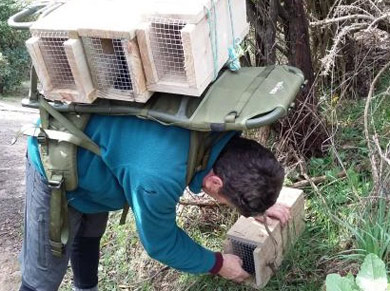
Installing a trap
Image: Wendy Sullivan ©
Rat traps
Plan to set your rat traps in a grid pattern as closely as possible.
Spacing between lines: 100 m or less
Spacing between traps on each line: 50 m (25 m along perimeter lines)
In difficult terrain: set lines down ridges and spurs, and along contours to achieve the necessary spacing
Rat bait stations
Plan to set your rat bait stations in a grid pattern as closely as possible.
Spacing between lines: 100 m or less
Spacing between stations on each line: 50 m
In difficult terrain: set lines down ridges and spurs, and along contours to achieve the necessary spacing
Stoat traps
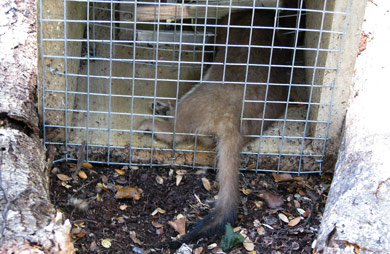
Place your trap or bait lines correctly to target predators
Image: DOC
Plan to set your stoat traps along the natural lie of the land, such as habitat perimeters, ridges, altitude contours, waterways (both sides if larger than a stream) and track and road edges.
Spacing between lines: no further than 800–1,000 m
Spacing between traps on each line: 100–200 m
Possum traps
Plan to set your possum traps where you see obvious possum sign at the base of trees and posts, and on pad runs (tracks made by possums).
Spacing between lines: 100 m or less
Spacing between traps on each line: 20–40 m initially, or up to 100 m at low possum densities or if using self-resetting traps
Possum bait stations
Plan to set your possum bait stations in a grid pattern as closely as possible.
Spacing between lines: 100 m
Spacing between traps on each line: 100 m (50 m along perimeter lines and habitat margins)
In difficult terrain: set lines down ridges and spurs, and along contours to achieve the necessary spacing
Feral cat traps
Plan to set your traps along linear landscape features (fence lines, forest edges, waterways, roads and tracks), in isolated patches of cover and areas where there is an abundance of food/prey. Localised threatened species protection requires an intensive trap layout: set traps about 50 m apart around the area being protected.
If there are domestic cats in the area, do not use kill or leghold traps and instead consider cage traps. Find more information on live capture trapping
Place traps along lines following these features at intervals of 100-200 m.
Consider positioning traps so they are not visible from recognised walking routes and are set more than 50 m from huts, picnic areas, or permanent campsites.
How to combine trap lines
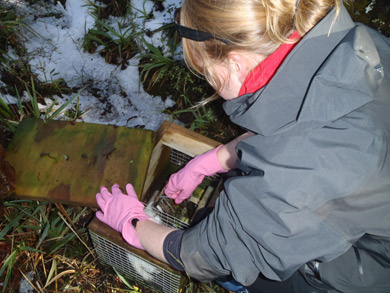
The DOC-200 kills stoats and rats
Image: Jin Ong ©
You can combine your traplines if monitoring has shown more than one target pest is present. As long as you maintain the recommended trap spacing for each species, combining lines can make trap checks easier and more efficient.
For example, targeting rats and stoats. Plan to set your rat bait station/trap lines at the recommended distance apart (100 m or less).
Lay stoat traps on the rat lines that most closely coincide with the recommended distance for stoat traps (no further than 800–1,000 m), at the recommended spacings (100–200 m). This could result in stoat traps along every eighth rat line.
Make sure you understand the spacings required for each of your target species.
Plot on a map or with software
Plot your line locations before you head out, and consider practicality of access when picking a line’s starting point. Mark your locations on a map and store them in a portable GPS device if possible.
In the field
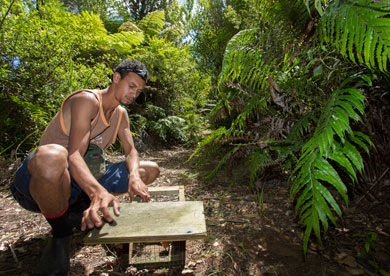
Setting a stoat trap
Image: Sabine Bernert ©
The frequency of control operations will depend on the characteristics of your protection area. Talk to your Predator Free Ranger for advice.
Mark each line
- Use your GPS device or map to locate the line’s start point.
- Follow the compass bearing for the line and measure the distance travelled.
- Place markers and/or flagging tape along the line to make it easy and safe to follow. Label them with the line’s identifier.
- At the relevant distance, place a device and collect your measuring line:
Place and mark each device
- Follow the set-up instructions for your chosen trap or bait station.
- Label the device clearly with the line and tunnel identifiers. Use a different coloured marker to make it easy to find.
- If the device isn’t obvious from the track, add an indicating marker using the same colour as for the tunnel.
- Mark the location on your GPS device.
- Continue until you’ve installed the relevant number of devices.
Recording results
You may wish to make a record of each pest control operation. Your notes could include the date, method and amount of bait consumed if using toxins.