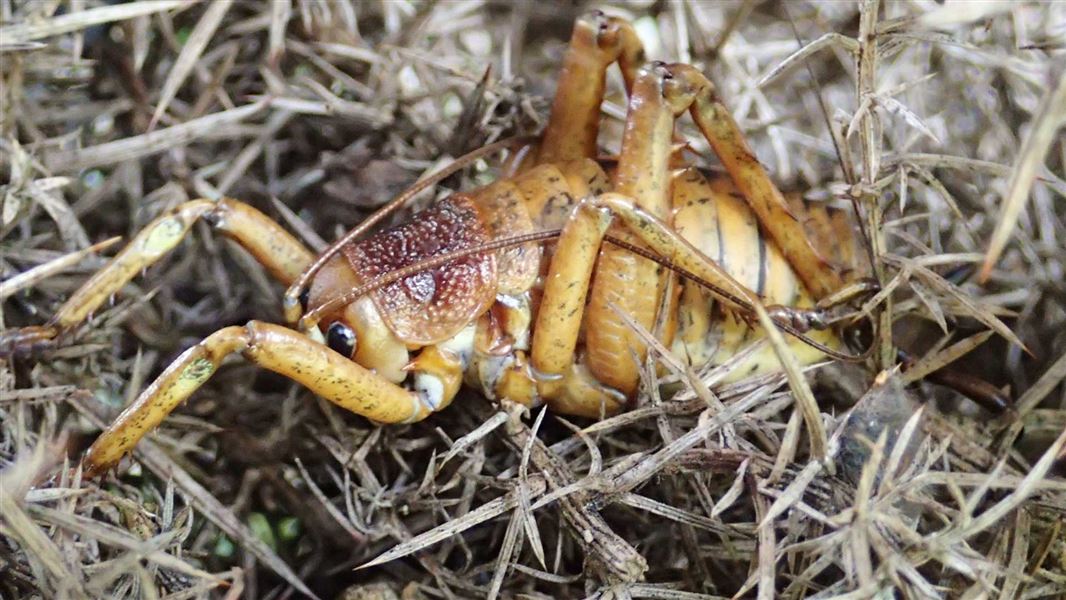
Conservation status: Threatened - Nationally Critical
Found in: Mahoenui Giant Wētā Scientific Reserve – the only known natural population.
Other sites: Successfully translocated to four other North Island locations (Mahurangi Island, a privately owned fenced site at Warrenheip near Cambridge, Sanctuary Mountain Maungatautari and Rotokare Scenic Reserve).
Threats: Predation from introduced mammals, fire, climate change.
In 1962 a population of giant wētā were discovered in remnant patches of tawa forest at Mahoenui in the southern King Country. More wētā were found on farmland reverting to gorse in 1987.
Image gallery
Description
Mahoenui giant wētā range in size. Females are larger than males – female adults measuring up to 75 mm and adult males 5 mm. Females weigh up to 19 gm (the same weight as a mouse) and males up to 12 gm.
Female wētā lay their eggs by pushing their ovipositor (egg laying tube) into the ground. They lay small groups of up to 100 eggs which develop in the ground and hatch only when the weather warms up. This can take up to 10 months.
Newly hatched wētā are called nymphs. It takes up to two years for the wētā to reach adulthood.
Mahoenui giant wētā are unique amongst the giant wētā species in having two distinct colour morphs. Although most tend to be a dark mahogany brown colour, a third of them are yellow, and one female was even discovered with mahogany for half of her body and the other side yellow.
Mahoenui giant wētā are highly vulnerable to predators such as rats, mice, mustelids, and hedgehogs.
A taonga and iconic species
Mahoenui giant wētā is treasured by Te Whare ki Mōkau ki Runga whanau who whakapapa to Ngāti Maniapoto. Mana whenua played a key role in their initial discovery, and later in the protection of their Mahoenui habitat. Today Mōkau ki Runga whānau are closely involved with conservation efforts.
Mahoenui giant wētā is a special icon to the King Country community – a statue of the wētā is located on the main street of Te Kuiti.
Mahoenui Giant Wētā Scientific Reserve
DOC purchased the land at Mahoenui where giant wētā were discovered and turned it into a reserve for the wētā.
Today, vegetation in the reserve is a mix of gorse and regenerating native forest. Although gorse is considered a pest throughout New Zealand, in this reserve it has played a key role protecting the wētā from predators for more than 30 years. Wild goats were allowed to browse on the gorse which helped maintain its tight regrowth and in turn provided protection for the wētā.
However, with native forest regeneration progressing through the reserve, gorse cover is declining and predators are taking hold. These habitat changes, although good for wētā in the long term, mean the wētā is more vulnerable to predation.
Threats
The main threats to Mahoenui giant wētā are introduced mammalian predators, fire, and climate change.
Wētā, particularly adult females when they come down to the ground to lay eggs, are very susceptible to predation from rats, mice, hedgehogs, possums, cats, and mustelids (stoats, weasels, and ferrets). Research has shown that Mahoenui giant wētā are nine times more likely to be killed by predators in regenerating native forest than in browsed gorse.
Fire is also a risk in the Mahoenui Giant Wētā Scientific Reserve because gorse is highly flammable and the danger is that if it catches fire, it could wipe out the entire original population of this wētā, in as little as two to three hours. We have fire breaks among the vegetation and a fire plan to mitigate this risk to the wētā population at this site.
Climate change is another long-term threat. For example, increasing drought and warmer temperatures could disrupt breeding cycles and impact wētā survival. A changing climate could also increase fire risk and result in climatic conditions more favourable to predators, increasing predation.
Conservation
Monitoring of wētā in the Mahoenui Giant Wētā Scientific Reserve shows numbers have significantly declined since 2013. This decline is concerning because the reserve population is the species stronghold. As a result, the conservation status of this wētā was reassessed as ‘Nationally Critical’ in 2022.
The conservation strategy for Mahoenui giant wētā is to:
- allow forest regeneration and control predators at the Mahoenui Giant Wētā Scientific Reserve while investigating other options for predator management – predator control commenced in 2019 and is ongoing
- continue to establish populations at locations free from mammalian predators to reduce the risk of extinction
- captive breeding – breed wētā for release at other locations because we can no longer collect wētā from the Mahoenui Giant Wētā Scientific Reserve for direct translocations to new locations.
Mahoenui giant wētā have been translocated to foursites:
- private land at Warrenheip near Cambridge.
- Mahurangi Island, off the Coromandel coast – 200 were transferred there and are now established on the island.
- Sanctuary Mountain Maungatautari, a mammal-free fenced forest near Cambridge.
- Rotokare Scenic Reserve, a mammal-free fenced forest near Eltham, Taranaki.
Populations are monitored to find out if Mahoenui giant wētā have successfully established a self-sustaining population. Although the sites are free from introduced mammal predators, they are all vulnerable to re-invasion and need constant surveillance and readiness to respond.
Watch a Meet the Locals video about Mahoenui giant wētā.
Captive management
DOC facilitated a captive breeding programme for Mahoenui giant wētā in 2021 with our partners Ōtorohanga Kiwi House and Te Whare ki Mōkau ki Runga – this means they can be bred within the rohe of Ngāti Maniapoto, as close as possible to their site of origin at Mahoenui.
The first young wētā hatched in 2023 and alongside our partners and other supporters we have begun releasing captive bred wētā to safe predator-free sites.
Watch a video of a Mahoenui giant wētā release
A new site for Mahoenui giant wētā
On 26 November 2025, 97 captive-bred Mahoenui giant wētā were translocated from Ōtorohanga Kiwi House captive breeding facility to Rotokare Scenic Reserve mammalian pest free sanctuary. This is the first of a series of translocations planned over the next 10-12 years to establish a new population of Mahoenui giant wētā at Rotokare.
Future plans and acknowledgements
Future conservation plans include continuing our efforts to protect Mahoenui giant wētā from introduced mammalian predators and other threats along with subsequent translocations to boost numbers at the above three sites and establishment of Mahoenui giant wētā at new sites.
DOC acknowledges the support and contributions of Te Whare ki Mōkau ki Runga to conservation efforts and other supporting mana whenua, including Ngāti Hinewai (Ōtorohanga), Ngāti Hei (Mahurangi Island), for Maungatautari and Warrenheip, Ngāti Korokī Kahukura, Ngāti Hauā, Raukawa and Waikato, and for Rotokare Ngāti Tūpaea and Ngāti Ruanui.
We gratefully thank Ōtorohanga Kiwi House for taking on and running the captive breeding facility, as well as the Sanctuary Mountain Maungatautari team, private landowners at Warrenheip and the Rotokare Scenic Reserve Trust and team for their support.
Manaaki Whenua – Landcare Research (now Bioeconomy Science Institute) scientists collaborate with DOC on research and conservation efforts.