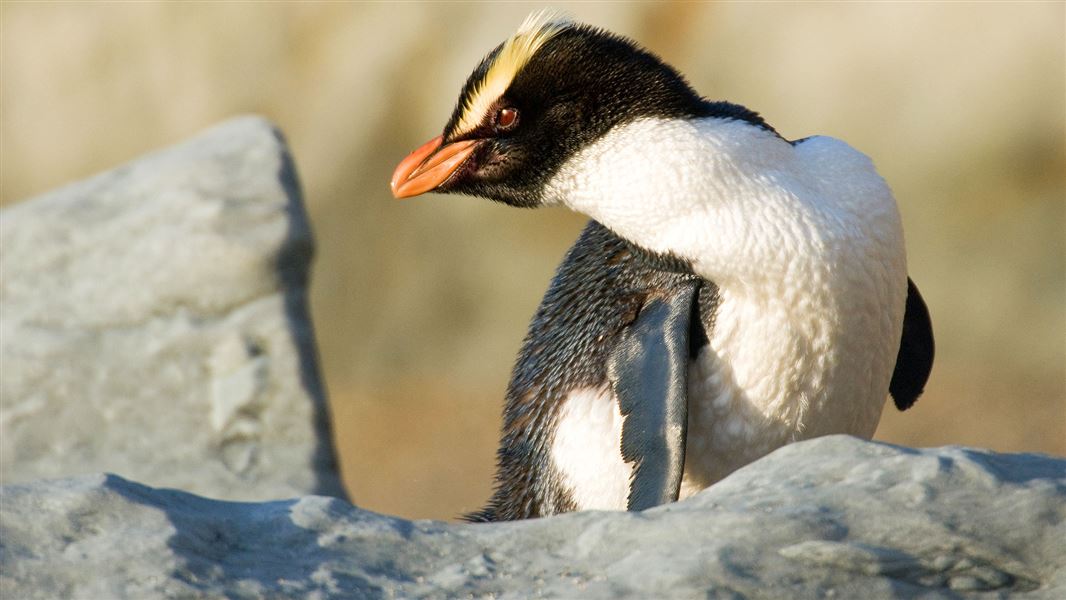
New Zealand status: Endemic
Conservation status: Declining
Threats: Dogs, human disturbance, climate changes
Species information: Fiordland penguins on NZ Birds Online
Did you know?
Two eggs are laid – the first is smaller than the second, and they are laid 3-6 days apart.
Fiordland crested penguin conservation
The current tawaki population is between 2,500 and 3,000 breeding pairs and has been in decline since the 1950s.
Human disturbance and predation
Tawaki are highly susceptible to human disturbance when nesting. There is a concern that increased nature tourism in South Westland and Fiordland may disturb breeding birds and cause nests to fail.
Stoats and dogs pose a serious risk to tawaki colonies. Stoats prey on both chicks and sick or injured adults, while a single dog has the potential to wipe out an entire colony.
Spotting tawaki
You can spot tawaki at Munro Beach, near Lake Moeraki 30 km north of Haast. A walking track leads from Lake Moeraki to the beach, and guided tours are conducted from the Lake Moeraki Wilderness Lodge. Tawaki can also be seen in Milford Sound and at Jackson Bay.
The best time of year to see tawaki is during the breeding season from July to November. They can sometimes be seen during the moulting season from mid-January to early March.
Tawaki are very timid, so do not approach birds, nests or areas of beach where penguin tracks are common.
Keep our penguins safe
- Leave penguins alone. Usually scruffy birds are simply moulting.
- Put your dog on a leash around penguin areas.
- Keep your dog away from nests, and warn others nearby of the location.
- Donate your time or money to help penguin protection groups, such as the Yellow-eyed Penguin Trust and Forest & Bird.
H5 bird flu and penguins
Risk from H5 bird flu
We don’t know exactly how H5 bird flu will affect New Zealand’s native species. Birds that breed in dense colonies, such as red and black-billed gulls, gannets and terns, may be especially vulnerable. This includes penguins that nest in colonies. H5 bird flu can affect little penguins, as well as other wild birds.
Work to protect penguins
Work to manage the risk of H5 bird flu focuses on increasing the resilience of wildlife populations and minimising its effects on vulnerable native wildlife.
For penguins, the best protection is good biosecurity, close monitoring, protecting breeding areas, reducing disturbance and continuing other conservation work like trapping that supports penguin populations.
If H5 bird flu becomes established in New Zealand wildlife, eradication will not be possible. Support to help native species survive and adapt to live with this virus in the long term will be important.
Reducing other pressures on native species can help their populations withstand losses from disease.
Vaccination
Vaccination may be considered for highly threatened native birds when the loss of individuals to H5 bird flu puts them at risk of extinction. Vaccinating wild birds requires significant intervention and handling. More than one dose is needed, and the protection only lasts about six months.
Kororā are not a priority for vaccination because they are not at risk of extinction from H5 bird flu. This may be disappointing for groups that care for local kororā colonies.
Kororā are not classified as threatened in New Zealand, but they face pressures from predators, habitat loss, and disturbance by people and dogs. H5 bird flu may cause losses, but the population is considered large enough to withstand this.
Management plans will be adapted if the disease risk for kororā changes significantly.
You can help
Keep a watch out for signs of H5 bird flu:
- Report any sick or dead wildlife in a group of three or more to MPI on 0800 80 99 66.
- Do not touch or collect sick or dead wildlife to avoid spread of the virus and protect yourself. Keep your dogs and cats away from wildlife.
- If a penguin is injured or in immediate danger, contact DOC’s wildlife emergency hotline – 0800 DOC HOT (0800 362 468).
Contact
For more information about the Fiordland crested penguin/tawaki contact:
Awarua/Haast Visitor Centre
| Phone: | +64 27 303 4890 |
| Email: | haastvc@doc.govt.nz |
| Hours: | Visitor centre hours and services |