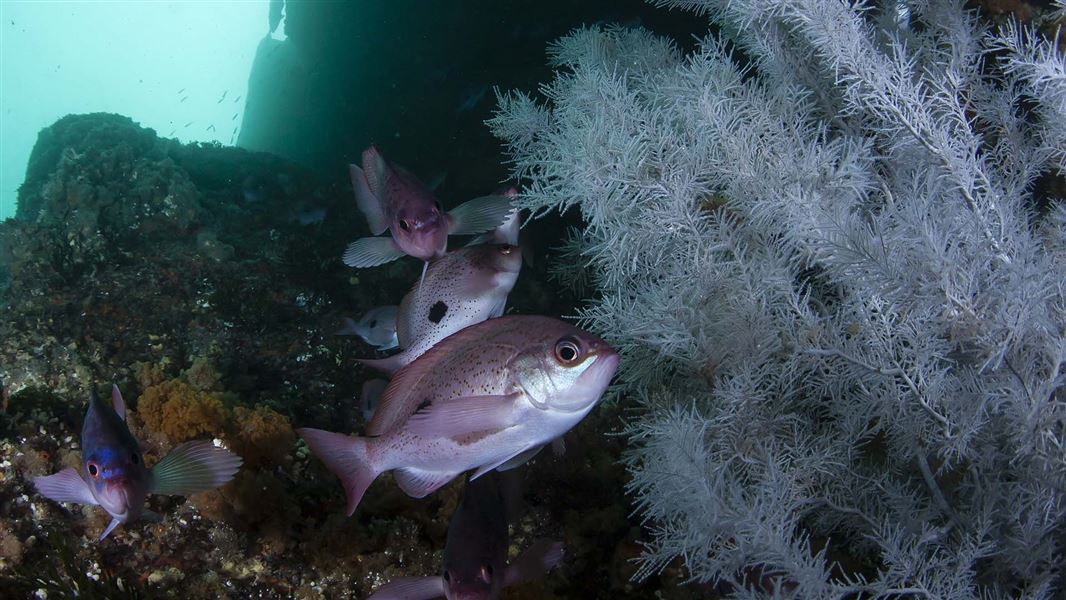
Identifying areas critical for marine biodiversity is essential for determining which parts of the ocean require enhanced protection. This process involves mapping locations that support rare species, unique habitats, or exceptionally rich ecosystems. Some environments – such as deep-sea coral gardens or hydrothermal vents – are naturally uncommon and can easily be overlooked. Highlighting these areas ensures they receive appropriate attention.
By integrating ecological data with advanced mapping techniques, DOC and its partners can pinpoint significant sites and make informed management decisions. The goal is to safeguard the most ecologically valuable parts of our marine environment for the long term.
Key Ecological Areas
The Key Ecological Areas (KEA) Programme is an initiative led by DOC to identify and map marine areas that are critical for biodiversity and ecosystem health in Aotearoa New Zealand.
Mapping key ecological areas in the New Zealand marine environment: data collation
Published: 2018
This report evaluates the availability of spatial datasets for mapping New Zealand’s key area criteria to inform protection and planning.
Mapping key ecological areas in the New Zealand marine environment: data collation (PDF, 7,185K)
Evaluating Key Ecological Areas datasets for the New Zealand marine environment
Published: 2020
This report assesses and updates priority key ecological area datasets for marine conservation that were identified in 2018.
Evaluating Key Ecological Areas (KEA) datasets for the New Zealand Marine Environment (PDF 6,430K)
Application of the Key Biological Area (KBA) process to identify Key Ecological Areas
Published: 2022
This report evaluates how the international Key Biological Areas (KBA) framework can be aligned with New Zealand’s Key Ecological Areas (KEA) criteria to identify and delineate marine areas of high conservation value.
Application of the Key Biological Area (KBA) process to identify Key Ecological Areas (PDF, 1,534K)
Marine biodiversity framework for Aotearoa New Zealand
Published: 2023
This report presents and applies a framework for mapping the key ecological area Biological Diversity criterion using three different methodologies applied to five high-level including macroalgae, seabirds, demersal fish, benthic invertebrates and cetaceans.
Marine biodiversity framework for Aotearoa New Zealand: Biological diversity mapping (PDF, 20,597K)
Marine Biodiversity framework – expert evaluation of Biological Diversity maps
Published: 2024
This report provides an independent expert review of maps for the Biological Diversity criterion developed in 2023, assessing their accuracy and usefulness for guiding marine conservation and spatial planning decisions.
Marine Biodiversity framework – expert evaluation of Biological Diversity maps (PDF, 3,289K)
High Value Biodiversity Areas
The high-value marine biodiversity areas project is mapping and identifying ecologically and biologically significant marine sites throughout New Zealand to provide data for conservation efforts, supporting government, iwi, industry, and communities in decision-making regarding species, habitats, and ecosystems.
Current project
Naturally uncommon marine ecosystems
Despite their small size, naturally rare ecosystems contain a high proportion of endemic biodiversity which is also often threatened. However, there is no formal process to assess marine ecosystems in terms of their rarity and/or threat status in NZ, compared to terrestrial rare ecosystems where this exists. This project will lead to identifying rare ecosystems at a national scale, providing an evidence base for advocacy and planning.
Current project