Support our work
Kākāpō are critically endangered. Adopt a kākāpō or donate to Kākāpō Recovery to support the conservation of one of New Zealand's rarest and most unique birds.
Rakiura nest live stream
To start the live stream, click on the 'play' button above or view on DOC's YouTube Channel. For the latest information and FAQ's check out the YouTube description.
Kākāpō Cam is live from Whenua Hou/Codfish Island, a small, remote island near the bottom of the world. If the live stream drops out briefly now and then, that’s just island life.
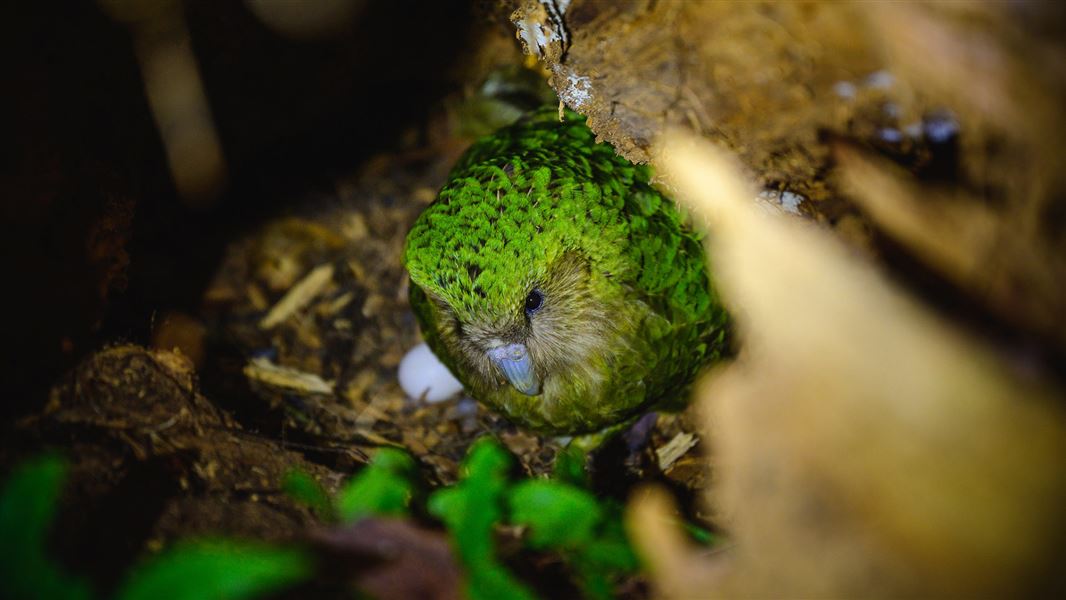
You’re looking at the underground nest of 23-year-old Rakiura. She has chosen this same site to nest for all seven breeding seasons since 2008, a large cavity under a rātā tree. Because she returns to the site so reliably, we’ve been able to make modifications over the years to keep it safe and dry, including adding a well-placed hatch for monitoring eggs and chicks.
There’s still much to learn about these nocturnal, elusive parrots, and Kākāpō Cam supports insights that help guide us to support their recovery. Through this Kākāpō Cam, we hope to gain greater insight into female nesting behaviour.
What you might hear
Kākāpō are nocturnal, but when Rakiura is out exploring and finding food you can watch and enjoy the natural soundscape of Whenua Hou.
By day, you may hear bellbird/korimako, tūī, fernbird/mātātā, long‑tailed cuckoo/koekoeā, brown creeper/pīpipi, yellowhead/mohua, tomtit/miromiro, red‑ and yellow‑crowned kākāriki, kākā, grey warbler/riroriro, fantail/pīwakawaka, silvereye/tauhou, swamp harrier/kāhu, and sacred kingfisher/kōtare. Non‑native visitors include Eurasian blackbird/manu pango, Eurasian skylark/kairaka, various finches and common redpoll.
At night, you may hear sooty shearwater/tītī, mottled petrel/kōrure, Cook’s petrel/tītī, ruru/morepork and sometimes kākā become active.
You may also be able to see a southern lesser short-tailed bat.
Kākāpō nesting
After kākāpō mate the male's work is done. Around a week later the female will start to lay one of up to five eggs (usually about three days apart). They typically incubate the eggs for about one month before the chicks are ready to hatch.
Once hatched, the chicks stay in or very close to the nest for about three months, relying entirely on mum for protection and food. After fledging (leaving the nest), they continue to depend on their mother for another three months or so. During this time she still feeds and looks after them until they begin to forage independently.
Rakiura the kākāpō
Rakiura hatched on 19 February 2002 on Whenua Hou/Codfish Island. She is the offspring of Flossie and Bill. Her name comes from the te reo Māori name for Stewart Island, the place where most of the founding kākāpō population originated.
Rakiura has nine living descendants, three females and six males, across six breeding seasons. In 2008 came Tōitiiti, in 2009 Tamahou and Te Atapō, in 2011 Tia and Tūtoko, in 2014 Taeatanga and Te Awa, in 2019 Mati-mā and Tautahi. She also has many grandchicks.
2026 breeding activity:
- 15 January: Rakiura mated with Kōmaru
- 21 January: Rakiura was artificially inseminated using sperm from Bluster Murphy, Moss and Gaupo
- 22 January: First egg laid at approximately 4:30 pm (not live)
- 23 January: With Rakiura now committed to this nest, Kākāpō Cam goes live
- 25 January: Second egg laid at approximately 3:00 pm
- 28 January: Third (and final) egg laid at 2.36 pm
- 1 February: Nest check reveals three fertile eggs. Egg 1 and 2 are taken in for incubation. Two eggs remain in nest (Egg 3 and an infertile egg from Tohu).
- 7 February: Egg three also swapped with infertile egg and moved to incubator to join her other two eggs.
- 11 February: Early embryo death of Rakiura-A1 (egg 1) reported. Egg 2 and egg 3 both still doing well in incubators.