Date: 12 November 2026
Bats Beyond Borders, the Department of Conservation-led research programme supported by Air New Zealand, aims to collect highly detailed information about where long-tailed bats travel, forage, and roost.
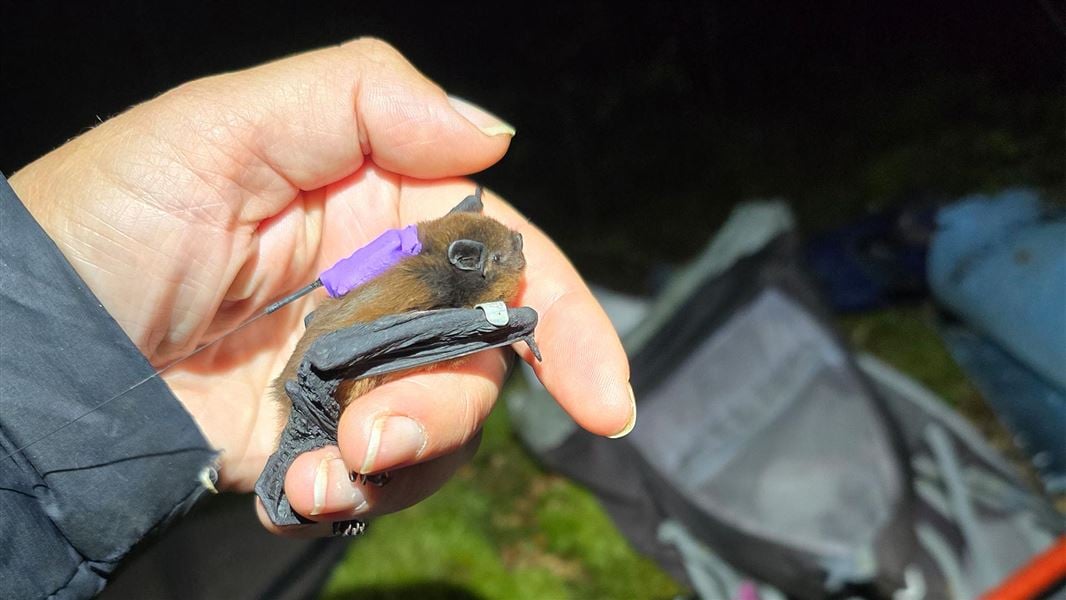
The bats, weighing up to 12 grams each, will carry transmitters weighing just one gram – the weight of a raisin. These connect to a network of 20 base stations that have been set up across the Eglinton valley in Fiordland. Researchers will receive each bat's location every 30 seconds for around 12 days, depending on the tiny rechargeable battery life.
Established in 2025, the three-year programme which is supported by Air New Zealand successfully piloted the new tracking system on seven bats last summer.
DOC project lead Dr Emma Williams says the breakthrough technology is an exciting step for conservation.
“This is the first time we've had GPS trackers small enough to attach to bats and show their fine-scale movements. Up until now we’ve only been able to attach VHF trackers, which require us to physically follow and locate bats to understand where they go and what resources they need. This method was problematic as it's common for bats to out-pace us and fly faster than a vehicle.
“This technology gives us a window into the secret lives of bats. These remarkable nocturnal mammals spend most of their lives out of sight, but we're now able to see in very high detail where they go, how they behave, and what they need to thrive – all while the rest of us are sleeping.”
“Bats Beyond Borders is a significant leap forward and a true team effort. We’re grateful to Air New Zealand for its funding, local landowners for hosting base stations, and Global Messenger for providing specialist expertise during installation.
“This research reflects the true spirit of naturing: giving back to the environment through meaningful action. We can use this information to better target predator control and habitat protection for bats.”
Long-tailed bats have the highest threat ranking – Nationally Critical. They live throughout mainland Aotearoa and its smaller islands, can travel up to 40 kilometres every night, and can even lift up to 80–100 per cent of their body weight.
Both long-tailed and short-tailed bat numbers are increasing in the Eglinton valley due to long-term predator control to suppress rats and stoats.
NATURE LOOKS DIFFERENT FROM HERE
Nature isn’t scenery. Nature is a society that we rely on for everything, every day. It’s behind our identity and our way of life.
Contact
For media enquiries contact:
Email: media@doc.govt.nz