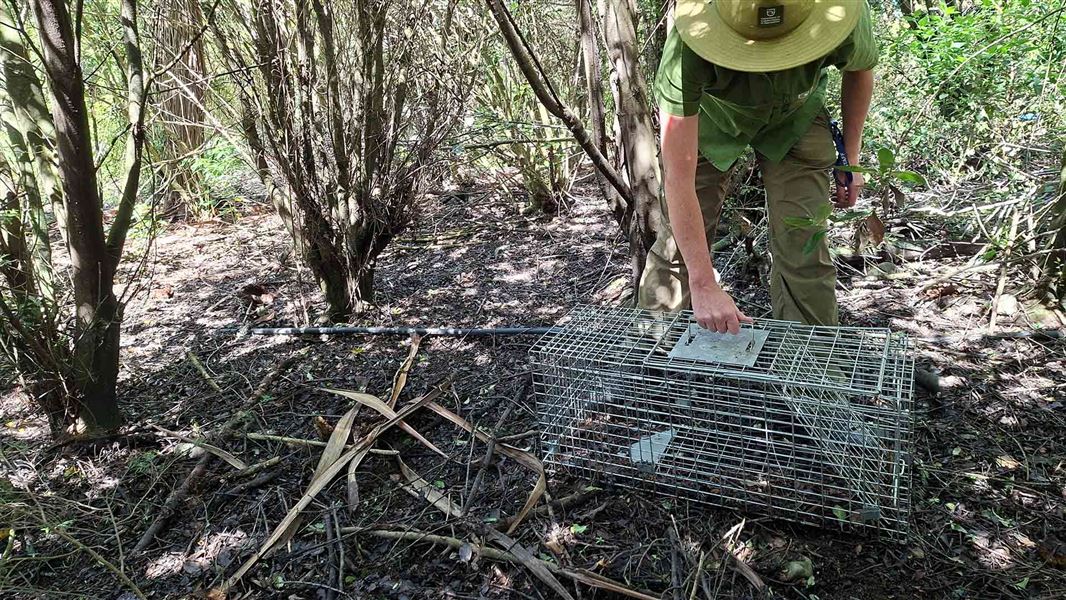
Cage and box traps are sometimes used where there is a risk to non-target animals accessing leghold traps or kill traps. Cage and box traps allow non-target animals to be released, usually without unreasonable harm to them. For example, you may choose to consider a cage trap in areas where domestic cats are present.
Legholds are often used by people targeting possums for fur. They are sometimes used for feral cat control in remote locations where there is no risk to domestic cats. Some leghold traps are prohibited by the Animal Welfare (Leg-hold Traps) Order 2007.
Refer to MPI guidance for what leghold traps can be legally used
If ground dwelling birds like kiwi or weka are present, leghold traps need to be set raised beyond their reach (700 mm off the ground for kiwi, 1000 mm for weka). An alternative for excluding kiwi (not weka) is presented in a particular trap cover design (‘chimney’ box cover) that excludes kiwi but allows access to feral cats.
Read more about site-specific factors
Legal requirements
Legal requirements have been set in place for live capture trapping to ensure that an animal does not suffer unreasonably. These rules ensure that traps are not left set without being checked regularly and any animal caught can be either released or dealt to quickly.
By setting live-capture traps, you are bound by the requirements set out in Section 36 of the Animal Welfare Act 1999. This includes that a person must:
- Manually inspect that trap, or cause a competent person to manually inspect that trap, within 12 hours after sunrise on each day the trap remains set, beginning on the day immediately after the day on which the trap is set;*
- remove, or cause to be removed, any live animal found in that trap; or attend properly to the care of the animal or, without delay, kill the animal.
There are significant penalties and legal ramifications if these rules are not followed correctly.
* There are separate requirements for people using a remote reporting system.
Humane methods of killing live trapped animals
The aim is to ensure live trapped pest animals are killed as humanely as possible, that methods are safe and practical for the trapper, and non-target captures are dealt with appropriately.
The most appropriate method of dispatch will be dependent on several factors including:
- The physiology/biology and typical behaviour of the species when they are live trapped.
- The type of trap you are using and the access it provides to the animal.
- The environment of the trapping area (e.g. peri-urban or rural), which will determine if firearm methods are allowable.
Advised methods for killing live trapped animals include shooting or blunt force trauma. But, it is the trapper’s responsibility to ensure they meet all their obligations under the Animal Welfare Act 1999. Before committing to live capture trapping, people should familiarise themselves with their obligations about animal welfare and ensure they are able to safely and responsibly kill live-trapped animals and manage potential non-target captures.
Refer to the Guide to humane killing of small pest mammals from live capture traps. (PDF, 656K).