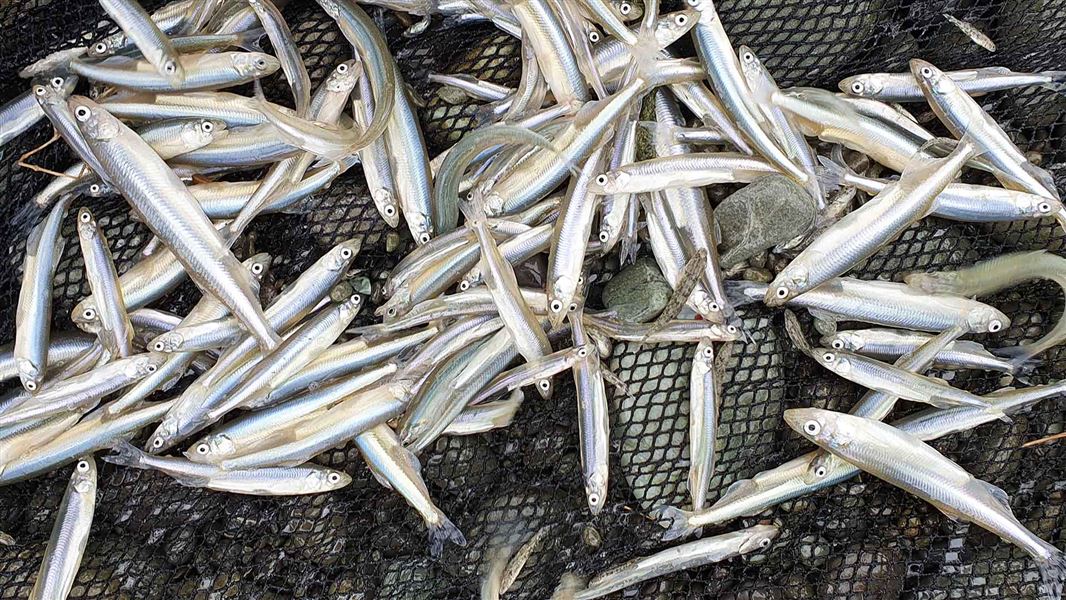
Smelt are small, shimmering, silver fish that form shoals in estuaries and rivers near the coast. They spend most of their lives at sea, but come back to rivers and streams in spring and summer to spawn. Some smelt return as juvenile fish, but most return as adults when they are about 100 mm long.
Both species look similar and it can be hard to tell them apart. Stokell’s smelt have smaller, finer scales than common smelt. Smelt found on the Canterbury coast can be either Stokell’s or common smelt, while those in the rest of the country are likely to be common smelt.
Some whitebaiters call smelt ‘silveries’ because of their distinctive colour or 'cucumber fish' because they smell like cucumber.
Smelt species
Common smelt
New Zealand status: Native
Conservation status (as at 2023): At Risk – Declining
International conservation status (as at 2014): Least concern (IUCN)
Found: Throughout New Zealand including Stewart Island/Rakiura, Chatham Islands/Rēkohu/Wharekauri.
Threats: Sedimentation in spawning habitat.
Common smelt (Retropinna retropinna) are found in estuaries, rivers and lakes throughout New Zealand. Some of the lakes are landlocked and these smelt have a different lifecycle to other smelt, and complete their whole lifecycle in the lake. In some lakes, common smelt were introduced to provide food for trout.
Adult fish are usually 90–100 mm long and the largest recorded was 165 mm.
Stokell's smelt
New Zealand status: Native
Conservation status (as at 2023): Threatened – Nationally Critical
International conservation status (as at 2014): Least concern (IUCN)
Found: East coast of the South Island in Canterbury, mainly in hāpua and estuaries.
Threats: Habitat degradation, predation, reduced river flows, declining water quality and climate change.
Paraki/Stokell’s smelt – have you seen this fish? (PDF, 1,200K)
Location, size and lifecycle
Stokell’s smelt (Stokellia anisodon) are only found near the coast in hāpua and estuaries in Canterbury between the Waiau River in the north and the Waitaki River in the south.
The species has cultural significance for Ngāi Tahu for mahinga kai (food gathering).
Adult fish are usually 70–85 mm long and the largest recorded was about 110 mm.
Population decline and response
In the past, Stokell’s smelt were found in large numbers and formed dense shoals as they migrated into Canterbury’s rivers. Recent surveys, however, show that their population has declined significantly since the 1980s, as reflected in their current conservation status of Threatened – Nationally Critical. The decline is thought to be caused by reduction and changes in river flows, river mouth connectivity, land use in the catchments, habitat modification, predation of eggs and adult fish, increased sedimentation and nutrients, and climate change.
In response to the decline, DOC convened a cross-agency workshop in November 2025 to develop a coordinated action plan for the recovery of this species.
Stokell's smelt coordinated action plan (PDF, 719K).
DOC is also partnering with Te Rūnanga o Arowhenua to find out more about Stokell’s smelt in Opihi and Rakitata hāpua.
eDNA samples are being used to confirm when Stokell’s smelt are moving into freshwater to spawn. Net surveys are also being carried out to find out when and where they spawn. This data is intended to inform and support long term work in Canterbury to help more young fish survive and manage threats to the species.