New Zealand status: Endemic
Conservation status: Lowland longjaw galaxias, Galaxias aff. cobitinis "Waitaki" (Waitaki River) – Threatened – Nationally Vulnerable
Lowland longjaw galaxias, Galaxias cobitinis (Kakanui River) – Threatened – Nationally Endangered
International conservation status: Critically Endangered (IUCN)
Found in: Braided sections of the lower Kauru and Kakanui rivers in North Otago and a handful of spring-fed tributaries and streams in the Waitaki River.
Threats: Predation by introduced fish and competition with native fish species, invasion of aquatic weeds (including monkey musk), reduction or alteration of water flows, gravel abstraction, poor water quality and habitat modification.
Image gallery
Habitat
Lowland longjaw galaxias (Galaxias cobitinis) thrive in cool springs and streams amongst the cobbles and gravels in the fast-flowing riffles of braided rivers.
Lowland longjaw galaxias have two closely related population that only live in small streams and spring-fed tributaries of the upper Waitaki River and Kakanui River systems in North Otago.
The few remaining populations are in the Kauru and Kakanui rivers in North Otago, and in a handful of spring-fed streams in the Mackenzie Basin. The lowland longjaw galaxias found in the Kauru and Waitaki catchments are genetically distinct from each other.
The adults need clean, ‘roomy’, movable substrates so they can burrow into the cracks and crevices between rocks. In winter, their young can be spotted in schools swimming in slower moving water, such as pools and backwaters.
Features
- Have a pencil-thin body and a long bottom jaw that extends from under their top lip.
- Are pale lemon colour with silver flecks lining their backs over dark brown splotchy patterns.
- Their outer eyes are sparkly gold in colour.
- One of the smaller species of galaxiid, typically growing up to 80 mm in length.
- They feed on small stream invertebrates such as mayflies and stoneflies.
- In the Kakanui they spawn from May to August, with juveniles recorded from June to January.
- In the Waitaki observations to date indicate spawning is later around August to December.
- They lay tiny 2 mm eggs in spring upwellings.
- Can live up to 3 years.
Threats
Their main threats are habitat loss from land development; the invasion of aquatic weeds (such as monkey musk), which clog waterways; and being eaten by introduced fish species such as trout. A combination of these threats recently caused the extinction of two lowland longjaw populations.
Changes in land use, such as stock access to streams, reduction of native vegetation, and forest harvesting are also contributing factors to its decline.
These land changes impact on the streams in which galaxiids live, increasing sedimentation, changing the natural flows through water abstraction, and reducing habitat available for spawning.
Find out how you can help non-migratory galaxiids.
Distribution
This map shows the known locations of lowland longjaw galaxias, as at 2013.
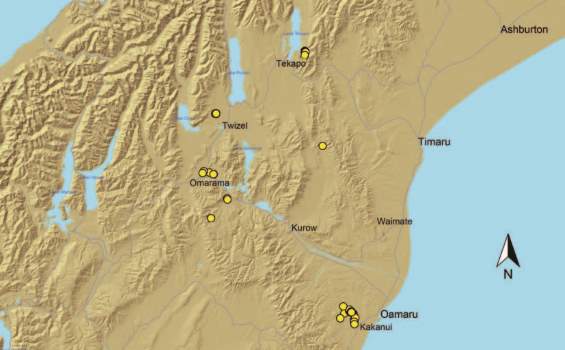
Source: New Zealand freshwater fish database