
Royal Cam follows northern royal albatross/toroa nesting at Pukekura/Taiaroa Head, near Ōtepoti/Dunedin. The camera captures different stages of their breeding cycle, from courtship and egg laying to chick rearing and fledging.
Northern royal albatross are long-lived seabirds that usually stay with the same breeding partner for life. After fledging, young birds spend 4 to 10 years at sea before returning to the colony. They return to socialise, practise courtship and eventually breed.
Watch videos about what to expect on Royal Cam by month:
- September-OctoberFledging and new nests
- November-DecemberLaying and incubating eggs
- JanuaryHatching chicks
- FebruaryPost hatching and guard stage
- March-AprilFeeding, play and curious juveniles
- May-JuneSex characteristics and adult feathers
- July-AugustBanding and preparing to fledge
September and October: Fledging and a new breeding season
Fledging
Chicks fledge when they are about 7.5 months old, at an average age of around 240 days.
Wind direction and the chick's location in the colony can affect where it takes off. This means not every fledging will be visible on Royal Cam.
Once young toroa leave the colony, they spend several years at sea before returning.
A new breeding season begins
Adults return to the colony after about a year at sea to begin the next breeding cycle.
Male toroa establish and defend breeding territories and choose nest sites. A male may nest as close as 40 m of the location where he grew up.
Raising a chick requires a large amount of energy. Parents that successfully raise a chick generally spend the following year at sea recovering and do not breed that season. If a breeding attempt fails, the birds may return to breed the following season.
Courtship and pair bonding
Young toroa returning from sea gather in social groups known as gams. Here they learn and practise courtship displays and interact with potential mates.
Courtship displays include:
- sky-pointing
- sky-calling
- ecstatic displaying (sky calling and head waving with wings out)
- mutual preening
- bill snapping and rattling.
As a pair bond develops, these displays become a distinctive way for the two birds to communicate and recognise each other when they return to breed.
Young birds often return close to where they hatched. They also move around the colony and practise courtship displays with other young birds.
Recognition
Toroa use visual cues and calls to recognise their mates and chicks. Sky-calling is particularly important.
It is not known whether parents recognise their offspring when the young birds return years later.
Individual birds can have distinctive markings, but researchers generally use identification bands to identify birds reliably.
Nest building
At the start of the breeding season, males establish and defend territories. Once a pair settles on a site, the female builds most of the nest.
Birds that are not breeding may also build incomplete nests. Older chicks sometimes make nearby play nests as they become more mobile.
November and December: Egg laying and incubation
Egg laying
Each female lays one egg during a breeding attempt. Egg laying takes place over several weeks across the colony.
Checking whether eggs are fertile
DOC rangers candle eggs using a specialised light in a dark location to check whether an embryo is developing. Visible blood vessels are a sign that development is underway.
Incubation
Both parents take turns incubating their egg. A parent may stay on the nest for days at a time while its partner feeds at sea.
Incubation lasts about 79 days on average.
If a changeover is delayed for too long, DOC rangers can intervene to protect the adult and the egg.
When a parent is away for too long
DOC rangers closely monitor incubating birds. If necessary, they may:
- move the egg to an incubator and temporarily replace it with a dummy egg
- provide fluids or supplementary food to the adult
- foster an egg to another nest in some circumstances.
These actions help protect the egg and adult while giving the returning parent a chance to resume normal incubation.
January and February: Hatching and guard stage
Hatching
Eggs usually begin hatching in January. Hatching is a slow process, and a chick may take several days to emerge fully from its shell.
Protecting chicks from flystrike
Flies pose a serious threat to hatching chicks. Flies can lay eggs on a hatching egg or chick, and the resulting maggots can be fatal.
DOC rangers move hatching eggs into incubators and leave a dummy egg with the parent. Rangers also treat nests and chicks with a bird-safe insect treatment. Once a chick has hatched, it is returned to its parent.
Guard stage
During the first few weeks of life, one parent remains with the chick while the other searches for food at sea. The parents take turns feeding and guarding their chick.
Chicks are fed regurgitated food that they need to beg for. A newly hatched chick does not need its first meal immediately because it continues to absorb nutrients from its yolk sac. When the chick first begs it triggers a hormone change in the parents which turns the bill pink. The pink remains until after the chick fledges.
Feeding and chick growth
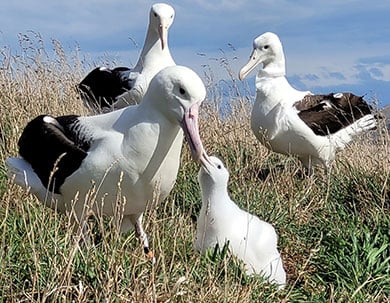 Toroa parent feeds its chick while adolescents watch
Image: DOC
How adults feed chicks
Northern royal albatrosses regurgitate food for their chicks.
A section of their digestive system called the proventriculus concentrates food by removing much of its water. This leaves an energy-rich mixture containing fish oils and pieces of prey such as fish and squid.
This concentrated food helps chicks stay nourished for several days between meals.
After the guard stage
Once chicks are older, both parents spend more time foraging at sea and chicks can spend long periods alone at the nest.
There is no predictable schedule for feeding visits. Weather and conditions at sea, particularly wind, affect how quickly adults can travel between feeding areas and the colony.
DOC rangers monitor chick condition and may provide supplementary food if a chick needs it.
Keeping warm and cool
Staying warm
Adult toroa use a specialised brood patch to transfer body heat to their egg or young chick. Small chicks shelter beneath their parent for warmth and protection.
Staying cool
Hot weather can put both adults and chicks under stress. Adults may pant, stand to expose their legs and feet, or use their bodies to shade their chicks.
DOC rangers can also use sprinklers to help cool nesting birds during hot conditions.
Curious juveniles and play nests
As chicks grow and become more mobile, they may start building play nests near their original nest.
Young toroa returning to the colony may also visit nesting areas as they socialise and learn breeding behaviour.
These visits are usually harmless, but they can sometimes cause a chick to respond defensively by vomiting fish oil. Oil on a chick's down can affect the feathers' ability to keep it dry.
May to August: Preparing for independence
Physical development
As chicks grow, adult feathers gradually replace their fluffy down. Differences between males and females also become more noticeable, with males generally growing larger and heavier.
Banding
Before chicks fledge, DOC rangers fit them with identification bands. These allow researchers to identify birds when they return and follow individuals throughout their lives.
Preparing to fly
Before fledging, chicks practise the skills they need for flight. You may see them:
- stretch and flap their wings
- face into the wind
- lift or hover above the ground
- make short practice flights.
After fledging: Life at sea
After fledging, young toroa spend several years almost entirely at sea.
Dynamic soaring
Albatrosses use a highly efficient flight technique called dynamic soaring. They use changes in wind speed above the ocean to gain height and speed.
This allows them to travel thousands of kilometres while using relatively little energy and with little wing flapping. They can also rest while floating on the ocean.
Feeding
At sea, toroa feed on marine prey such as squid, octopus and fish. 70% of the diet is squid. Prey is found on the ocean surface or up to 1m below the surface. Albatross do not dive for food.
Threat from plastic
Plastic pollution is a threat to seabirds. Marine organisms growing on floating plastic can make it smell like food and increase the chance of a bird swallowing it.
Swallowed plastic can harm a bird's health and take up space that would otherwise be available for food.