Visitor safety management overview
Visitor safety cannot be managed everywhere
DOC administers approximately 30% of New Zealand's land area – around 8 million hectares. Much of it consists of remote wilderness. Therefore, visitor safety cannot be managed across all PCLW.
DOC’s visitor safety management efforts apply only within managed visitor sites. Beyond these areas, DOC cannot effectively manage risk to visitors, so visitors must take full responsibility for their own safety.
A ‘visitor site’ is a location on PCLW with the following attributes:
- non-commercial visitor infrastructure is provided by DOC or an authorised third party, or
- non-commercial visitor infrastructure is provided by DOC or an authorised third party to access it, and/or it is part of the visitor experience being offered. Even if the location that is accessed has no visitor infrastructure or is not on PCLW. For example, the beach at Cathedral Cove.
If a location does not have these attributes, visitor safety management is not applied. However, visitor safety information may be provided through wider safety initiatives like the outdoor safety code, publicly available weather forecasts, avalanche advisories and other website information.
Outdoor recreation always involves some risk
Even at managed visitor sites, outdoor activities always involve some risk. DOC doesn't try to eliminate all risk, as making sites completely safe would not be reasonably practicable, would damage natural and cultural values and limit visitor freedom.
Visitor safety management is scaled
DOC manages risk to an acceptable level for the type of visitor site against set risk thresholds. Easier sites for less skilled visitors have more safety features like bridges and barriers, while more challenging sites for experienced visitors have fewer safety measures and higher risk.
Visitors should choose activities that match their skill level and risk tolerance. They are responsible for their risk tolerance decisions.
Where inexperienced visitor use is resulting in incidents at visitor sites for advanced skilled visitors with inherent challenges and hazards, DOC provides additional information to help visitors make informed decisions and decide whether the site is suitable for them. However, we do not usually change the track classification or add safety infrastructure that doesn’t match the natural environment and intended use of the site.
How we manage risk at our visitor sites
There are three acceptable risk thresholds for visitor sites on PCLW. The thresholds correspond to the type of visitor site and its intended use.
- Lower risk threshold and highest level of safety infrastructure:
Short walks, walking tracks, grade 1-2 cycle trails, campsites and amenity areas. - Medium risk threshold and moderate level of safety infrastructure:
Easy tramping tracks including Great Walks, and grade 3-4 cycle trails. - Higher risk threshold and lowest level of safety infrastructure:
Tramping tracks, routes, and grade 5-6 cycle trails.
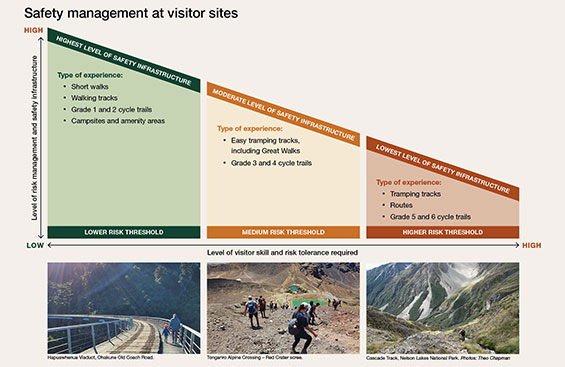
Visitor safety graphic. View larger image (JPG, 293K)
Image: DOC
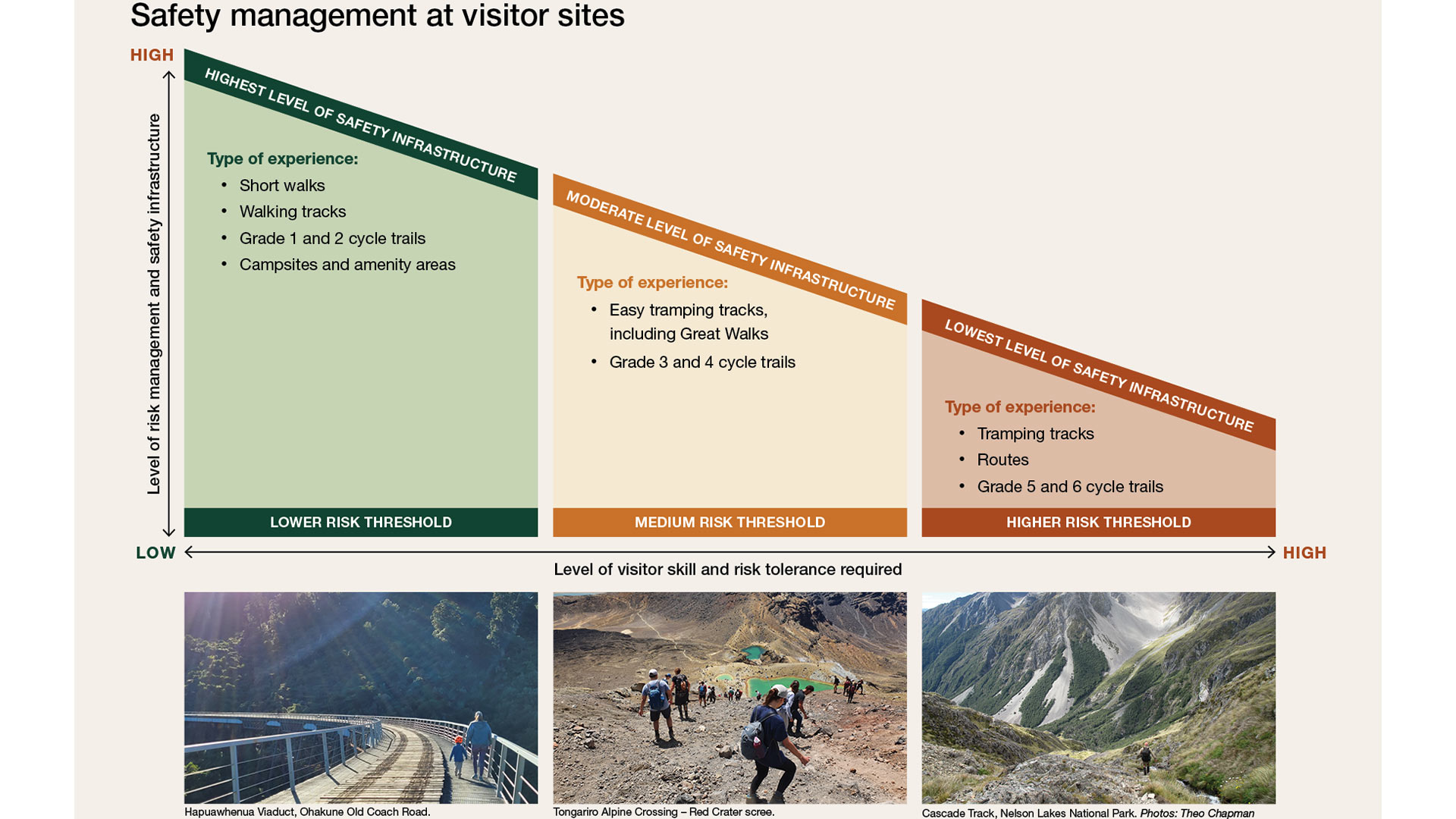
Our visitor safety management policy
The policy is based on the understanding that effective risk management in outdoor recreation is a joint undertaking of DOC and the visiting public.
The visitor safety policy describes the visitor safety responsibilities of DOC and visitors.
What DOC is responsible for
- Managing visitor sites to acceptable risk levels for the type of site.
- Identifying significant site-specific hazards at visitor sites and informing visitors about them.
- Communicating the skill level needed for visitors to manage their safety at visitor sites.
- Working with others where appropriate to improve visitor safety management at visitor sites.
- Ensuring visitor infrastructure meets legal requirements.
What visitors are responsible for
- Selecting visitor sites that fit their skill level and risk tolerance.
- Having the competence and equipment to manage their safety at the visitor site they select.
- Making risk tolerance decisions, including decisions to go into areas where no visitor infrastructure is provided, or to undertake inherently risky activities.
- Identifying and managing hazards that are commonly encountered in natural areas.
- Applying the above responsibilities to those under their care.