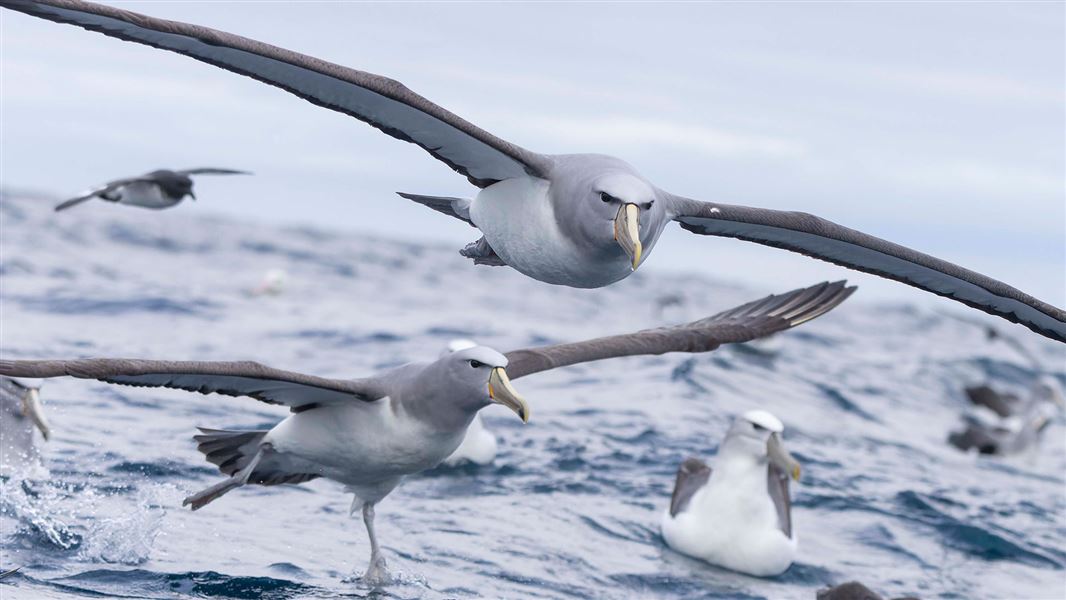
Like fishers, seabirds depend on the ocean for their livelihood. They spend their whole lives at sea catching fish for themselves and their young. The only time they come to land is to lay an egg and raise their chick.
Seabirds include albatrosses and their smaller cousins, petrels and shearwaters. Threatened seabirds include:
- Antipodean albatross: Endangered. Down 63% since 2003. Declining 6% each year.
- Gibson’s albatross: Endangered. Down 52% since 2004. Declining 4% each year.
- Southern royal albatross: Vulnerable/Endangered. Down 36% since 1998. Declining 2% each year.
- Salvin’s albatross: Vulnerable. Down 70% since 1978. Declining 4% each year.
- White-capped albatross: Vulnerable. Down 45% since 2006. Declining 5% each year.
Image gallery
What is seabird bycatch?
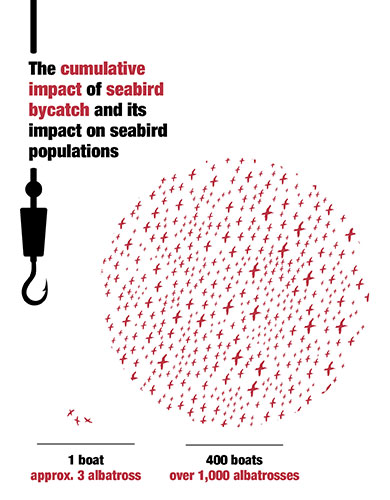
Graphic showing the cumulative impact of seabird bycatch
View larger (JPG, 390K)
Sometimes seabirds mistake bait on a hook for a meal and are accidentally hooked and drowned. This is known as seabird bycatch.
In the Southern Hemisphere alone, between 30,000 and 40,000 seabirds die each year on hooks set to catch tuna and swordfish.
Many seabird populations are under threat of extinction. Bycatch in longline fishing is the top threat for the endangered seabirds such as the Antipodean albatross.
A single longline vessel may only accidentally catch 2-3 Antipodean albatross every year, which may not seem like a lot.
However, because there are more than 400 vessels fishing in the same waters as the Antipodean albatross, it is enough to cause the population to collapse, which is already happening
Seabird bycatch and tuna longline businesses
No one wants to catch seabirds. Hooks with seabirds don’t help fishers catch tuna and bait is expensive.
People who buy seafood care where it comes from and how it is caught. They don’t want marine wildlife injured or killed because of fishing. Many retail businesses only sell seafood caught in sustainable ways, like fishing that avoids catching seabirds, turtles and sharks.
Tuna and swordfish fisheries employ hundreds of thousands of people around the world. Many countries use fishing profits to keep people healthy and educated. It is important that tuna and swordfish fishing continues to provide this income.
Fishing companies are adapting to what seafood consumers want. This means using practices to keep seabirds safe.
How the Seabird-Safe Fishing Toolkit can help
The Seabird-Safe Fishing Toolkit helps businesses:
- adapt to customer expectations
- fish in seabird safe ways.
The toolkit is for tuna and swordfish fishing vessels using longlines. It is designed for fisheries in any ocean and for vessels approximately 24 meters or longer.
The seabird-safe practices included in the toolkit have been scientifically proven to work. Some practices used by fishers but not proven, like blue dyed bait and lasers, are not included.
The toolkit includes information about ways to monitor if seabird-safe practices are being used on vessels. Only monitoring methods that are independent are included to add trust and confidence to the results.