Image gallery
Te Au Roa o Te Rakihouia reflects a unique partnership between Kāi Tahu and the Department of Conservation dedicated to protecting and caring for a network of five new marine reserves along the southeast coast of Te Waipounamu.
This spectacular coastline supports some of the most endangered wildlife in Aotearoa New Zealand. Species include hoiho/yellow-eyed penguins, toroa/northern royal albatross and pakake/New Zealand sea lions. These species rely on a healthy marine environment.
The marine reserves protect a range of special environments, including:
- river mouths and estuarine areas
- coastal feeding and foraging zones
- sandy beaches, rocky headlands, dramatic volcanic cliffs and one of the region’s only boulder beaches
- striking Otago Schist rock pools, crevices and gutters
- an offshore seabird sanctuary
- unique canyon ecosystems
The protection of these marine environments enable scientific research, strengthen cultural practices, enhance recreation and tourism opportunities, and help safeguard biodiversity for generations to come.
Learn more about the marine reserves of Te Au Roa Rakihouia
I guess somebody had a dream a dream of creating an environment here off the coast of Te Tai-o-Āraiteuru that was beneficial to the whole community, not just to mana whenua. But as drivers of this wonderful project it's given us an opportunity to involve ourselves thoroughly in the process itself of being able to create a sustainable environment.
This is a project which involves everyone, and that must be a good thing that everyone is actually talking to each other and working for, in this case, the marine reserves off our takutai moana. But sitting that alongside our mātaitai, our taiāpure and the commercial as well.
The name is Te Au Roa o Te Rakihouia and that is a traditional ancient name, actually, the son of one of the first navigators to arrive on these lands, Te Waipounamu. And he journeyed down the east coast of Te Waipounamu to just north of here exploring identifying places where they could live and sustain themselves. So of the waka Uruao, a very old ancestral name.
He left his son, Te Rakihouia to navigate back up the coast, which is why we see that name as appropriate to sit back on the, the marine landscape that's behind us.
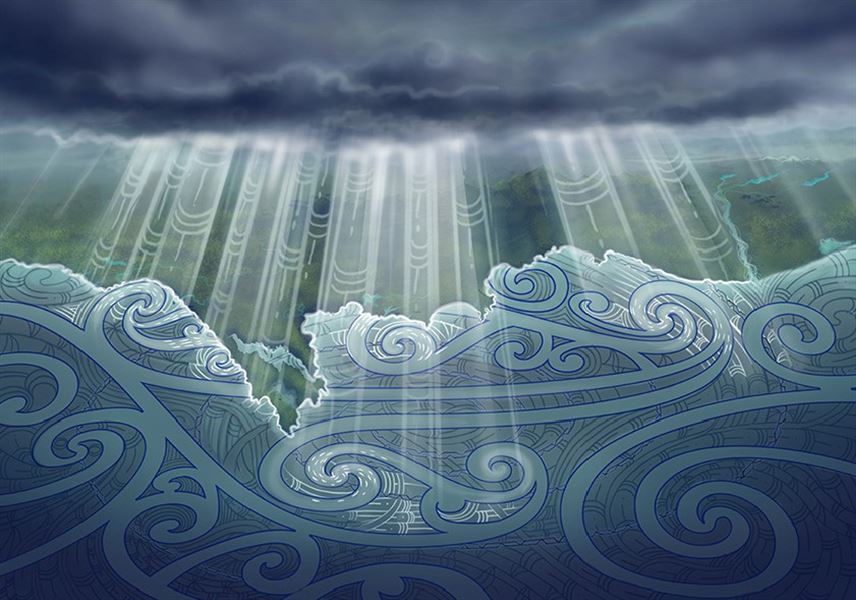
So the long current of Rakihouia here represents the coastal current which comes from the south up the east coast of the South Island here, and is a very good representation of the, what was called the East Otago Marine Protected Areas process. Te Au Roa, long current of Rakihouia is a whole lot more poetic name to my mind to apply to this wonderful project.
I think the current that sustains life in the moana off the Te Tai-o-Āraiteuru coast is that Murihiku current. And the Murihiku current is a feeder. It supplies the sustenance for all of those wonderful taoka we have that survive and sustain us generationally off this coast. It's really, really important that that feeder current supplies all those nutrients, whether they're the huge whales that come up and down this coastline, or whether it's the periwinkles and the cockles and the mussels. They're all the same. They're all fed by that the sustenance from that current.
The significance of the gift of this name is really important. It symbolizes the partnership. It symbolizes the work of the forum in terms of that collective approach to the moana and protecting the moana and all of the ecosystem that it obviously nourishes. And we feel really privileged to have this name and to bring to life as a state the partnership at place and the implementation of the marine protection.
The partnership that we have in relation to these marine reserves with the Department of Conservation is significant to the mana whenua. It's a first within New Zealand in terms of the co-management, working alongside, developing the monitoring and other mahi that goes on when we have rangers employed to do the work. So it was really significant, and the importance of it, it keeps us connected to that marine reserve.
This is an opportunity for this nation to understand that co-management is not a frightening description. It's an opportunity for mana whenua to be involved directly with a Crown entity, in this case Te Papa Atawhai, the Department of Conservation, and of course, Fisheries New Zealand to ensure that we are real true treaty partners, and that we have the opportunity to do something together that is hugely beneficial for this environment out here.
It also represents the ability to not only apply Western science, but also the value that can be added by adding another cultural perspective or way of viewing a marine environment, so bringing that matauraka to the fore. Also, we'll be working really carefully with communities that have played a key part throughout this, and other stakeholders as well.
I do think it's very important nationally because it has been an issue not only for Ngāi Tahu and mana whenua here, but for iwi generally across the country. Marine reserve legislation has tended to alienate mana whenua from their moana. And so this is quite significant in that respect in terms of building that working partnership and continuing engagement in the management, co-management of those marine reserves, monitoring and gathering data, and then putting, yes, the matauraka into the mahi. If we start from the south, I suppose, Akatore, just south of the Taieri mouth, there's a marine reserve along the coast. To the south, there's an island, Ōkaihae just to the south of us here. Ōrau, then it runs right down to Harekeke Point out on the Otago Peninsula. And then we've got the Papanui Marine Reserve taking in Papanui Canyon. And then to the north, right up to the Waitaki River, just south of and to the edge of the river is the, there's a marine reserve there. So there are five along the Otago coast.
The significance of the geographical locations is also to try and identify key ecosystems or environments across the moana, from estuarine systems, tidal lagoons, through to rocky reefs, through to deep canyons, bryozoan thickets, and large kelp forests. So it represents different portions of all of that. And I think the importance is as well, it only represents some of those areas.
So it's, it's really important that we ensure that those marine reserve networks actually function alongside the mātaitai. They function alongside the taiāpure.
Well, it's very important for us to remain involved, to be a part of that monitoring, gathering data. Also having our wānanga and engaging within those marine reserves so that we are actually there at the, at the table, so to speak. We're involved and able to bring our matauraka. And actually, the purpose is also to retain memory location hoarded or associated with these places and build on that going forward for, for future generations.
Give us 10 years of the establishment of these marine reserves, and you'll see two things happen. One, there'll be a huge enlightenment from the public of New Zealand. The importance is to ensure that the public of New Zealand understand what this kaupapa is all about. And secondly, that environment out there will recover. It will recover in lots of ways.
And what it'll allow us to do going forward is to be able to go back to this point in time and see and get clear measurable on what the benefits of, the marine reserves are. But it provides that opportunity to also compare those areas outside the reserves with the areas inside to make sure this is a tool that's working for us.
More than anything, just a far better knowledge of our takutai moana, the species and, and actually implementing sustainable management.
I think we have the opportunity here in Otago to really pave the way. I think, in terms of what these partnerships and working with the government in the wider sense can look like. We need models like that.
So we're really excited to what that will mean in the long run. And as it's already been stated, and it's for the community, and we will ensure that there is opportunities for all to play a part and to be involved, and ultimately to have a legacy that we're all really proud of, of what this means for protecting our environment, protecting our seas, and protecting all the species that call that home, so taking action for nature.
The concepts of kaitiakitanga, we are putting into practice in probably the most effective way in New Zealand. And that's what I think is really great. We're forging ahead with a new understanding, a new way of doing things, which hasn't quite been done the same way before.
We have become more engaged in our environment, in our waters, in our whenua. This process here in terms of the moana is a great opportunity to build on that for this generation, but more importantly, for future generations, so that we do really fully stand up and carry our responsibilities in a way that we're enabled through the process to work in partnership with the DOC, with community to do the best for our marine resources off the coast here.
Kāi Tahu partnership
This coastline lies within the takiwā of Kāi Tahu Whānui, encompassing the rohe moana of:
- Te Rūnanga o Moeraki,
- Te Rūnaka o Ōtākou,
- Kati Huirapa Te Rūnaka ki Puketeraki,
- Te Rūnanga o Arowhenua,
- Te Rūnanga o Waihao, and
- Āwarua Rūnanga.
Kāi Tahu maintain an enduring and functional relationship with this coastline – a vital source of life, food, and identity. This relationship is founded on whakapapa (genealogy) and kaitiakitaka (guardianship), with the coast regarded as a taoka (treasure) that links past generations to the present.
Kāi Tahu and DOC are working in partnership to co-manage Te Au Roa , the network of marine reserves. This recognises Kāi Tahu rakatirataka (authority) and kaitiakitaka (guardianship) alongside DOC’s Te Tiriti o Waitangi | Treaty of Waitangi responsibilities.
Te Au Roa will be cared for and monitored by Kāi Tahu and DOC rangers. Work will include education, surveillance and ecological and cultural monitoring.
Monitoring will support adaptive management into the future. It will allow decisions to be made based on environmental outcomes, scientific research and mātauraka Kāi Tahu. This will ensure the network continues to deliver lasting benefits for people, place and the moana.
Rakatirataka and kaitiakitaka – recognising Kāi Tahu customary rights
Special measures recognise the customary rights of Kāi Tahu and allow them continued access to the marine reserves to strengthen mātauraka moana (traditional maritime knowledge) through organised wānaka (sharing of knowledge).
The removal of Undaria pinnatifida and the retrieval of koiwi tākata (ancestral remains), artefacts and marine mammal remains by Kāi Tahu are also provided for.
Linking ancient voyaging with the coastal landscape
The name Te Au Roa o Te Rakihoua conveys the enduring ocean pathway (au roa ) of Te Rakihouia, son of the great explorer Rākaihautū.
Te Rakihouia was the first person to journey along and around the eastern coastline of Te Waipounamu, forging relationships with the bays, currents, fisheries and coastal landscapes of this region.
Part of a wider network
The marine reserves in Te Au Roa are the first in this region. They form part of a proposed network of 12 marine protected areas complementing existing mātaitai and taiāpure reserves. This network will protect key habitats, support biodiversity, and improve the long‑term health of the moana.
This kaupapa has been developed over more than 13 years through collaboration, partnership and commitment.
See new marine reserves for the southeast of the South Island for more information about the establishment of the proposed marine protection network.