2.4 km return via same track
Brochures
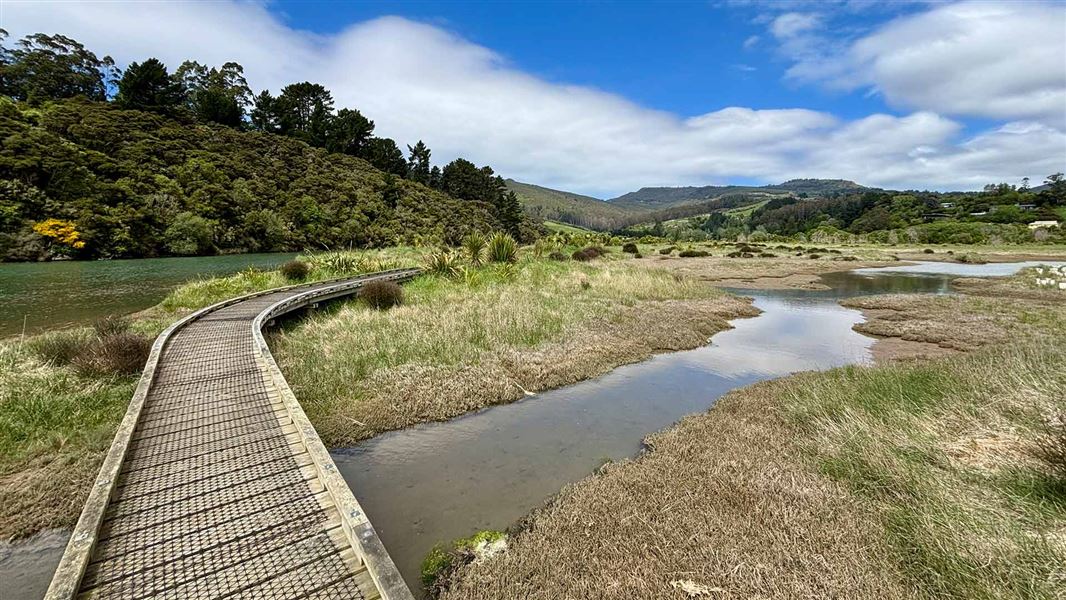
The Orokonui Creek walking track winds through native bush and lagoon environments in the Orokonui valley. It is flat, well-maintained, and suitable for all ages.
From the car park on Orokonui road, use the stile to cross the fence and follow signage to continue to the right, around the lagoon and wetlands.
After 500 m the track reaches an intersection with the Orokonui Lagoon Walk (not maintained by DOC). This encircles the lagoon and loops back to the car park.
To continue the Orokonui Creek track, follow signs through the gate and up the valley. The track continues up the forested Orokonui Creek for 700 m before ending at the Orokonui ecosanctuary boundary fence.
From here, return via the same track to the car park. Or you can continue around the Orokonui Ecosanctuary boundary track (not maintained by DOC) to go round the ecosanctuary. The ecosanctuary can only be entered via the visitor centre off Blueskin Road.
This track is accessed via the DOC car park on Orokonui road.
After turning off SH1 into Waitati, 20 minutes North of Dunedin, drive along Harvey Street for 600 m. Then turn left onto Orokonui Road and follow for 800 m to the sign-posted parking area on the left.
The track can also be accessed via the Orokonui Lagoon Walk or the Orokonui Ecosanctuary boundary walk (neither maintained by DOC).
- Track is open year-round.
- No rubbish or toilet facilities on the track, practice leave no trace and take all rubbish away with you.
- Biking is not permitted on the track.
- Fires are not permitted.
Private land
Track crosses private land – stay on formed track and be aware of moving vehicles.
Stock may be present on private land – be respectful and follow instructions from farm workers.
Flood risk
- Sections of track may be prone to flooding in times of high rainfall.
- Check weather forecasts before you go.
Your safety is your responsibility. Stay safe in the outdoors by following the Land Safety Code.
Tsunami risk
This track is susceptible to tsunami. If a siren sounds or a tsunami alert is received move to higher ground and stay away from the coast until the risk or alert period is over.
Thanks to efforts from local groups, the Halo project and Orokonui Ecosanctuary, the valleys biodiversity is being revitalised.
Large sections of the valley are being regenerated with native plants such as harakeke/flax, totara, and tī kōuka/cabbage trees. As well as this, large scale predator trapping efforts are being undertaken in the area.
These efforts have gone a long way to revitalising the wetlands and forests which existed here before European settlement. This also provides safe habitat for a large array of wetland and forest birds once displaced from the area.
Royal spoonbill/kōtuku ngutupapa, New Zealand falcon/kārearea, fantail/pīwakawaka, kākā, and many more native and introduced species can be seen from the track.
The Orokonui Lagoon was once a large flax swamp surrounded by native forest. The name Orokonui translates to "a healthy place", being a prime location for local iwi to gather food and supplies.
With the arrival of European settlers in the late 1850's the landscape was transformed. Between 1868 and 1875 a large-scale flax cutting operation wiped out the estuaries whole flax swamps to produce rope.
It is only now with large community efforts that these habitats are returning, as can be seen from the track.
DOC Customer Service Centre
| Phone: | 0800 275 362 |
| Email: | dunedinoffice@doc.govt.nz |
| Address: | Ōtepoti / Dunedin Office |