1 km return via same track
Brochures
This track starts from the Aramoana Domain on Moana Street. From the car park in the Domain, follow signs across the domain and past the playground to reach the signposted start of the track.
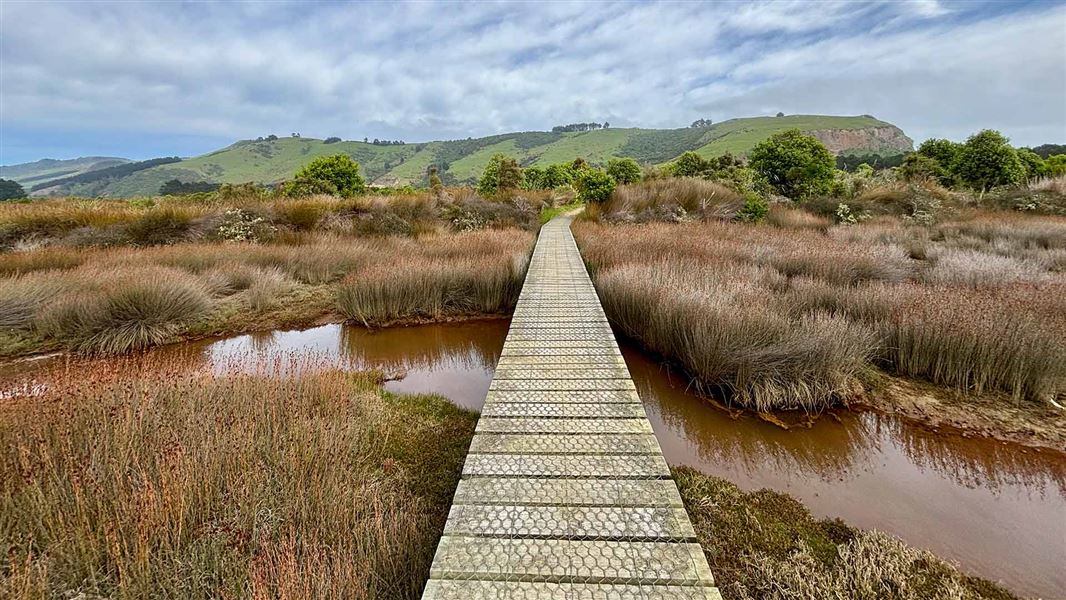
The track is a great option for all ages as it is very flat. It is a mixture of boardwalks and gravel paths. It winds through native dune and saltmarsh vegetation of the Aramoana Ecological Area.
The viewing platform at the end of the boardwalk is a great place to enjoy the rich variety of life on the saltmarsh. You can observe a variety of bird, fish, and invertebrate life on the mud flats, and watch the range of ships passing in and out of the harbour.
From the viewing platform return to car park via the same route.
From Central Dunedin follow SH 88 towards Port Chalmers. At the end of the SH 88, turn left and follow the road around the waterfront to Aramoana. The drive from Central Dunedin is roughly 25 km.
After entering Aramoana, follow Moana Street for 400 m and turn right into the Aramoana Domain car park.
The track starts from the far end of the Domain opposite the car park. It is sign posted.
Be aware of these track details
- No dogs allowed.
- No fires allowed at any time.
- No biking allowed.
- Toilets can be found at the Domain. Portaloos are available at Pari Street car park and Mole Road car park over the summer period.
- Be careful of the ongaonga (stinging nettle) that grows in places along the track.
- Practice leave no trace and take all rubbish with you.
Drone use
Be aware of restrictions on drone use in this area. There is a no-fly zone around Pukekura/Taiaroa Head which extends to part of the mole. Additionally, a concession is required to fly a drone on any public conservation land.
Tsunami risk
This track is susceptible to tsunami and rouge waves. If a siren sounds or a tsunami alert is received move to higher ground and stay away from the coast until the risk or alert period is over.
Ecosystem melting pot
The high biological production of saltmarshes is a result of the large volume of ocean water which irrigates the flats at each tide. Every day, thousands of tonnes of water flow into the marsh. This provides food for birds, nursery areas for fish and safe dwellings for invertebrates.
A rich community of snails, bivalves, anemones, worms and crustaceans thrive amongst the eel grass that grows on the low tide sand flats. Millions of cockles, amongst the largest in New Zealand, can be found. 80 species of moths have been recorded.
The large number of invertebrates and plant species in the sand flats provide food for large flocks of birdlife adapted to live in coastal wetlands. Birds commonly found in the area include migratory eastern bar-tailed godwit, spur-winged plover, banded dotterel, South Island pied oyster catcher, pied stilt, white faced heron and various species of ducks and gull.
Flora
The saltmarsh provides a habitat for a range of salt-tolerant plants. There are dense stands of glasswort, distinguished by its succulent stems. Thin, dark threads of eel grass, a favoured food for ducks, can be found.
On the upper marsh, jointed rush is growing, its rounded stems resembling bamboo. Thickets of shore ribbonwood can be found. The shore ribbonwood looks almost dead in winter. But comes to life in spring with small, narrow, coprosma-like leaves and delicate, white, five-petalled flowers. Flax is also thriving, encouraged by recent efforts to replant the area.
For more information see Aramoana area.
DOC Customer Service Centre
| Phone: | 0800 275 362 |
| Email: | dunedinoffice@doc.govt.nz |
| Address: | Ōtepoti / Dunedin Office |