This area features both a high protection area (HPA) and seafloor protection area (SPA). Make sure you know what you can and can’t do in each of these areas.
New marine protection
19 new marine protected areas are now in place in the Hauraki Gulf/Tīkapa Moana. These areas will contribute to a healthier Gulf for future generations.
Find boundaries and maps on this website and the marine mate app, ask your electronic chart provider or check signs at water entry points.
You can enjoy Tiritiri Matangi Island walks on Tiritiri Matangi Island.
Ensure you follow the rules and conditions of this pest free island. Visiting pest free islands
3.5 km east of Whangaparāoa Peninsula, the Tiritiri Matangi HPA and SPA can be visited by private boat, kayak or by the public ferry that takes 75 minutes from downtown Auckland, or 25 minutes from Gulf Harbour.
View a map and co-ordinates of Tiritiri Matangi High Protection Area and Seafloor Protection Area
This area features both a High Protection Area and Seafloor Protection Area.
Make sure you know Hauraki Gulf protection area rules and how you can help preserve this precious ecosystem.
Report illegal or suspicious activity
Don't take, disturb, kill or damage anything within the protection areas. It is illegal. If you see people taking anything from the reserve, report it as soon as possible.
Call 0800 4 POACHER (0800 476 224) or 0800 DOCHOT (0800 362 468).
It is an offence to pollute, litter, discharge fire arms and erect structures.
Report pests
Find-A-Pest lets you report potential pest species, including marine, plant, animal and fungal species.
If you come across something out of the ordinary, upload a picture to the app and a specialist will help identify it. If it's a biosecurity threat, this will be forwarded to Biosecurity New Zealand. If possible, take photos and record the location and name of the vessel.
Or call the Ministry for Primary Industries' Pest and Diseases hotline on 0800 80 99 66.
Prevent pests from spreading
Minimise the spread of pests on land and in water by thoroughly checking and cleaning your boat and gear. Keep your favourite spots pest-free for future generations by following these guidelines:
- clean your hull out of the water before you leave, including the propeller and anchor - see guidelines for hull cleaning
- clean all recreational and boating gear
- if leaving Auckland, check the marine pests website for biodiversity rules for other regions.
Check the marine pests website for more marine biosecurity information.
Tiritiri Matangi is home to a variety of seabirds including several petrel species and little blue penguins/kororā. Seabird waste is important to the marine ecosystem and feeds the smallest zooplankton and phytoplankton which in turn feeds larger marine species.
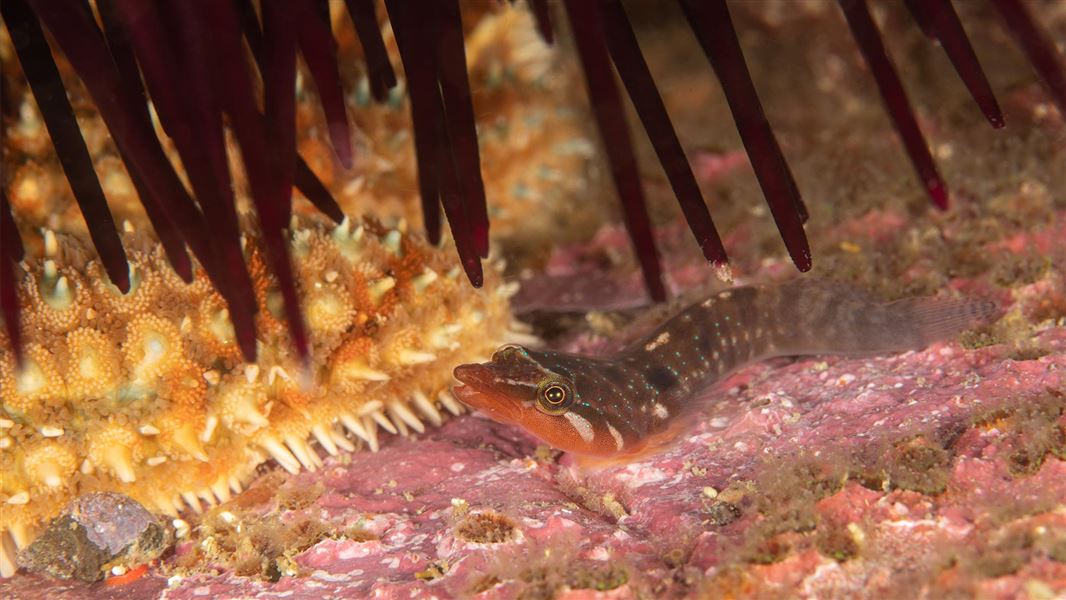
This protected area of ocean is home to a broad range of living organisms. From microscopic planktons to horse mussel beds, jewel anemone to rhodolith (coral-like algae). The sandstone shoreline leads to rocky reefs that fringe the coast and in deeper areas you’ll find kelp, sponges and reef fish.
Reef fish include:
- snapper/tāmure
- John dory/kuparu
- red gurnard/kumu-kumu
- sand flounder/pātiki
- eagle rays/whai keo
- short tail rays/whai.
Open ocean species include:
- kahawai
- kingfish/haku
- trevally/araara
- Jack mackerel/hautere
- various shark species/mangō
Prevent pests from spreading
Minimise the spread of pests on land and in water by thoroughly checking and cleaning your boat and gear. Keep your favourite spots pest-free for future generations by following these guidelines:
- clean your hull out of the water before you leave, including the propeller and anchor - see guidelines for hull cleaning
- clean all recreational and boating gear
- if leaving Auckland, check the marine pests website for biodiversity rules for other regions.
Check the marine pests website for more marine biosecurity information.
The Hauraki Gulf Marine Park/Tīkapa Moana/Te Moananui-ā-Toi has a rich history of human settlement. It includes the earliest places settled by Māori.
The area has supported the physical and spiritual wellbeing of mana whenua for centuries. Mana whenua use tikanga/customs that care for and protect the environment when collecting kaimoana/seafood. Mana whenua is the iwi or hapū that has customary authority in an area.
Tiritiri Matangi translates from te reo to ‘tossed by the wind’. According to Māori lore, the island is thought to be the float of an ancestral fishing net.
Iwi and hapū with significant connections to Tiritiri Matangi include the Kawerau people who occupied the island from as early as 1380 until the 1820s, and again briefly in the 1830s-50s. Ngāti Pāoa also occupied the island and built a second, smaller pā known as Papakura. This was towards the northern end of the island. Ngāi Tai ki Tāmaki and the Marutuahu iwi also have ancestral links with Tiritiri Matangi.
Archaeological excavations during the construction of the wharf showed that Māori occupied the island by the 14th century. They caught marine mammals, coastal birds, sharks and rays. By the beginning of the 19th century the catching and drying of sharks had become an important seasonal activity in the waters north of Tiritiri Matangi.
At the top of the island is the Hauraki Gulf’s oldest lighthouse. Erected in 1864 it is still operational today. There is also a small Maritime Museum.
Tiritiri Matangi is one of New Zealand’s best-loved and most accessible wildlife sanctuaries. Over half a century of determined conservation work has transformed the farmland into an open scientific sanctuary.
Protection areas
These protection areas began in 2025. They were initiated from the Government response to the Sea Change – Tai Timu Tai Pari Hauraki Gulf Marine Spatial Plan. Sea Change was developed collaboratively by tangata whenua, environmental groups, and the fishing, aquaculture and agriculture sectors of the Hauraki Gulf between 2013 to 2017.
Help high protection areas
- No recreational or commercial fishing.
- No dumping or discharge of waste, sewage or litter.
- Take no more than a handful of shell, sand or driftwood.
- Anchoring is allowed.
- Certain Māori customary practices are allowed.
Some protection areas have exceptions to these rules.
Help seafloor protection areas
- Only low impact fishing is allowed, such as line or spear fishing, harvesting by hand.
- No bottom trawling, dredging, Danish seining.
- No dumping or discharge of waste, sewage or litter.
- Take care when anchoring to avoid damage to the seafloor.
- Set netting, potting and bottom longlining are not allowed in parts of Mokohīnau Islands SPA.
DOC Customer Service Centre
| Phone: | 0800 275 362 |
| Email: | info@doc.govt.nz |
If you see any illegal or suspicious activity, contact the DOC emergency hotline 0800 DOC HOT (0800 362 468).