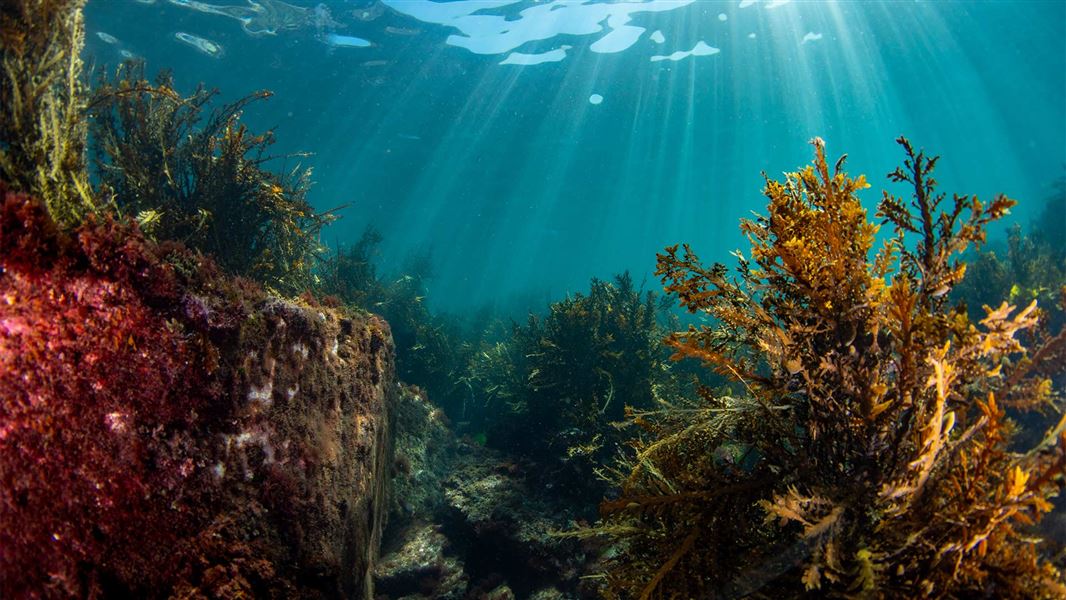
This area features both a high protection area (HPA) and seafloor protection area (SPA). Make sure you know what you can and can’t do in each of these areas.
New marine protection
19 new marine protected areas are now in place in the Hauraki Gulf/Tīkapa Moana. These areas will contribute to a healthier Gulf for future generations.
Find boundaries and maps on this website and the marine mate app, ask your electronic chart provider or check signs at water entry points.
Nearby Te Hauturu-o-Toi / Little Barrier Island Nature Reserve can only be visited by permit. Permits are capped at 600 per year and are only issued for cultural or management purposes, research and education.
Te Hauturu-ō-Toi is 22 km from Cape Rodney and 18 km from Aotea/Great Barrier Island.
Boats from the mainland often launch from Sandspit or Ōmaha, but you cannot land at Te Hauturu- ō -Toi nature sanctuary without a permit.
Te Hauturu-o-Toi / Little Barrier Island Nature Reserve
It is separated from the mainland to the west by Jellicoe Channel, and from Aotea/Great Barrier Island to the east by the Cradock Channel.
This area features both a High Protection Area and Seafloor Protection Area.
Make sure you know Hauraki Gulf protection area rules and how you can help preserve this precious ecosystem.
Report illegal or suspicious activity
Don't take, disturb, kill or damage anything within the protection areas. It is illegal. If you see people taking anything from the reserve, report it as soon as possible.
Call 0800 4 POACHER (0800 476 224) or 0800 DOCHOT (0800 362 468).
It is an offence to pollute, litter, discharge fire arms and erect structures.
Report pests
Find-A-Pest lets you report potential pest species, including marine, plant, animal and fungal species.
If you come across something out of the ordinary, upload a picture to the app and a specialist will help identify it. If it's a biosecurity threat, this will be forwarded to Biosecurity New Zealand. If possible, take photos and record the location and name of the vessel.
Or call the Ministry for Primary Industries' Pest and Diseases hotline on 0800 80 99 66.
Prevent pests from spreading
Minimise the spread of pests on land and in water by thoroughly checking and cleaning your boat and gear. Keep your favourite spots pest-free for future generations by following these guidelines:
- clean your hull out of the water before you leave, including the propeller and anchor - see guidelines for hull cleaning
- clean all recreational and boating gear
- if leaving Auckland, check the marine pests website for biodiversity rules for other regions.
Check the marine pests website for more marine biosecurity information.
This HPA provides habitat for various fish species including:
- Oceanic manta rays (whai rahi)
- carpet shark/pekapeka
- school shark/kapetā
- butterfly perch/oia
- golden snapper/kaorea.
Black coral, commensal snake stars and sponges can also be seen around the shallow reefs.
Te Hauturu-o-Toi/Little Barrier Island was established as a conservation area in 1895 making it Aotearoa New Zealand's first nature reserve. Although Te Hauturu-o-Toi is a major conservation sanctuary, the waters around the island were not protected until 2025.
Excluding the subantarctic islands, Te Hauturu-o-Toi is New Zealand’s largest island nature reserve. It was declared pest free in 2006 following the eradication of the last Pacific rat/kiore.
Once abundant, scallop and mussel beds are nearly non-existent. The depletion of mature crayfish/koura and snapper/tāmure have led to urchin/kina barrens. Protection will now extend from Te Hauturu-o-Toi/Little Barrier Island into the sea, ki uta ki tai, from the mountains to the sea.
Home to some of New Zealand’s last remnants of primeval forest, the island is a home for:
- over 40 species of rare or endangered birds
- 14 reptiles
- 2 bat species.
More than 400 native plants also flourish within this pest-free sanctuary.
The Hauraki Gulf Marine Park/Tīkapa Moana/Te Moananui-ā-Toi has a rich history of human settlement. It includes the earliest places settled by Māori.
The area has supported the physical and spiritual wellbeing of mana whenua for centuries. Mana whenua use tikanga/customs that care for and protect the environment when collecting kaimoana/seafood. Mana whenua is the iwi or hapū that has customary authority in an area.
Te Hauturu-ō-Toi takes its name from its highest point ‘the windblown summit of Toi’ or ‘resting place of the wind of Toi’. The name features in whakataukī, pepeha and waiata and is a reminder of the earliest period of human settlement in the region. It acknowledges the arrival of Toi Te Huatahi who discovered Te Hauturu-ō-Toi in the 12th century.
Archaeological finds show that Te Hauturu-ō-Toi was settled by humans between 1350 and 1650,
It was later named Little Barrier by Captain James Cook during his first voyage to New Zealand in 1769.
In 1894 the Crown enacted the Little Barrier Island Purchase Act and used this legislation to forcibly buy the island from the owners. The owners refused to sell or leave the island and were evicted by the Crown in 1896. The Crown later apologised and gifted the island to the people of New Zealand. Parts of the island have also been farmed, logged and deforested.
Protection areas
These protection areas began in 2025. They were initiated from the Government response to the Sea Change – Tai Timu Tai Pari Hauraki Gulf Marine Spatial Plan. Sea Change was developed collaboratively by tangata whenua, environmental groups, and the fishing, aquaculture and agriculture sectors of the Hauraki Gulf between 2013 to 2017.
Help high protection areas
- No recreational or commercial fishing.
- No dumping or discharge of waste, sewage or litter.
- Take no more than a handful of shell, sand or driftwood.
- Anchoring is allowed.
- Certain Māori customary practices are allowed.
Some protection areas have exceptions to these rules.
Help seafloor protection areas
- Only low impact fishing is allowed, such as line or spear fishing, harvesting by hand.
- No bottom trawling, dredging, Danish seining.
- No dumping or discharge of waste, sewage or litter.
- Take care when anchoring to avoid damage to the seafloor.
- Set netting, potting and bottom longlining are not allowed in parts of Mokohīnau Islands SPA.
DOC Customer Service Centre
| Phone: | 0800 275 362 |
| Email: | info@doc.govt.nz |
If you see any illegal or suspicious activity, contact the DOC emergency hotline 0800 DOC HOT (0800 362 468).