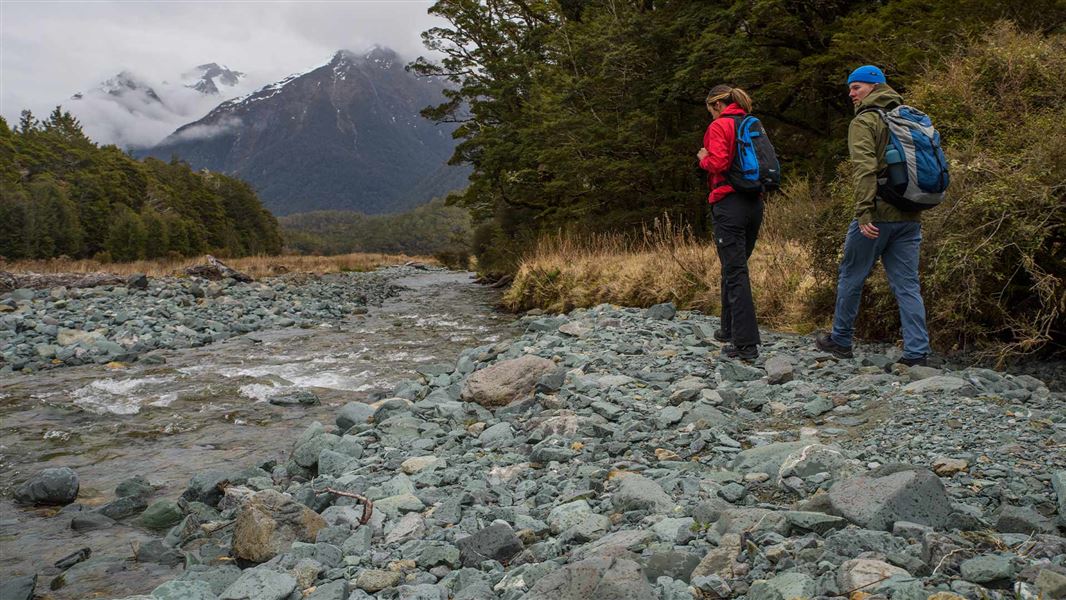
Knowing how to identify an unsafe river, when you should cross and the correct technique to use when crossing are crucial skills for hiking in New Zealand.
If you are not sure a river is safe, do not cross. Wait, turn back, or use another route.
Check if your trip has unbridged crossings
Before you go, find out if your planned route has unbridged crossings. You can find this out by:
- Checking the track page on the DOC website.
- Looking on a topographic map.
- Contacting a local DOC visitor centre or 0800 ASK DOC.
- Researching the track online using reliable sources, such as Plan My Walk.
Think about small side streams as well as major valley rivers. Even small side streams can flood and become too dangerous to cross.
Check weather and river conditions
Before you go, check whether recent and forecast rain or snowmelt could make the river unsafe. You can find this out by:
- Checking the local weather forecast. Think about the weather in the whole catchment area.
- Checking the NIWA river flow forecasts: View a video of national followed by regional river forecasts.
- Contacting the local DOC Visitor Centre for advice on current river and snowmelt conditions.
Be ready to wait or turn back
You may encounter a dangerous river and need to turn back or wait until the river is safe to cross.
Plan ahead by:
- Building flexibility and extra time into your trip plans.
- Having a backup route or plan identified before you go.
- Packing an emergency shelter and extra food.
- Carrying a two-way communications device and a distress beacon (learn more about communications device options).
Know the signs of an unsafe river
When you arrive at a river crossing, look for the warning signs of an unsafe river. If any are present, do not attempt a crossing.
Signs of an unsafe river:
- Fast: the water is flowing faster than walking pace.
- Murky: the water is discoloured, often brown.
- Messy: there is debris in the water, such as branches.
- Loud: you can hear roaring water or rocks moving.
Do not cross if there is any doubt
Do not cross if:
- the river is flooded.
- the river is showing any of the signs of an unsafe river, as listed above.
- you cannot find safe entry and exit points.
- you do not have the skills or experience to cross safely.
If in doubt? Stay out.
Crossing safety
If you are satisfied that the river is safe to cross, and you have the necessary skills and experience, choose a safe crossing point and use the mutual support method.
Learn river crossing techniques and skills on the Mountain Safety Council website.
Learn river safety skills
Before choosing a trip with a river crossing, make sure you have the necessary river crossing skills and experience.
- Learn about river crossing safety and techniques for groups and individuals on the NZ Mountain Safety Council website.
- Attend an in-person river safety course.
- Complete a free online river safety course with NZ Mountain Safety Council
- Watch river safety videos to learn the correct techniques.