About BioInvest and how it works
BioInvest (biodiversity investment approach) details all the biodiversity work we need to do to fulfil our responsibilities to protect and restore representative examples of every land-based, freshwater and marine ecosystem, and all the species that live in them.
It enables us to make informed decisions about the work we choose to do, because we can’t afford to do everything.
BioInvest is based on a set of plans that detail the:
- desired outcome of the work (eg, ensuring a threatened species doesn’t decline)
- work needed to achieve this outcome (eg, predator control, captive breeding)
- length of time the work is needed
- costs associated with the work.
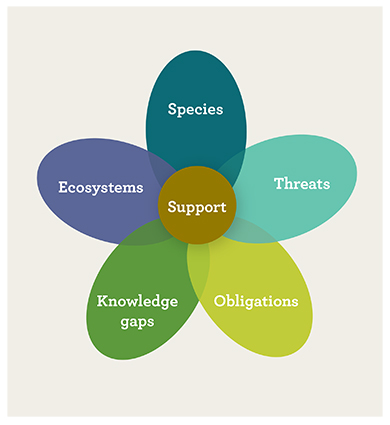 The BioInvest programme groups
Every threatened species, for example, has a plan that describes all the work needed to ensure it can thrive for the next 50 years, including the activities, costs and locations. All these plans are stored in a database called the register. The plans are continually being updated as our methods improve and our knowledge increases.
The plans sit in 1 of 33 programmes, according to the type of work they describe, like managing threatened species. Programmes are organised into programme groups: ecosystems, species, threats, obligations, knowledge gaps and support.
Every programme describes how it contributes to New Zealand’s biodiversity strategy.
Te Mana o te Taiao – Aotearoa New Zealand Biodiversity Strategy 2020
Work in one programme (like predator control to protect a fragile ecosystem) often contributes to an outcome in another programme (like a threatened species that lives in the same ecosystem). BioInvest allows us to map these overlaps and avoid duplicating work.
Programme 1: Managing representative terrestrial, lake, and wetland ecosystems
To ensure a full range of indigenous terrestrial, lake, and wetland ecosystems are effectively conserved to a healthy and functional state.
Programme 2: Managing representative riverine ecosystems
To ensure a full range of river ecosystems are effectively conserved to a healthy and functioning state and managed to restore the mana, mauri, wairua and whakapapa of river catchments.
Programme 3: Managing representative marine ecosystems
To ensure the full range of indigenous marine and estuarine ecosystems are effectively conserved to a healthy and functional state.
Programme 4: Managing rare and threatened ecosystems
To effectively manage rare and threatened ecosystem types to ensure their long-term persistence.
Programme 5: Health of landscapes and seascapes
To ensure large, connected landscapes and seascapes are effectively managed to a healthy and functional state while delivering multiple socio-ecological benefits.
Programme 6: National status and trend of ecosystems and species
To measure and report on the status and trend of terrestrial, freshwater, marine ecosystems, species and social measures of biodiversity at a national scale.
Programme 8: Managing threatened species
To manage threatened native species to ensure their long-term persistence.
Programme 9: Managing iconic species
To ensure populations of threatened iconic species are maintained or enhanced Threats programme group.
Programme 10: Managing taonga species
Programme 15: Nationally coordinated stoat, rat and possum control programme
To eradicate, contain or minimise the impact of rats, stoats, and possums, for the benefit of indigenous species, habitats and ecosystems through large-scale, nationally co-ordinated pest control.
Programme 16: New-to-New Zealand threats programme
To prevent the arrival and establishment of transformative threats to New Zealand.
Programme 17: Contain or exclude established threats programme
To prevent the spread of established threats to sites where they are currently absent.
Programme 18: Eradicate established threats programme
To eradicate an established threat or control it to zero density.
Programme 19: Landscape-scale threat suppression programme
To undertake landscape-scale suppression of transformative, established threats on public conservation land.
Programme 20: Strategic advocacy to reduce pressures on biodiversity programme
To influence policy, planning and investment decisions in sectors that impact biodiversity, through advocacy, strategic partnerships and collaboration.
Programme 28: Predator Free 2050 programme
To eradicate the most damaging introduced predators from all of Aotearoa New Zealand by 2050.
Programme 11: Regional pest management plans programme
Manage DOC's obligations under regional pest management plans and pathway plans.
Programme 12: Managing international biodiversity sites programme
To maintain the ecological values of internationally significant sites that have been formally designated under international biodiversity agreements.
Programme 13: Managing statutory and non-statutory obligations programme
Meet our biodiversity-related obligations as a land, water, coasts and species manager, under various acts, regulations and agreements under which the Director-General and Minister of Conservation have responsibility.
Programme 14: Resource management of land and water obligations programme
Enable the Director-General to engage and advocate for conservation values, for which Te Papa Atawai has obligations under broader resource management legislation.
Programme 29: Ecosystem services
Programme 21: Climate change response programme
Develop and improve knowledge and tools to effectively limit the impact of pressures that can be attributed to climate change on biodiversity and to protect and enhance indigenous carbon stores.
Programme 22: Developing knowledge for managing species programme
Develop and improve knowledge and tools for managing indigenous species.
Programme 23: Developing knowledge for data deficient species programme
Develop tools and knowledge to enable threat classification of indigenous species assessed as data deficient.
Programme 24: Developing knowledge for ecosystems programme
Develop and improve knowledge and tools to effectively conserve the full range of ecosystems to a healthy functioning state
Programme 25: Developing knowledge for data deficient ecosystems programme
Develop and improve conservation management knowledge and tools for ecosystems types we have little knowledge on how and when to manage.
Programme 26: Developing knowledge for managing threats programme
Develop and improve conservation knowledge and tools for managing national threats on indigenous species, habitats and ecosystems.
Programme 27: Developing knowledge of social drivers related to biodiversity programme
Develop and improve knowledge of the social drivers that effect the conservation of indigenous biodiversity.
Programme 30: Building data systems and platforms
Programme 31: Providing operational standards and best practice guidance
Programme 32: Providing systems, processes and products
Programme 33: Providing across programme advice
Making choices about work to fund
BioInvest allows us to make informed decisions about the biodiversity work we focus on, so we use the funding we have in the most efficient way.
Within programmes, plans can be ranked according to their priority for management using the criteria below:
- urgency
- feasibility
- uniqueness of the species or ecosystem
- contribution to New Zealand’s biodiversity
- likely benefits of the work compared with no management.
BioInvest has a modelling tool that we use to explore different ways to prioritise biodiversity work. We also use it to look at how any new investment in biodiversity could be allocated.
The modelling tool also allows others to see where they can align their work to contribute to the national biodiversity goals. For example, the New Zealand Nature Fund used BioInvest to identify projects it raised funds for in 2024.
Projects – New Zealand Nature Fund
Priority biodiversity work
We spread our biodiversity work across threats, ecosystems, species, obligations and research programmes, with a focus on preventing imminent and irreversible loss of threatened species and ecosystems.
More information
Contact info@doc.govt.nz for more information about BioInvest.