Date: 05 December 2025
Gunak Lee was caught in an undercover sting operation involving the Department of Conservation (DOC), Ministry for Primary Industries and New Zealand Police.
He was charged under the Wildlife Act 1953 for buying absolutely protected wildlife, and the Trade in Endangered Species Act 1989 for possessing a threatened species with intent to illegally export. He pleaded guilty to both charges and was sentenced to 14 months in prison. The US $15,000 cash for the illegal purchase was forfeited to the Crown.
Lee booked just a three-day trip to New Zealand in October. On the morning of his departure, he met with an undercover DOC officer at a hotel and agreed to purchase ten live geckos for $15,000 USD (more than $26,000 NZD). The officer handed Lee a bag with two geckos visible at the top and a package underneath.
Lee paid an initial $5,000 USD to the officer, before taking the package to his hotel room to confirm it concealed 8 more geckos. He was arrested returning to his room, and the two geckos used in the sting were returned unharmed to DOC.
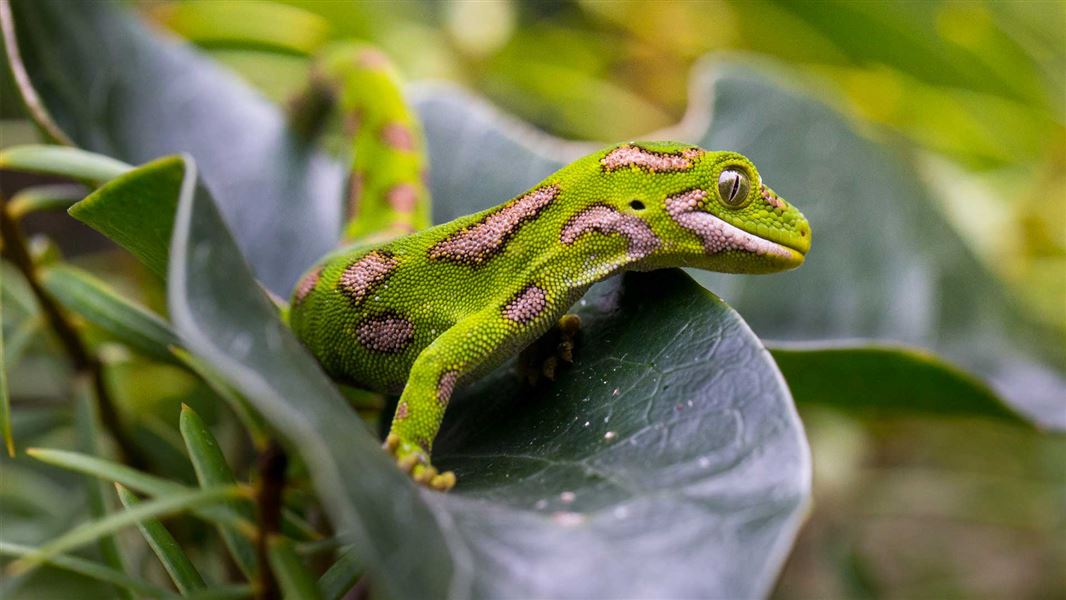
Dylan Swain, DOC’s Wildlife Crime Team Leader, says jewelled geckos are highly sought after in the international illegal reptile trade.
“Poachers are targeting jewelled geckos due to their rarity, distinctive features, and striking colouration. A single gecko can sell for over $14,000 (NZD) in Europe. There was a spate of poaching jewelled geckos a decade ago, and they continue to be a target in poaching attempts in New Zealand. They have also been found in illegal collections overseas.”
Jewelled geckos are only found in New Zealand, and their conservation status is classified as ‘at risk – declining’. Adults reach around 155-170 mm in length and can live for over 20 years. The species are found in pockets of Canterbury, Otago and Southland.
“Illegal wildlife trade is a serious and ongoing threat to native reptiles,” says Swain. “Many of our lizard species live in small, discrete populations, so any poaching of animals from the wild can have a significant effect on the species at a local level. It undermines the incredible conservation efforts of so many New Zealanders.”
“It’s a welfare issue for trafficked reptiles, too. They are often transported over long time periods in crude containers without proper ventilation, temperature control or food. Some estimates suggest that up to 80–90% of reptiles die before they are sold or delivered to buyers.”
“Illegal wildlife trade is estimated to be worth between $7–23 billion USD annually. On top of threatening ecosystems and species, the trade fuels corruption and organised crime activities such as money laundering and false document production.”
Swain says that the public can help by reporting suspicious behaviour they see when out naturing by calling the 24-hour emergency hotline 0800 DOC HOT (0800 362 468) or emailing wildlifecrime@doc.govt.nz.
Contact
For media enquiries contact:
Email: media@doc.govt.nz