About Lake Rotopiko
Lake Rotopiko is a complex of three small peat lakes near Ōhaupō in the Waipā district. Drainage of surrounding land lowered water levels, creating three lakes linked by swampland. East Lake (the smallest) has one of the best representations of natural aquatic plants in the Waikato region. Its relative lack of invasive aquatic plants is extremely unusual, making Rotopiko nationally significant.
DOC manages the lakes and their immediate margins as a 30-ha Wildlife Management Reserve and Waipā District Council (WDC) has a further 10-ha of reserve land. The reserve is managed collaboratively by Ngāti Apakura, WDC, DOC and the National Wetland Trust, with support from Waikato Regional Council, NZ Landcare Trust, Wintec and Toi Ohomai Institute of Technology.
Protecting the ecological values of Lake Rotopiko is a key priority for all management partners.
Why introduced birds are a problem
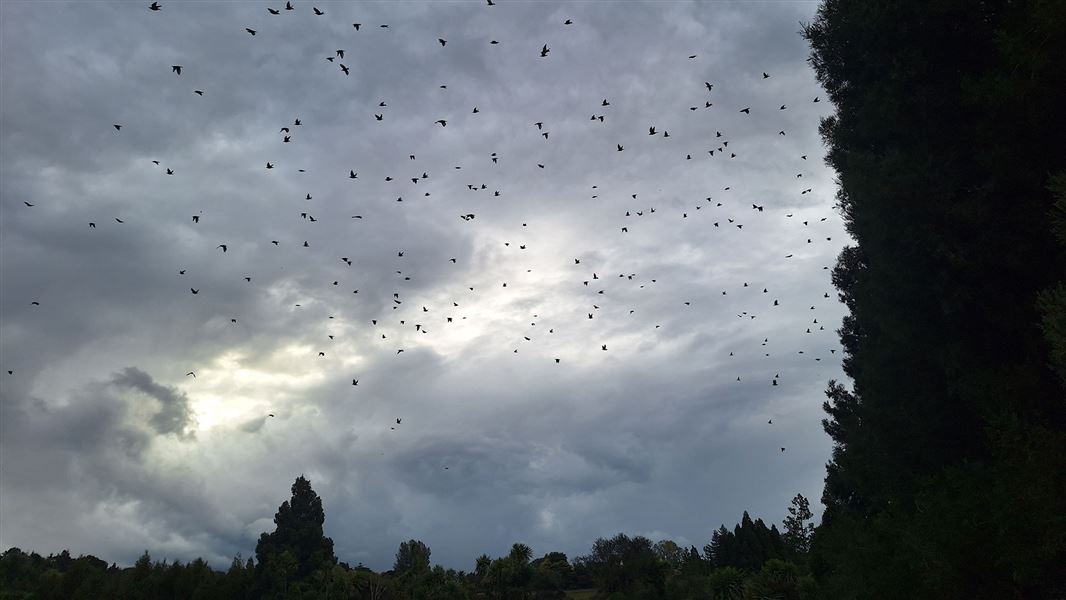
The reserve contains a large stand of mature trees that provides an ideal overnight roost for introduced bird species such as starlings, sparrows and pigeons. These birds arrive late in the day, spend the night in the trees and leave in the morning to feed elsewhere.
Tens of thousands of introduced birds roost at Lake Rotopiko. Their droppings (guano) have:
- reduced lake water quality
- created unpleasant odours and amenity issues
- accumulated on neighbouring properties
- affected nearby horticultural operations
- raised concerns about contamination for local residents.
The birds using Lake Rotopiko are believed to be part of a much larger population spread across the Waikato region.
Responses to the problem
Because birds continue to arrive from the wider landscape, ongoing management is required. The primary goal is to reduce the very large winter flocks that create the greatest impacts.
A range of methods has been trialled to discourage birds from roosting at the reserve, including:
- laser light deterrents
- scent deterrents
- wood vinegar
- reintroducing rats inside the predator-proof fence
- thinning preferred roosting sites
- controlled shooting to create noise disturbance
- strobe lights
- noise cannons.
These methods have achieved varying levels of success.
Our approach
Current management has not yet delivered a long-term solution. Partner agencies remain committed to minimising impacts on neighbouring residents, and identify more effective and sustainable management approaches into the future.
We are not aware of any other similar situations across the country that have found an effective long-term solution to the issue. We need to manage impacts on the reserve – this may include more aggressive methods to reduce the number of roosting birds.
If birds are removed from the site, they are quickly replaced. The larger the winter roosting flock becomes, the more birds are drawn in – and the flock spills over onto neighbouring properties.
Drinking water concerns
Many rural properties near Lake Rotopiko rely on roof-collected rainwater for household use.
Property owners who are concerned about water quality should seek advice from qualified water treatment professionals. They can provide guidance on testing, filtration and treatment options appropriate to individual circumstances.
How residents can help
Residents can support monitoring and management efforts by:
- sharing observations that may assist monitoring by emailing info@waipadc.govt.nz
- reporting unusual bird activity
- supporting bird management efforts on their own properties where appropriate
- working collaboratively with neighbours and management agencies.
Because birds move across a wide area, community-wide action is generally more effective than action at a single site.