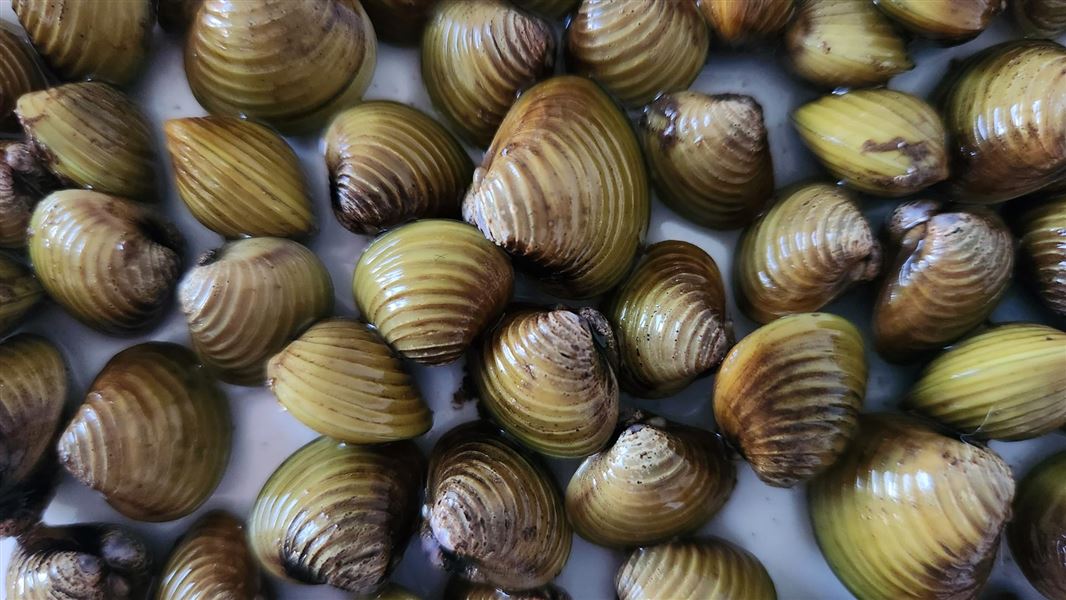
Invasive clams are in New Zealand waterways
When and where they have been found:
- May 2023: Invasive clams (Corbicula fluminea) were found in the Waikato River.
- March 2024: Invasive clams (Corbicula australis) were found at the Lake Taupō Aqua Park but have since been controlled at this location.
- November 2025: Invasive clams (Corbicula fluminea) were found in Lake Rotomanu in Taranaki.
- Significant numbers of invasive clams are present throughout the Waikato River from Lake Maraetai as far downstream as Port Waikato, reaching up to thousands per square metre in some locations.
It is unknown how invasive clams were introduced to New Zealand and if they have already spread further than these sites.
Overseas, invasive clams have been difficult to control, and eradication has never been achieved.
Agency response to the spread
Biosecurity New Zealand led the initial response and since November 2024 has been coordinating a long-term management plan, working collaboratively with DOC, regional councils, and mana whenua.
Corbicula fluminea collaborative long-term management plan
In mid-August 2023, invasive clams were declared an Unwanted Organism under the Biosecurity Act, which means that clams and water that could contain them must not be knowingly moved or spread.
DOC is supporting the response through advocacy including communications and education, technical advice, and operational support.
Earth Sciences NZ received funding from MBIE to research their impacts and how their spread could be contained.
Earth Sciences funding: Stopping the gold clam: it's now or never
There are two controlled area notices in place to help prevent the spread of invasive clams:
- Whakarmaru Dam to the river mouth at Port Waikato One. Wake boats that have been used in this stretch of the river must not be used in any other waterways. Waikato River (PDF, 300K)
- Te Arawa Lakes with additional protections. Lake Ōkataina Te Arawa lakes and Lake Ōkataina (PDF, 344K)
BNZ is leading a nationwide surveillance programme. eDNA and visual surveys have continued in the Waikato River since the clams were discovered. New methods to detect clams are being developed. No clams have been detected above Whakaramu Dam.
Invasive clams and their lifecycle
Invasive clams live in freshwater – rivers, lakes and reservoirs – but can also survive in the salty water found in estuaries. They can thrive in sandy or muddy substrates.
The clams can grow to 50 mm across. They have triangular shells with distinctive ridges across them, and range in colour from dark brown to dull gold.
Invasive clams reproduce quickly because they are self-fertile. Fertilisation happens inside the shell, where the embryos develop into microscopic juveniles – one mature clam can produce up to 70,000 juveniles a year.
The juveniles give out a thread that helps them attach to anything absorbent – not just rocks and pebbles on the river or lakebed, but also on fishing gear, ropes, mats, waders or togs. This makes them very easy to spread.
In a few months, juveniles grow into adult clams and live for about 2–4 years.
Why invasive clams are a problem
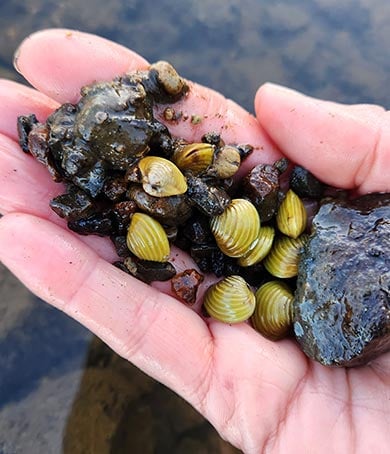
Invasive clams found in the Waikato River
Image: Ministry for Primary Industries
Invasive clams are filter feeders that could compete with native species such as kākahi and freshwater fish for food and cause their populations to decline.
Invasive clams also:
- disrupt the sediment and degrade water quality
- reduce dissolved calcium in the water, with consequences for drinking water treatment to remove contaminants such as arsenic
- excrete nutrients into the water column.
It is unknown how the clams will behave in New Zealand conditions in the longer term and how they will affect native species.
Invasive clams breed rapidly and can clog up infrastructure like:
- drinking water supplies and water treatment plants
- electric power stations
- irrigation systems.
The regular maintenance work needed to clean out pipes and other infrastructure has proven to be costly overseas.
How invasive clams are spread
Invasive clam larvae are exceptionally small, at just 200 microns or 0.2 mm – they’re basically invisible. This allows them to be carried on boats or other recreational gear and accidentally transported to an uncontaminated site.
Whitebaiters could also accidentally spread clam larvae by fishing in more than one river. Whitebaiting gear (nets, screens, spotterboards and other equipment) is very difficult to decontaminate.
Use Check, Clean, Dry to prevent the spread
Everyone who visits freshwater – boaties, fishers, swimmers and trampers – must use the Check, Clean, Dry method when moving between different lakes and rivers.
Whitebaiters should limit their fishing to only one river. If you want to move to another river, you should use a different set of fishing gear – nets, screens and spotterboards.
All fishers should thoroughly wash and dry all their gear using the Check, Clean, Dry method. Neoprene gear such as waders should be frozen to kill any larvae that might be left in the residual water.
Check, Clean, Dry is more important than ever. The method has been tested and updated for invasive clams – and it works. Also consider limiting fishing or recreation to one river system and work from upstream to downstream.
Good decontamination is particularly important for people moving from locations where invasive clams have been detected (Waikato: Lake Maraetai downriver and Taranaki: Lake Rotomanu) to any area where invasive clams haven’t been found.
The updated Check, Clean, Dry method must be used in the Waikato River catchment. Early clam infestations may not be easy to see, so we must assume that there are invasive clams or other pests at every location, and do excellent Check, Clean, Dry.
Report a sighting
If you think you have seen invasive clams, note the location and take a photo if possible. Report it to Biosecurity New Zealand either on 0800 80 99 66, or complete their online reporting form.
Find out more on the Biosecurity New Zealand website.