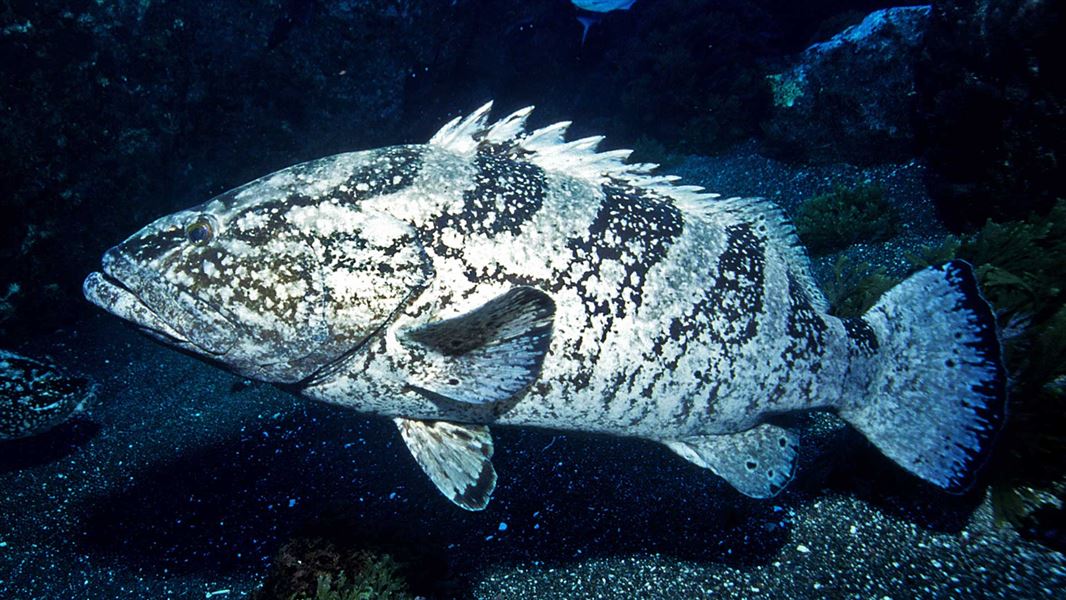
As very little is known of the biology of spotted black grouper dead specimens are of considerable scientific value.
Should you inadvertently catch or kill a spotted black grouper please notify DOC immediately. You may be requested to return the specimen to shore if this is practical.
Useful information to provide with the specimen includes the location and depth that the fish was taken in.
Facts
The spotted black grouper is classified as Near Threatened by the IUCN Red List of Threatened Species.
Spotted black grouper (Epinephelus daemelii) are known as black cod, saddled rockcod and saddletail grouper in Australia.
Spotted black grouper are true groupers belonging to the family Serranidae, subfamily Epinephelinae. Although commonly called ‘grouper’ in New Zealand, the hapuku (Polyprion oxygeneios) and bass (P. americanus) are actually ‘wreckfishes’ belonging to the family Polyprionidae.
They are commonly mistaken for eight bar grouper (Epinephelus octofasciatus) and convict grouper (Hyporthodus octofasciatus) and can be identified by the five distinctive black bands on the body.
Range and habitat
Spotted black grouper are only found in southeast Australia (Spencer Gulf to southern Queensland, excluding Tasmania), Elizabeth and Middleton Reefs, Lord Howe and Norfolk Islands, and northern New Zealand.
In New Zealand the largest and possibly only breeding population is found in the Kermadec Islands Marine Reserve. Around mainland New Zealand spotted black grouper are relatively common on shallow reefs at Three Kings Islands and along Northland’s rocky east coast. Small juveniles have been recorded as far south as Hokitika on the west coast, and Palliser Bay in the east.
Spotted black grouper inhabit rocky reefs in estuaries and on the open coast to at least 50 m depth. They are replaced in deepwater by the hapuku, bass and the eightbar grouper (E. octofasciatus). They are highly territorial and may inhabit the same piece of reef for life. At the Kermadec Islands small juvenile spotted black grouper are found in large intertidal rock pools as well as amongst boulders at 20 to 30 m depth.
Population
There is no population estimate for any spotted black grouper population. Spotted black grouper appear to have had very little fishing pressure anywhere in New Zealand, however those in eastern Australia are considered to be heavily depleted by line, set net and spear fishers.
Diet and foraging
Spotted black grouper are opportunistic predators of smaller reef fishes and crustaceans (shrimps, crabs and rock lobster).
Life history
Very little is known about any aspect of the biology of spotted black grouper. They appear to be slow growing. Australian estuaries appear to be important nursery habitats for juveniles. Small fish are mostly females, but they change sex to become males around 100 to110 cm in length. Social factors potentially controlling growth and sex change are unknown. Reproductive behaviour is unknown.
Threats
Spotted black grouper are vulnerable to a variety of fishing methods due to their large size, territorial behaviour and natural curiosity.
Populations in eastern Australia are considered to be overfished, and their estuarine nursery habitats are threatened by coastal development and pollution. As a consequence of their vulnerability spotted black grouper have been protected throughout their Australasian range, including New Zealand.
DOC's work
Wildlife Act
It is illegal to hunt, kill or harm spotted black grouper within New Zealand’s Territorial Sea and Exclusive Economic Zone (200 nm limit around New Zealand).
Any offence under this Act is liable to a fine of up to $250,000 and six months imprisonment.
Fishers and bycatch
It is not illegal to accidentally catch a spotted black grouper, but it must be released alive and unharmed where possible.
Report the catch to the DOC 0800 DOC HOT and/or the Ministry of Primary Industries as soon as possible.
As very little is known of the biology of spotted black grouper dead specimens are of considerable scientific value and DOC may request dead specimens be landed for scientific research. Useful information to provide with the specimen includes the location and depth that the fish was taken in.
Trade in any part of a spotted black grouper is illegal.
You can help
Fishing
Fishers and divers should familiarise themselves with the identification of protected marine fishes. If you are a spearfisher do not spear any grouper you cannot positively identify.
Spotted black groupers may suffer internal damage from hooks and over-expansion of their swim bladder if caught by accident. Handle the fish carefully, keeping it in the water if possible; carefully remove the hook or cut the trace if it is deeply hooked; if possible use a small hook through the lip or a fin and weighted line to drop the fish back to the bottom if its swim bladder has blown.
Don't discard rubbish at sea
Do not discard plastics, nylon fishing line and other types of rubbish at sea. Marine species can accidentally ingest these marine debris, or suffer from entanglement causing injury or death.
Report sightings
Report details of sightings or captures to DOC (sharks@doc.govt.nz) or to 0800 DOC HOT (0800 362 468).