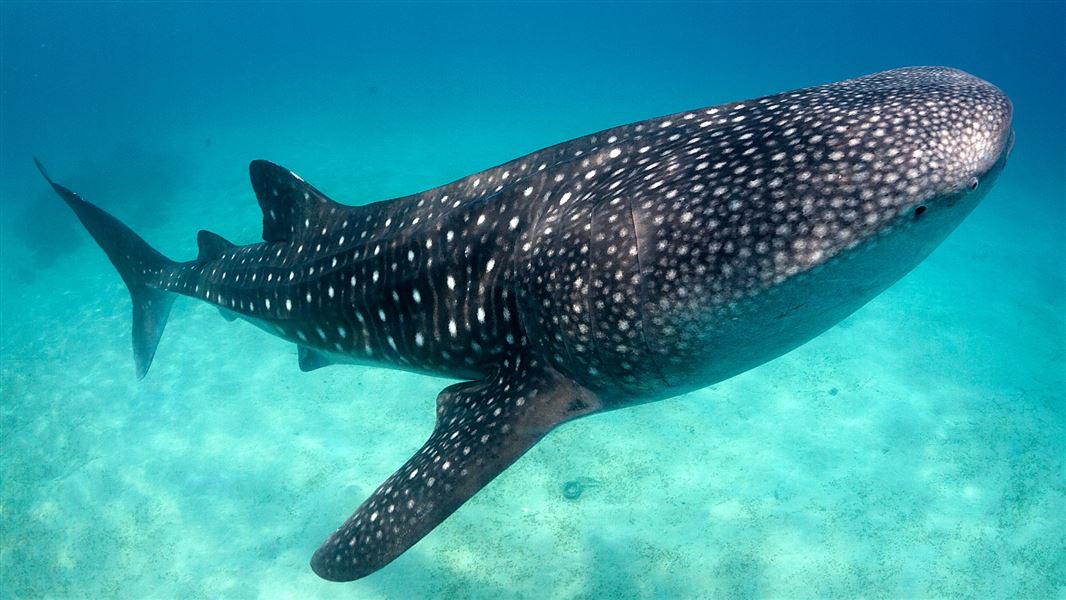
New Zealand status: Non-resident Native.
Conservation status: NZ Threat Classification – Migrant; IUCN Red List – Endangered.
Population: Unknown, declining globally.
Found in: Northern NZ, and circumtropical distribution through all tropical and warm temperate seas, apart from the Mediterranean.
Threats: Commercial fishing and vessel strikes.
Whale sharks (Rhincodon typus) are thought to migrate here by following major ocean currents including the East Auckland Current when our sea surface temperatures are around 21-23°C.
Facts
Whale sharks are members of the order Orectolobiformes - this is a large group of sharks that includes mainly tropical bottom-living species like wobbegongs and bamboo sharks (Orectolobidae) and the leopard shark (Stegastoma fasciatum).
Range and habitat
Whale sharks are found worldwide in almost all tropical/warm temperate waters, except the Mediterranean. They migrate frequently and aggregate seasonally in areas with high food availability.
Transoceanic migration has been documented in the North Pacific. In other places satellite tracking showed long distance movements north from Ningaloo Reef–Western Australia, to Indonesia and Christmas Island; from the Seychelles to Somalia, Tanzania to Thailand (max. distance travelled 5000 km); from Taiwan north into the Kuroshio Current; and return migration between Yucatan Peninsula and Florida Straits.
Whale sharks occur in New Zealand waters from November to March, with peak sightings in February.
There have been confirmed sightings of whale sharks to at least 38oS along the east coast of North Island, and unconfirmed reports of them as far south as Timaru off the east coast of South Island, and off Milford Sound, Fiordland. The latter sightings were made during a period of exceptionally long warm summers that occurred in the mid to late 1970s.
In February 2024, a yachtie reported seeing five whale sharks near the Poor Knights Islands over a distance of 5 nautical miles. The following month in March, a single animal was videoed cruising the waters underneath a recreational vessel for around 10 minutes, also at the Poor Knights.
Population
There are no estimates of regional or global population size, however the IUCN lists this as a species in decline. Relative abundance (measured by encounter rates and/or catch per unit effort in directed fisheries) have reportedly been declining off Western Australia and in the Philippines.
Research has shown there is limited variation in the genetic population structures across the Atlantic, Indian and Pacific oceans which suggests males and females disperse widely across ocean basins.
Diet and foraging
Whale sharks are open ocean (pelagic) filter-feeders. Their diet includes zooplankton, squids, fish eggs and small fishes including sardines, anchovies, mackerels and small tunas. They use a combination of active suction-feeding and passive ram-feeding.
Suction-feeding may allow whale sharks to exploit smaller patches of zooplankton and feed on larger, more active prey than the basking shark. It also allows them to feed on dense schools of small bait fishes in a particularly novel way.
Whale sharks have been observed in many parts of the world hanging vertically, almost motionless, with their heads near the surface amongst schools of bait fishes that are being bailed up by tunas. As the small fish crowd around the head of the whale shark to avoid the tuna, the shark opens its mouth sucking in most, or all of the “bait ball”. When feeding like this whale sharks occasionally lift their snouts out of the water as they swallow.
Whale sharks aggregate seasonally in response to increased food availability at specific locations. At Ningaloo Reef, Western Australia they aggregate to feed on zooplankton blooms that follow mass coral spawning on the reef. At Gladden Spit, Belize and Isla Holbox, Mexico they aggregate to feed on fish eggs released during mass spawning events.
Life history
Few details of the life history of whale sharks are known. Males mature between 8-9 m total length, female size at maturity is unknown. Size at birth is 55-64 cm total length.
Whale sharks are ovoviviparous, meaning the embryos initially develop within a thin walled egg case inside the female and hatch out of this before birth. A single litter of 304 embryos from a 10.6 m female captured off Taiwan in 1995 was reported in scientific literature. These embryos ranged in size from as small as 42 cm total length that were still inside egg cases, to hatched embryos up to 64 cm total length – free-living in the uterus.
Genetic analysis across the full size range of the embryos showed they were all full siblings sired by the same male, suggesting female whale sharks may have the ability to store sperm for later fertilization.
The gestation period is unknown. Records of new born whale sharks are extremely rare but all come from the open ocean. Juvenile whale sharks have been found in the stomachs of a blue shark and a blue marlin. Large shark bites, possibly inflicted by tiger sharks, have been observed on adults and subadults at Ningaloo Reef, Western Australia.
Maximum size is uncertain. The largest measured specimen was 13.7 m total length but there are reliable reports of whale sharks up to 18 m length. Most reports are of individuals less than 12 m. The size range of whale sharks reported in New Zealand waters is from 3 m to 15 m total length.
Whale sharks are generally solitary but loose aggregations of over 100 have been observed.
Threats
The major threat to whale shark populations globally are directed fisheries and vessel strikes.
Whale sharks’ slow surface swimming makes them vulnerable to harpoon, gaff and fixed net fisheries along with interactions with recreational vessels colliding with them while they're feeding at the surface.
A large whale shark fishery existed off Gujarat, India. A study of the fishery found that until the beginning of 1990s whale sharks had not been a profitable catch, but by 1992 they were being regularly hunted – partly due to increased demand from southeast Asian countries created by bans on whale shark fisheries in countries such as the Philippines and Maldives.
About 1,000 are estimated to have been taken off Gujarat between 1990-2001 but estimates of the annual catch vary from about 150 to almost 500.
Whale sharks were protected in India in May 2001. Taiwan managed whale shark fishing under a declining annual quota from 2004-2007, and banned the fishing, selling, importing and exporting of whale sharks in March 2007.
Whale sharks are also fished in southern China, Japan and Indonesia. Illegal fishing continues in many countries where whale sharks have been officially protected. A small number of whale sharks are reportedly killed by ship strike.
The potential effects of global climate change on the distribution and abundance of whale sharks are unknown, however it is likely the species will venture polewards with warming sea temperatures.
Whale sharks are classified as Endangered globally by the IUCN Red List of Threatened Species.
DOC's work
Wildlife Act 1953
Whale sharks are protected under the Wildlife Act 1953. This means it is illegal to hunt, kill or harm basking sharks within New Zealand’s Territorial Sea and Exclusive Economic Zone (200 nm limit around New Zealand).
Any offence under this Act is liable to a fine of up to $250,000 and six months imprisonment.
International trade
International trade in whale shark products is regulated under the International Convention on Trade in Endangered Species (CITES).
DOC is New Zealand’s CITES agency and collaborates with other government agencies, including Customs and the Police to ensure that New Zealand’s obligations under the convention are met.
Whale sharks are listed on Appendix II of the convention, meaning a non-detriment finding and export permit are required from the country of origin.
DOC issues export permits for CITES listed species but protection under the Wildlife Act means all trade in whale shark products in New Zealand is illegal.
Whale sharks are also listed in Appendix II of the Convention on Migratory Species (CMS). This requires co-operation between range states on research and management.
DOC scientific research
DOC scientists conduct research on the distribution and biology of whale sharks in New Zealand waters, and DOC contracts research related to fisheries interactions through the Conservation Services Programme.
Fishers
It is not illegal to accidentally catch a whale shark but it must be released alive and unharmed.
- Immediately report all catch and sightings to DOC on 0800 DOC HOT or sharks@doc.govt.nz and/or catch to Ministry of Primary Industries.
- DOC may request that dead sharks be landed for scientific research and all specimens are of considerable scientific value.
- Useful information to provide with the specimen includes the location and depth that the fish was taken in.
You can help
Overseas
Do not buy whale shark products when travelling overseas (whale shark meat is often sold as ‘tofu shark’).
Boating, swimming and fishing
When operating a boat around whale sharks try to minimise the disturbance and risk to the animals by travelling slowly and quietly, not obstructing their movements, and avoiding loud noises or sudden movements that may startle them.
If swimming with whale sharks, do not obstruct their movements or attempt to touch or ride on them, swim slowly with as little noise as possible, do not swim directly at them.
When fishing, carefully release any unwanted sharks and rays.
Don't discard rubbish at sea
Do not discard plastics, nylon fishing line and other types of rubbish at sea. Like whales, large filter-feeding sharks and rays can accidentally ingest these, and all species suffer from entanglement in marine debris.
Report sightings
Report details of sightings, captures or strandings to DOC sharks@doc.govt.nz or to 0800 DOC HOT (0800 362 468).