New Zealand status: Native.
Conservation status: NZ Threat Classification – Data deficient; IUCN Red List – Endangered.
Population: Unknown, declining globally.
Found in: Northern NZ, and distributed circumglobally in tropical waters in all oceans.
Threats: Commercial fishing, particularly purse seine nets.
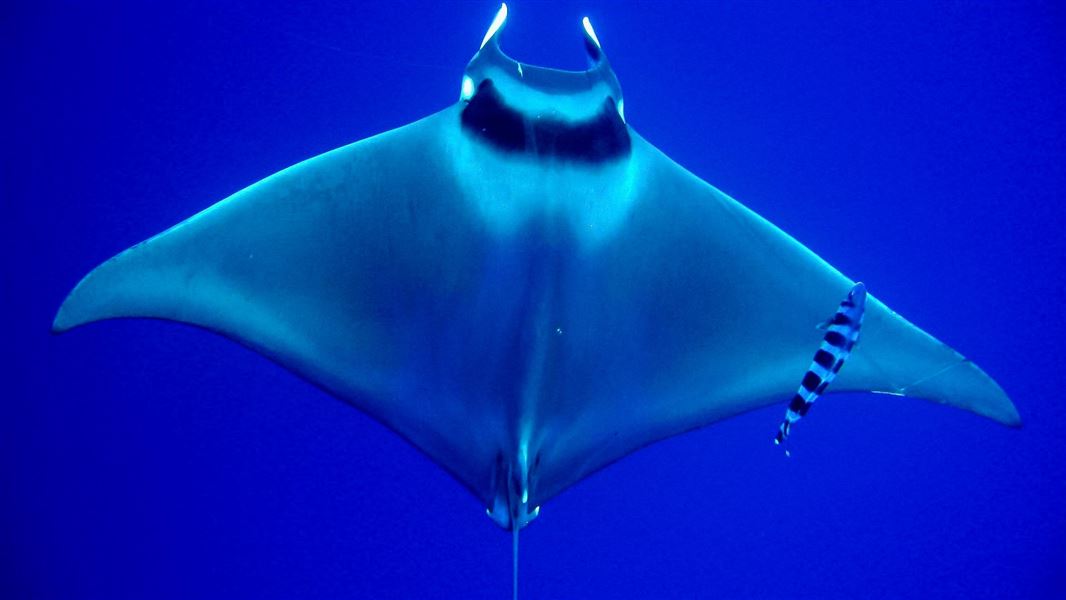
Spine-tailed devil ray (Mobula mobular) migrate to the waters around northern New Zealand annually during spring and summer.
Other common names used for this species include Japanese devil ray, spine-tailed mobula, devilfish and blue manta ray.
Facts
As their appearance suggests devil rays are closely related to the oceanic (giant) and reef manta rays (M. birostris, M. alfredi) and are generally grouped together in the Mobulinae subfamily. They are often mis-identified as mantas.
Members of the Mobulinae subfamily are often collectively referred to as mobulid rays or just mobulids and belong to the Myliobatidae family, which includes eagle rays. Eagle rays are common in New Zealand.
Description
The spine-tailed devil ray can be distinguished from the oceanic manta ray by their:
- narrower head and body
- inferior (sub-terminal) mouth
- small functional spine at the base of the tail
- purple sheen to the upper body (while alive only), and
- white tip to the dorsal fin.
Other devil rays occurring in the Indo-Pacific region include the lesser devil ray (M.akuhlii), sicklefin devil ray (M. tarapacana) and the bentfin devil ray (M. thurstoni). These all lack a functional tail spine. Lesser devil ray and sicklefin devil ray also lack a white tip to the dorsal fin.
In lesser devil rays the slit-like spiracle is located beneath the leading edge of the dorsal fin instead of above it like the Japanese devil ray and sicklefin devil ray.
The bentfin devil ray has a white tip to the dorsal fin similar to spine-tailed devil ray but the spiracle is sub-circular and below the leading edge of the disc; the outer half of the underside of the wing is silver with a large dark blotch near the back/posterior margin (pure white in spine-tailed devil ray).
Range and habitat
The spine-tailed devil ray is found in all oceans with tropical and warm temperate waters. It is reported to be at least 38oS off the east and west coasts of the North Island.
They are pelagic, spending much of their time in the open ocean, but are also found in shallow water close to the shore.
In New Zealand waters this species is usually encountered at or near the surface in the open ocean beyond the edge of the continental shelf (deeper than 200 m). Tuna spotter plane pilots report it is one of the most abundant large pelagic species encountered offshore during summer.
In subtropical and tropical regions they are usually found in shallow coastal waters. In the Gulf of California devil rays are regularly caught in bottom-set gill nets and have been observed feeding close to shore in water less than 1 m deep.
It is not known where the spine-tailed devil rays observed off northern New Zealand originate from. Their movements may be similar to those of skipjack tuna, with which they are often associated.
Population
There is no information on population trends in New Zealand waters. Fishery data suggests this is probably the most abundant mobulid ray in the western Central Pacific and Indo-Pacific regions.
Diet and foraging
Spine-tailed devil rays feed mainly on krill (euphausiids), but will also eat copepods, hyperiid amphipods, crustacean larvae and small fishes. Seasonal movements in the southern Gulf of California (subtropics) appear to be related to the abundance of krill.
Life history
Little is known of the biology of spine-tailed devil rays in New Zealand waters.
In the southern Gulf of California males tend to dominate during spring, and females dominate over the summer – birth occurs in the spring, with mating occurring in late spring and summer on the feeding grounds. No sex segregation has been observed, however segregation by size does occur.
Males mature around 198-205 cm disc width (wing tip-to-wing tip). Female size at maturity is unknown. The smallest pregnant female recorded was 236 cm disc width but large eggs have been observed in females as small as 207 cm disc width.
Females give birth to a single 'pup'. Size at birth is 92-99 cm disc width. The gestation period is unknown. Aborted embryos found in purse seine nets suggest pregnant females with late term embryos are relatively common in New Zealand waters.
Devil rays are commonly seen in small groups off northern New Zealand but there are occasional reports of spectacular aggregations of several hundred individuals being seen off Northland. This species frequently leaps clear of water.
Maximum reported size is 310 cm disc width, but most seen in New Zealand waters are less than 250 cm disc width.
Predators probably include killer whales and large pelagic (midwater) sharks.
Threats
Spine-tailed devil rays are taken in directed set-net and harpoon fisheries in the southern Gulf of California and as by-catch in tuna purse seine and set-net fisheries for skipjack tuna.
In New Zealand, they are occasionally taken on tuna longlines but historically, the greatest fishing threat came from purse seine fisheries. In recent years this fishery has almost ceased to exist, and with it the number of spine-tailed devil ray bycatch has been greatly reduced. Improved handling and release of bycaught animals increases their post-release survival odds.
The biological significance of fishery mortality is unknown but the size of the reported catch in some countries and their very low fecundity (number of offspring) is cause for concern.
DOC's work
Protected under Wildlife Act
Spine-tailed devil rays are protected under the Wildlife Act 1953. This means it is illegal to hunt, kill or harm devil rays within New Zealand’s Territorial Sea and Exclusive Economic Zone (200 nm limit around New Zealand).
Any offence under this Act is liable to a fine of up to $250,000 and six months imprisonment.
Fishers and bycatch
It is not illegal to accidentally catch a spine-tailed devil ray but it must be released alive and unharmed when possible.
- Immediately report all sightings and catch to the Department of Conservation by phoning 0800 DOC HOT (0800 362 468) or emailing sharks@doc.govt.nz and/or Ministry of Fisheries.
- DOC may request that deceased devil rays be landed for identification and scientific research.
- Useful information to provide with the specimen, includes the location and water depth the fish was caught in.
As very little is known of the biology of spine-tailed devil rays, dead specimens are of considerable scientific value.
Trade in any part of a devil ray is illegal.
You can help
Travelling overseas
- Do not buy manta or devil ray products when travelling overseas (the skin is used for leather and the dried cartilage filter plates from the gills are used in traditional Chinese medicine).
Boating, swimming and fishing
- When operating a boat around devil rays try to minimise the disturbance and risk to the animals by travelling slowly and quietly, not obstructing their movements or cutting through a school, and avoiding load noises or sudden movements that may startle them.
- When fishing, carefully release any unwanted sharks and rays.
Don't discard rubbish at sea
- Do not discard plastics, nylon fishing line and other types of rubbish at sea. Like whales, large filter-feeding sharks and rays can accidentally ingest these, and all species suffer from entanglement in marine debris.
- If you catch a ray, try to gently release it alive as soon as possible and remove all trailing line and gear if possible, following DOC's best practice handling guide.
- If it's not possible to remove gear, cut the line so that no more than 1 m is trailing. This helps prevent the line getting entangled around objects which then prevent the animal from swimming freely which will likely result in mortality.
Report sightings
Report details of sightings or captures to DOC (sharks@doc.govt.nz) or to 0800 DOC HOT (0800 362 468).