Conservation status: NZ Threat Classification – Threatened – Nationally Vulnerable; IUCN Red List – Endangered
Population: Globally decreasing
Found in: Northern New Zealand waters along the east and west coast and in open water across tropical, sub-tropical and temperate latitudes
Threats: Commercial fishing and plastics, fishing lines or other marine pollution
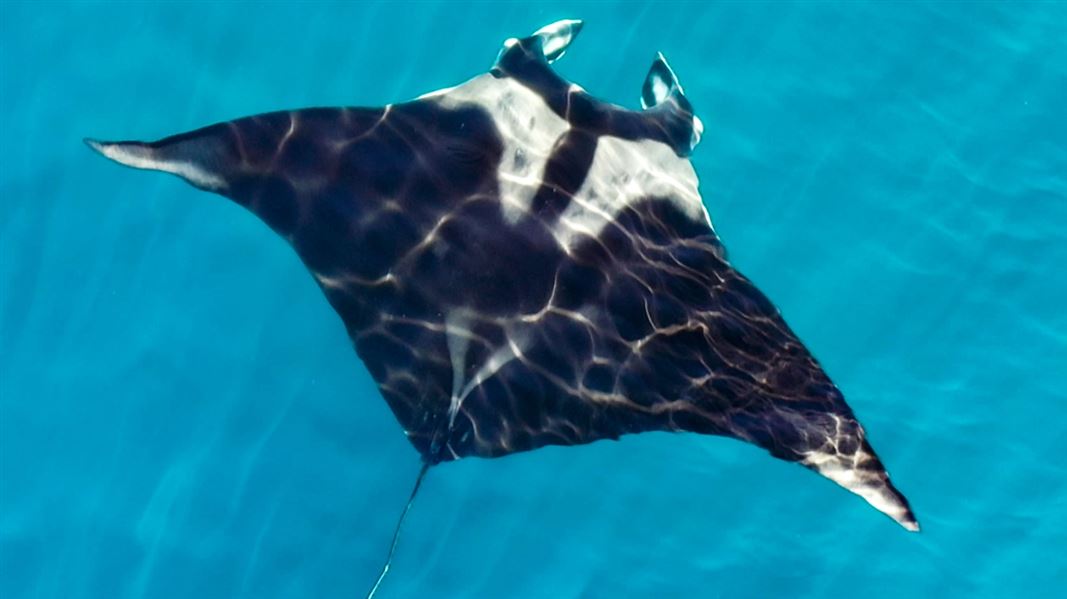
Oceanic manta rays (Mobula birostris) have huge, diamond shaped bodies and swim by beating their ‘wings’ up and down together. They can also beat them in opposite directions – one up, one down.
Manta rays breed in New Zealand where courtship behaviour and heavily pregnant females have been witnessed, but no pupping has been confirmed yet. They spend 6 months of the year, between October and March, here before migrating north towards Tonga and Fiji.
We consider manta rays harmless. But divers have occasionally been towed through the water at high speeds when mantas have become accidentally tangled in their float lines.
How to identify oceanic manta rays
Oceanic manta rays have diamond-shaped bodies and two large muscular fins that protrude forward from the head either side of their mouth. These are called their ‘cephalic fins’. They use these for feeding and roll them up to improve swimming efficiency when not in use.
While rolled up, oceanic manta rays' cephalic fins resemble horns. This has given rise to their alternative common name of ‘devilfish’.
Manta rays do not have a functional barb or sting on their tail. But the oceanic manta has a large swelling at the base of the tail close to the dorsal fin where a sting is buried in. This sting has become functionless as they’ve evolved.
If you see an oceanic manta ray or devil ray, report it to DOC:
- Phone: 0800 DOC HOT (0800 362 468)
- Email: sharks@doc.govt.nz
Similarities with devil rays
Oceanic manta rays are closely related to the reef manta ray (Mobula alfredi) and their smaller relatives, the devil rays (Mobula spp.).
The reef manta is common throughout the central and western Pacific and Indian Oceans but has not yet been found in New Zealand waters. It differs from the oceanic manta in having dark spots between the gills on the underside of the body, and the pale shoulder blazes on the upper body angle back towards the tail forming a V-shape. They also do not have a vestigial sting.
The only devil ray so far recorded from New Zealand is the spinetailed devil ray (Mobula mobular; formerly Mobula japanica).
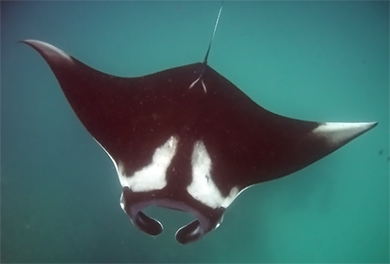
Oceanic mantas’ shoulder markings form a t-shape
Image: Dr Mark Erdmann
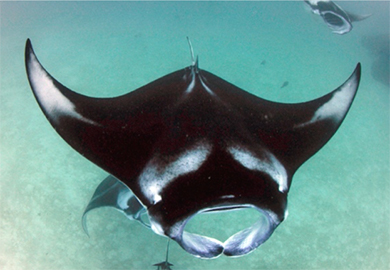
Reef mantas’ shoulder markings form a v-shape
Image: Dr Mark Erdmann
More about this species
Range and habitat
Manta rays occur in open water, in tropical and some warm temperate regions of the world. They live in shallow water close to shore and in the open ocean, diving up to depths of 1,250 m. Although they spend most of their time swimming, they sometimes rest on the bottom.
Researchers once thought there was only a single globally distributed species of manta ray. However, in 2009 two species were recognised: the oceanic or giant manta, and the reef manta.
Both species are globally distributed. More recent research suggests there is a third species in the Northwest Atlantic.
The oceanic manta is the only manta ray recorded from New Zealand. It’s been recorded off east and west coasts of the upper North Island, mainly from spring to early autumn. The distribution of reported sightings off the northeast coast closely matches the course of the East Auckland Current.
In 2024, the Hauraki Gulf was recognised by the IUCN Shark Specialist Group as a habitat of significance for oceanic manta rays.
E-Atlas - Important Shark Ray Areas
Diet and foraging
Little is known of the diet of oceanic manta rays in New Zealand, although they are often seen feeding on dense patches of zooplankton. To eat, they use the large fins on either side of their head to funnel water containing these tiny organisms into their mouths.
Oceanic manta rays trap zooplankton on their distinctive filter plates and periodically swallow. These filter plates are attached to the arches of their gills. They often swim in repeated backward loops or ‘somersaults’ to remain in a dense patch of plankton.
Life history
Female manta rays give birth to single pups. Pupping probably occurs during spring. Size at birth is 122-190 cm disc width, and we suspect gestation to be over a year.
Manta rays sometimes jump out of the water. Even large adults are capable of this. The reason manta rays do this is unknown, but it may be to remove parasites or sucker fish (remora).
Manta rays are host to a variety of external parasites. Reef and oceanic mantas regularly use cleaner stations on coral reefs where reef fishes like damsel and butterfly fishes pick these parasites off them.
The largest accurately measured oceanic manta ray was 670 cm disc width (wing tip to wing tip) but they are reported to reach 910 cm disc width. Individuals estimated to be between 200-790 cm disc width have been reported from New Zealand waters.
Threats to manta rays
Oceanic manta rays have a small population size and a low birthing rate of only 1 pup every other year. This means they have low resilience to fishing pressure.
Coastal development, pollution and human disturbance also threaten many manta populations. This causes habitat loss, reduces their food sources and disrupts their natural life-cycle.
Manta and devil rays are protected in New Zealand and there is no reported bycatch of oceanic manta in our waters. Fisheries targeting manta and devil rays occur in several other countries. These include India, Sri Lanka, Indonesia, and the Philippines. There is also growing concern overseas about the use of manta rays for medicines.
Manta rays are classified as Endangered globally by the IUCN Red List of Threatened Species.
DOC’s work with manta rays
DOC undertakes research on protected fishes, including manta and devil rays, to improve our understanding of their distribution, overlap with fisheries and to monitor their conservation status. Currently, we are collaborating with Manta Watch NZ on a genetics project to gather population data for this species in New Zealand.
Oceanic manta rays are protected under the Wildlife Act 1953. Since 2011, it has been illegal to hunt, kill or harm manta rays within New Zealand’s national waters (200 nm limit around New Zealand). Any offence under this Act is liable to a fine of up to $250,000 and six months imprisonment.
Fishers and bycatch
It is not illegal to accidentally catch a manta ray, but it must be released alive and unharmed. Immediately report all catches and sightings to DOC by calling 0800 DOC HOT (0800 362 468) or emailing sharks@doc.govt.nz, or by contacting the Ministry of Fisheries. DOC will provide advice and support and may ask you to land the dead manta ray for scientific research. Very little is known of the biology of oceanic manta rays. Dead specimens are of considerable scientific value. It is useful to record the location and depth that the fish was taken in.
Follow DOC's best handling and release guide to improve post-release survival chances.
Trade in any part of a manta ray is illegal.
How you can help manta rays
Report sightings, strandings or captures to the DOC Marine Species Team by emailing sharks@doc.govt.nz or calling 0800 DOC HOT (0800 362 468).
Report your sighting to Manta Watch New Zealand
By reporting your sighting to Manta Watch New Zealand you can support other research on oceanic manta rays in our waters. This will help confirm if New Zealand has its own distinct population of oceanic manta rays and work to estimate their population size.
To report a sighting, use the Manta Watch NZ mobile app or the manta ray sightings form below.
Report a sighting to Manta Watch New Zealand
Other ways to help
- Do not buy manta ray products when travelling abroad. You may find manta ray skin used for leather in some products abroad. Some traditional Chinese medicine also use their filter plates from their gills.
- When operating a boat around manta rays, try to minimise the disturbance and risk to them. Travel slowly and quietly and do not obstruct their movements. Avoid load noises or sudden movements.
- Although manta rays may tolerate divers touching them or riding on their backs, avoid interacting with them in this way. It is illegal and can remove the protective mucus layer covering their skin and cause infections and blistering.
- When fishing, carefully release any unwanted sharks and rays.
- Do not throw away plastics, nylon fishing line, and other types of rubbish at sea. Like whales, large filter-feeding sharks and rays can accidentally eat these or become entangled in this debris.