Leatherback turtle
Report injured or stranded turtles, and all turtle sightings to turtles@doc.govt.nz or the DOC emergency hotline 0800 DOC HOT (0800 362 468).
Leatherback turtles (Dermochelys coriacea) are sighted widely around New Zealand’s coastline and have been recorded as far south as Fiordland. This ancient tuatara species of the seas is around 80 million years old, are the largest of all sea turtles growing up to around 2.5 m long, can weigh over 1 tonne, and dive to depths over 1 km. New Zealand provides very important foraging habitat for these turtles. There is uncertainty about the age they reach sexual maturity and their life expectancy, but current estimates are 9-20 years and 50 years respectively.
They swim vast distances of around 12,000 km on migrations from the east coast of California all the way across the Pacific Ocean to breeding grounds in the islands north of New Zealand. This is hugely energy intensive and on the way, they are stopping in our waters to forage. A particular hotspot where they gather is in the rich waters of the outer Bay of Plenty and East Cape region where there are lots of jellyfish and salps – their preferred food sources.
Female leatherbacks only come ashore to breed; those occurring in the Southwest Pacific breed in northern Australia, Papua New Guinea, Vanuatu and the Solomon Islands. Males remain at sea their whole lives.
The turtles we see here belong to the critically endangered Western Pacific leatherback population which is close to extinction with as few as 1,500 mature adults thought to remain. DOC is collabroating nationally and internationally to try and bring leatherbacks back from the brink of extinction. The greatest threat to leatherback survival here and overseas is from commercial fisheries.
If you see a leatherback on a beach here in New Zealand, it is likely to be unwell and needs our help. Please report all sightings immediately to DOC so that we can send a ranger out to assist.
Green turtle
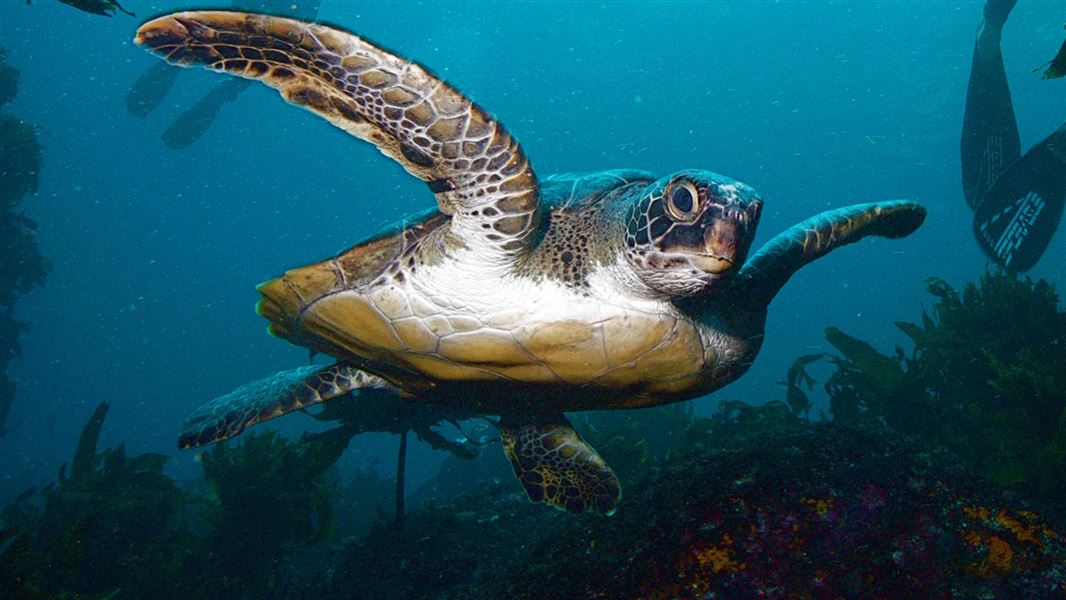
Green turtles (Chelonia mydas) are the most common species seen in New Zealand coastal areas and is the species most associated with strandings each year.
They are the only herbivorous turtle as adults, feeding mostly on seagrasses, algae and mangroves. Younger turtles also eat fish and their eggs, jellyfish, sponges and various shellfish.
Juvenile and sub-adult green turtles spend a good part of their life cycle around the northern North Island and the Poor Knights. They are considered resident year-round at Rangaunu Harbour in Northland. This area is an important foraging ground during the coastal foraging life-cycle of pre-breeding age turtles we find here. The numbers of green turtles sighted in and around Rangaunu and other coastal areas in Northland appears as if it may be increasing and DOC is monitoring this within the context of increased sightings possibly also being associated with increased public awareness. It is likely that with climate change and warming sea temperatures, more green turtles may come to inhabit our coastal areas for long periods of time.
In 2025, DOC began New Zealand’s largest research programme to satellite track 20 green turtles and investigate how they use our coastlines and harbours so that we can use the data to inform conservation management and policy actions for this species. This work is ongoing and results are hoped to be published in 2026/27.
Green turtles do not breed here as the sand is not warm enough to lay their eggs in. This may change one day. The individuals we see here are thought to have come from source populations in the Indo/Western Pacific, and perhaps from beaches along the east coast of Australia. A few also come from the Eastern Pacific population and are often referred to as the black sea turtle. Whilst genetically speaking they are all the same species (Chelonia mydas), some refer to the black turtle as a sub-species Chelonia mydas agassizzi. Black turtles can be recognised by their distinctive tent-shaped carapace (particularly the females) and dark black colouration.
The IUCN lists green turtles as Endangered (population decreasing). The greatest risk to green turtles in New Zealand comes from sediment pollution in harbours and coastal foraging areas, loss of seagrass meadows which are their main food source, boat strikes, fishing bycatch, habitat loss, and plastic ingestion.
If you see a green turtle on a beach, it is almost certainly sick and in need of our assistance. Many think turtles on beaches are just resting and need to be put back in the water. This is not the case. Please leave them and contact DOC immediately.
Loggerhead turtle
Records of loggerhead turtles (Caretta caretta) in New Zealand are concentrated around the upper North Island, though they have washed up on beaches as far south as Stewart Island.
They appear to be only occasional visitors to mainland New Zealand, however they can live in relatively cold waters (10°C) and some may even hibernate in waters below 15°C. They do this by resting on the seafloor and surfacing as little as every 10 hours to breathe.
It's estimated that they live for 47 to 67 years.
Hawksbill turtle
Because they are the most tropical species, hawksbill turtles (Eretmochelys imbricata) are relatively rare visitors to mainland New Zealand due to cool water temperatures. In 2024, there were four reported beach strandings. Rehabilitated hawksbill turtles are usually released in warmer waters around Poor Knights north of New Zealand.
Hawksbills are mostly seen in the warmer waters of the upper North Island though they have been recorded as far south as Cook Strait.
They generally live in the clear, shallow waters of continental and island shelves and are distributed widely through the tropical band of the central Atlantic and Indo-Pacific regions.
Olive ridley turtle
The olive ridley turtle (Lepidochelys olivacea), once considered the rarest species found in New Zealand waters, has been seen more freqently in recent years. Between 2024-25 seven strandings were reported. These are possibly sick or injured individuals that have drifted here on ocean currents and are the most difficult species to treat sucessfully with veterinary care.
The turtle is not named after a person called Olive Ridley. Rather the 'olive' refers to its colour, and the 'ridley' may refer to the fact that 19th Century fishermen around Florida and the Bahamas (where it is common) often confused it with loggerhead or green turtles. It was therefore considered to be 'riddly' (a riddle).
If you see an olive ridley turtle on a beach, it will be very sick and in need of our assistance. Many think turtles on beaches are just resting and need to be put back in the water. This is not the case. Please leave them and contact DOC immediately.
Turtles in the Kermadecs
The Kermadec Islands are a string of volcanic islands and islets in the subtropical zone between New Zealand and Tonga. Hawksbill, green, and leatherback turtles have been found in the Kermadecs, which are New Zealand territory.
Green turtles are commonly seen in the Kermadecs, but records are sparse because the region is so remote. The first records (made by W.B. Oliver in 1911) note that turtles were seen in the summer months, and that they did not breed in the Kermadecs but went north to the tropics.
Green and hawksbill turtles were spotted inshore. All of this is consistent with our current understanding of the habitat and behaviour of these turtles.
Most records of leatherback turtles from the Kermadec region are of individuals accidentally caught on pelagic longlines. Again this is consistent with our understanding of leatherback turtles, who prefer a deeper, offshore environment.
DOC's work with turtles
DOC rangers attend beached or entangled sea turtles and this is done with urgency.
Those that are alive when found are sent immediately to Auckland Zoo for specialist veterinary care and if they survive are then transferred to Kelly Tarlton’s for rehabilitation before being released back into the wild. DOC may transfer dead specimens to museums and scientists for research and educational purposes, with iwi approval. We also collect tissue samples and measurements.
Data from beached turtles and live sightings are recorded in the New Zealand Amphibian and Reptile Distribution Scheme with oversight from the Marine Species Team.
DOC monitors the bycatch of turtles and other protected species in commercial fisheries through our Conservation Services Programme.
All reptiles, including sea turtles, are protected under the Wildlife Act 1953. This means it is illegal to kill or harass any species of sea turtle within New Zealand's Territorial Sea or Exclusive Economic Zone.
It is also illegal to possess a sea turtle, or any part of a sea turtle, without a permit issued under the Wildlife Act, or evidence that it was legally imported into New Zealand or was in your possession prior to commencement of the Wildlife Act (1 April 1954).
Please report all turtle sightings immediately to DOC so that we can give the animal the greatest possible chance of survival by organising veterinary care, or arrange appropriate burial.
Convention on International Trade in Endangered Species (CITES)
DOC is also involved in monitoring and regulating international trade in endangered species under the Convention on International Trade in Endangered Species (CITES).
CITES officers work closely with other government agencies, particularly Customs and the Ministry for Primary Industries biosecurity team, to detect illegal trade in endangered species.
All species of sea turtle are listed in Appendix I of CITES. This controls the international movement in specimens and products derived from sea turtles.
CITES permits
To move sea turtle specimens into or out of New Zealand, a CITES permit may be required. This includes personal items such as specimens and curios that may have been in your possession prior to protection under the Wildlife Act (1 April 1954).
Visit Convention on International Trade in Endangered Species (CITES) for more information.