Electronic monitoring can:
- Check if night setting protocols are followed.
- Check if bird scaring lines are used. EM cannot always confirm that the bird scaring line meets design specifications. However, when EM is combined with dockside inspections, there can be greater confidence these specifications are being met.1
- Check if hook shielding devices are used. EM cannot confirm the hook shielding device meets specifications. However, when EM is combined with dockside inspections, there can be greater confidence these specifications are being met.
- Check if an underwater bait setter is used. EM cannot confirm the depth that hooks are released from the bait setter
- Check if line weights are present on branchlines. EM cannot currently confirm the mass of weights or their distance from the hook.2 However, when EM is combined with dockside inspections, there can be greater confidence these specifications are being met. However, the position of sliding weights in relation to the hook is easily changed during fishing (and after the dockside inspection).
- If a bespoke EM system was installed that could detect the aerial extent of the bird-scaring line, a verifier would have greater confidence that the specifications were being met.
- If a bespoke electronic monitoring system was installed that could detect the distance of a weight from the hook, a verifier would have more confidence that the specifications were being met.
Recommended minimum specifications
- Cameras record every fishing set and haul.
- At least 20% of sets and hauls reviewed.
- Cameras view all seabird-safe practices used.
Check bird scaring lines
Camera position
Place a camera so that the bird scaring line streamers are in the camera frame. Visibility will be diminished at night, but it should still be possible to detect the presence of the bird scaring line and see the streamers. Alternatively, a camera could be positioned to observe crew deploying the bird scaring line before setting starts, and when crew retrieve it at the end of the setting process.
Recommended footage review
Footage at both the start and end of the set.
What to record for each set
- Whether a bird scaring line is deployed prior to start of the setting process and is present until after the last baited hook is set.
- The presence of coloured streamers.
Check branchline weighting
Camera position
Place a camera so the hook end of the branchline is in frame during:
- setting (camera at the stern), or
- hauling (camera at the hauling station).
Recommended footage review
Samples throughout the set and/or haul. Check to see if a weight was used on each branchline.
What to record for each set or haul
- Instances where weights are missing from branchlines.
Check night setting
What to record for each set
- Time of the start and end of the set.
- Latitude and longitude.
- Length of time (minutes) any setting occurs before nautical dusk.
- Length of time (minutes) setting continues after nautical dawn.
Check hook shielding devices
Camera position
Ideally place a camera at the stern, so the baiting process and use of hook shielding devices can be seen. Alternatively, a camera placed at the haul station can detect if hook shielding devices are present on the branchlines.
Recommended footage review
Samples throughout the set or haul, to see if hook shielding devices were used on each hook.
What to record for each set
- Instances when hook shielding devices are missing from branchlines.
- Ideally, instances where hook shielding devices are not used properly.
More about hook shielding devices
Check underwater bait setter
Camera position
Place a camera close to the stern so it is possible to see the bait being placed inside the bait setter capsule.
Recommended footage review
Samples throughout the set.
What to record for each set
Instances when the bait setter is not used and instead the crew cast the baited hooks by hand.
More about underwater bait setters
Artificial intelligence/machine learning
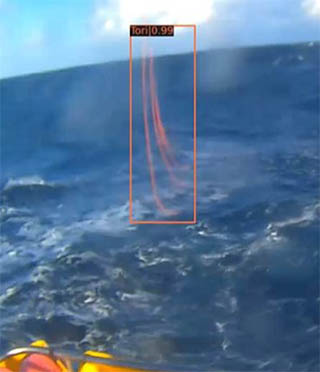
AI detecting bird scaring lines shown in red box
Australia’s national science agency CSIRO has developed artificial intelligence/machine learning (AI/ML) that can detect whether a bird scaring line is being used on a fishing vessel.
This new technology will make the footage review process faster and cheaper. It is expected that AI/ML will be further developed to detect use of other seabirdsafe practices.
More about AI/ML technology for fishing
Download a factsheet
Electronic monitoring (PDF, 825K)
Further information
To learn about the use of EM to assess the impact of fishing on seabirds see Agreement on the Conservation of Albatrosses and Petrels - Bycatch monitoring.