2.6 km return via same track
Tunnel Beach car park is open from:
- 8 am–9 pm (September to March)
- 9 am–5 pm (April to August).
Image gallery

No drones
Flying a drone without a permit is strictly prohibited.
About the walk
- Historic tunnel to a secluded beach
- Dramatic headland and sandstone cliffs
- Gravel path with long descent and uphill return
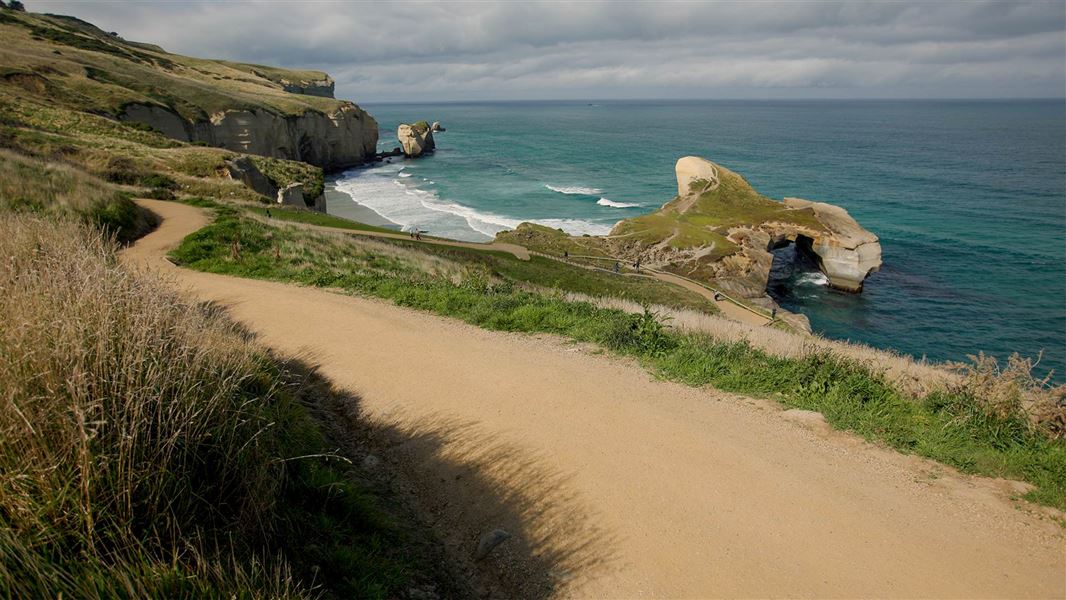
Tunnel Beach Walk is a popular short walk on Dunedin’s southern coastline. It’s famous for its tunnel carved through solid rock and spectacular, wave-battered headland. The track is often crowded.
For an easy walk, stop at the first viewpoint and enjoy the view.
The walk to the tunnel and beach is more challenging. It’s a long descent with some steep sections. You’ll need sturdy footwear and good fitness.
Return to the car park the same way you came.
Keep to the track
Keep to the gravel track to:
- protect critically endangered coastal plants
- stay safe around high cliffs
- avoid trespassing on private land.
Car park to viewpoint
600 m / 10 min (return)
Follow the well-formed path to the first viewpoint for dramatic views of the headland, coastline and a natural rock archway.
Car park to historic tunnel and beach
1 hr / 2.6 km (return)
Continue past the first viewpoint and down to the spectacular rocky coastline. A short tunnel with steps leads down to Tunnel Beach.
The track is steep and narrow in places, with lots of zigzags and some steps.
Directions
Tunnel Beach car park is 15 min by car from Dunedin, just past the southern suburbs of Corstorphine and Concord.
From Blackhead Road, take the signposted turnoff to Tunnel Beach Road. The car park is at the end of the road.
Parking
Tunnel Beach car park is managed by Dunedin City Council. It has:
- free parking for cars and campervans
- two marked mobility spaces
- bike stands.
The car park gets very busy during the summer season (November to April). It’s best to arrive earlier in the day.
Opening hours
Tunnel Beach car park is open from:
- 8 am–9 pm (September to March)
- 9 am–5 pm (April to August).
Impounded vehicles
Vehicles left at Tunnel Beach car park after closing time will be locked in overnight. Your car may be impounded at your expense.
If your vehicle is locked in, contact Dunedin City Council on (03) 477 4000.
Alternative parking
No parking is permitted on Tunnel Beach Road. Cars parked illegally may be towed.
If the car park is full or locked, the closest parking is by the bus stop at 292 Middleton Road, Corstorphine.
To get to the track entrance, follow the footpath along Blackhead Road and Tunnel Beach Road. It’s a 25 min walk (1.7 km).
Lock it or lose it
Thieves may target cars parked at Tunnel Beach car park. Take valuables with you.
Public transport
Several bus routes go from Dunedin city to the bus stop at 292 Middleton Road, Corstorphine. It’s a 25 min walk to the track entrance.
Mana whenua
Te Rūnanga o Ōtākou hold mana whenua or customary authority over this special place.
Safety and hazards
- High cliffs: Tunnel Beach has high, unfenced cliffs with steep drops and unstable edges. Stay on the formed gravel track, keep children close and take extra care in wet and windy weather.
- Beach unsafe for swimming: Tunnel Beach has dangerous currents and waves. It is not patrolled by lifeguards.
- Tidal access: Tunnel Beach is unsafe at high tide and in rough seas. Large waves can wash ashore at any time without warning.
- Historic tunnel: The tunnel at Tunnel Beach is dark with a low ceiling, slippery steps and no handrail. Watch your step.
When to go
- Plan your walk for low tide if you want to explore Tunnel Beach.
- New Zealand weather changes quickly. Check the weather forecast before you go, and be prepared.
Plan your visit
- Bookings are not required for Tunnel Beach Walk.
- Toilets and accessible toilets are located at Tunnel Beach car park. To report a problem, phone Dunedin City Council on +64 477 4000.
- Drinking water is not available. Bring your own.
- Food and petrol can be found in Dunedin (15 min by car).
- Mobile phone coverage is unreliable.
What to take
- A torch for the tunnel
- Sturdy footwear with good grip
For a complete list, see Short Walks gear list.
Care for nature
- Rubbish bins are provided at the car park.
- Stay on the track to protect critically endangered coastal turf.
- New Zealand fur seals/kekeno and sea lions/pakake come ashore at Tunnel Beach to rest. Stay at least 20 m away.
Coastal turf
Coastal turf is a critically endangered ecosystem found on the headland at Tunnel Beach. These low-growing plants are a mix of tightly interlaced herbs, grasses and sedges.
Coastal turf has evolved to survive in one of the harshest environments on Earth. The plants tough it out against wind and salt spray – a thin layer of life on rocky ground.
The biggest threats to coastal turf are:
- invasive weeds
- being trampled by people and farm animals.
Fewer than 40 ha (about 50 rugby pitches) of coastal turf are left around New Zealand.
Plants of coastal turf
The main plants of coastal turf are:
- selliera/remuremu (Selliera radicans)
- Buchanan’s orache (Atriplex buchananii)
- shore cotula (Leptinella dioica)
- sea primrose/mākoako (Samolus repens).
Rarer species include:
- a tiny gentian (Gentianella saxosa) which produces white flowers in summer
- a small buttercup (Ranunculus recens)
- the pygmy forget-me-not (Myosotis antarctica).
Insects of coastal turf
Coastal turf supports a variety of invertebrates. Insects found here include beetles and a species of moth that has evolved to jump because it’s too windy to fly.
Te Tai o Ārai te Uru
Early Kāi Tahu people gave coastal Otago the name Te Tai o Ārai te Uru. The name refers to the waka/canoe Ārai te Uru, which was wrecked at Matakaea/Shag Point, north of Dunedin.
The tunnel and the Cargill family
The tunnel at Tunnel Beach was commissioned in the 1870s by Scottish settler John Cargill. John was a member of Dunedin’s prominent Cargill family.
Both John and his brother, Edward, built their homes high on the clifftops here. It’s thought John arranged to have the tunnel built so the family could enjoy private access to the cove below.
To dig out the tunnel, labourers chipped through solid sandstone with picks and shovels. The tunnel’s roughly hewn rock walls are testament to this painstaking work.
Nature's in trouble
Thousands of New Zealand’s native species are heading towards extinction. Once they’re gone, they’re gone for good. Nature needs your help.
DOC Customer Service Centre
| Phone: | 0800 275 362 |
| Email: | dunedinoffice@doc.govt.nz |
| Address: | Ōtepoti / Dunedin Office |